
 Worksheets
8th grade Math STAAR Review
Total questions: 69
Worksheet time: 3hrs 7mins

A
B
C
D

F
G
H
J

F
G
H
J

A
B
C
D

A
B
C
D

A
B
C
D

The model represents an equation.
What value of x makes the equation true?

4
14
24
6


45,000x + 2,500x = 54,000x + 1,500x
45,000x + 2,500 = 54,000x + 1,500
45,000 + 2,500x = 54,000 + 1,500x
45,000x + 2,500x = 54,000x + 1,500

3t + 350 = 2.50t + 225
350t + 2.50 = 225t + 3
2.50t + 350 = 3t + 225
3t + 350 = 2.50 + 225t

(a)


Natasha walked from the library to the grocery store and then to her house. The diagram shows the top view of the locations of these three places and their distances from each other.
Which measurement is the closest to the shortest distance in miles from Natasha's house to the library?
2.6 mi
1.9 mi
1.4 mi
2.3 mi

The manager of a car dealership wants to attach a rope with flags to the top of a pole and to a stake in the ground, as shown in the diagram.
Based on the diagram, what is the distance in feet from the top of the pole to the bottom of the stake?
(a)

The set designer for a play painted some background scenery on a large piece of plywood. He used a 13-foot-long pole to hold the piece of plywood upright, as shown in the diagram below.
What is h, the total height in feet of the piece of plywood?
(a)

A
B
C
D

A
B
C
D

A
B
C
D

A
B
C
D

F
G
H
J

A
B
C
D

F
G
H
J

A
B
C
D

F
G
H
J

-5
5
15
-15

A
B
C
D

F
G
H
J

-7
7
6
-6

A
B
C
D

A
B
C
D

Which representation shows y as a function of x?
A
B
c
D

Which graph does NOT represent y as a function of x?
A
B
C
D

Which set of ordered pairs represents y as a function of x?
A
B
C
D

Which set of ordered pairs represents y as a function of x?
A
B
C
D

Which statement describes the mapping?
The mapping represent y as a function of x, because each y-value corresponds to exactly one x-value.
The mapping does not represent y as a function of x, because two of the x-values correspond to the same y-value.
The mapping represent y as a function of x, because each x-value corresponds to exactly one y-value.
The mapping does not represent y as a function of x, because there are more x-values than different corresponding y-values.

Which graph represents y as a function of x?
F
G
H
J

A
B
C
D

What is the slope?
10
-5
0
5

(a)

WHAT IS THE ESTIMATED AMOUNT OF SALES AT 21 DEGREES?
600
400
480
510


Hint: create the trend line first
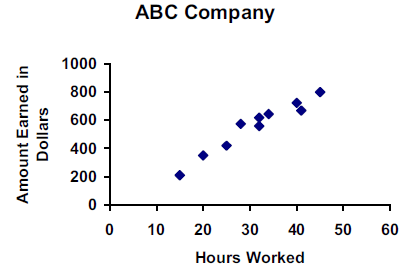

The dimensions of a rectangular prism are shown in the diagram.
What is the total surface area in square inches of the prism?
(a)

The side lengths of the base of a triangular prism are 5 meters, 8 meters, and 10 meters. The height of the prism is 16.5 meters.
What is the lateral surface area of the prism in square meters?
(a)

An architect uses a cylindrical container to protect her blueprints. The dimensions of the cylinder are shown in the diagram.
Which measurement is closest to the total surface area of the container in square inches?
424.12 in2
791.68 in2
339.29 in2
282.74 in2

Find the volume of the figure. Round to the nearest tenth.
128.6 units³
1,286.8 units³
401.9 units³
5,144.6 units³

Find the volume of the cone. Round to the nearest tenth. (ONLY INPUT THE NUMBERS - NO UNITS)
(a)

Find the volume of the sphere. Round to the nearest tenth. (ONLY INPUT THE NUMBERS - NO UNITS)
(a)


View question in the picture then select the best answer
A
B
C
D

View question in the picture then select the best answer
A
B
C
D

View question in the picture then select the best answer
F
G
H
J

(x, y) --> (2x, 2y)
(x, y) --> ( 21 x, 21 y)
(x, y) --> (-4x, -3y)
(x, y) --> (x + 2, y + 2)

(x, y) --> (-14 + n, 7 - n)
(x, y) --> ( −n14 , n7 )
(x, y) --> (-14n, 7n)
(x, y) --> (-14 + n1 , 7+ n1 )

(x, y) --> ( 54 x, 54 y)
(x, y) --> (x+4, y)
(x, y) --> ( 45 x, 45 y)
(x, y) --> (2x, 2y)
(x, y) --> (0.3x, 0.3y)

(x, y) --> (2x, 2y)
(x, y) --> ( 56 x, 56 y)
(x, y) --> (x + 0.5, y + 0.5)
(x, y) --> (4.5x, 4.5y)

If p is greater than 1, the image of the polygon is congruent to the polygon
If p is between 0 and 1, the image of the polygon is smaller than the polygon
If p is between 0 and 1, the image of the polygon is larger than the polygon
If p is less than 1, the image of the polygon is larger than the polygon.

Quadrilateral FGHJ was dilated with the origin as the center of dilation to create quadrilateral F'G'H'J'.
Which rule best represents the dilation that was applied to quadrilateral FGHJ to create quadrilateral F'G'H'J'?
(x, y)→(75x, 75y)
(x, y)→(x+1, y+2)
(x, y)→(1.4x, 1.4y)
(x, y)→(x−2, y+1)

Figure S, the small arrow, was dilated with the origin as the center of dilation to create figure T, the large arrow.
Which rule best represents the dilation that was applied to Figure S to create Figure T?
(x, y)→(2x, 2y)
(x, y)→(4x, 4y)
(x, y)→(21x, 21y)
(x, y)→(41x, 41y)

Quadrilateral E'F'G'H' is a transformation of EFGH. Which rule describes this transformation?
A. (x, y) --> (x - 4, y + 6)
B. (x, y) --> (x - 4, y - 6)
C. (x, y) --> (x + 4, y + 6)
D. (x, y) --> (x + 6, y + 4)
Trapezoid WKRP was translated 4 units to the left and 5 units up on a coordinate grid to create trapezoid W'K'R'P'. Which rule describes this transformation?
(x,y)→(x−4, y+5)
(x,y)→(x+4, y−5)
(x,y)→(x+4, y+5)
(x,y)→(x−4, y−5)
A figure was transformed on a coordinate grid using the rule (x,y)→(−x, −y) . Which of the following describes this transformation?
A reflection across the x-axis
A reflection across the y-axis
A 90 degree clockwise rotation around the origin
A 180 degree clockwise rotation around the origin

Triangle RST is translated 6 units to the left and 4 units up to create R'S'T'.
Which rule best describes this transformation?
(x,y)→(6x, −4y)
(x,y)→(−6x, 4y)
(x,y)→(x+6, y−4)
(x,y)→(x−6, y+4)

The coordinate grid shows a pentagon. The pentagon is translated 1 unit to the left and 10 units down to create a new pentagon.
Which rule describes this transformation?
(x,y)→(x−1, y−10)
(x,y)→(x+1, y−10)
(x,y)→(x−1, y+10)
(x,y)→(x+1, y+10)
A circle is graphed on a coordinate gird and then reflected across the y-axis. If the center of the original circle was located at (x, y), which ordered pair represents the center of the new circle after the transformation?
(x, y)
(x, -y)
(-x, y)
(-x, -y)

The coordinate grid shows parallelogram PQRS.
Parallelogram PQRS is rotated 90 degrees clockwise around the origin to create parallelogram P'Q'R'S'. Which rule describes this transformation?
(x,y)→(x, −y)
(x,y)→(−x, y)
(x,y)→(y, x)
(x,y)→(y, −x)

