
 Worksheets
Evolution Review
Total questions: 11
Worksheet time: 11mins

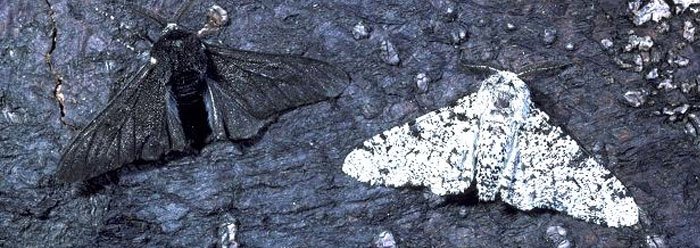
The trees these moths used to live on were white, but have been covered in soot from coal factories. Which moth will be more successful or more fit, in this environment?

Artificial Selection
Fitness

Observe the two fish in the image. The cave fish and minnow are genetically related to each other and are similar in many ways. The cave fish lives very deep in the ocean where there is no light. It has only the remnants of eyes and is blind. Minnows live in shallow waters where the water has light. Their eye sight is important for their survival. Which statement below best describes these two fish?
The DNA of the cave fish has changed over time to differ from the minnow. Since there is no light where the cave fish lives, it was not necessary to have working eyes. Over time, mutations occurred which proved to improve the survival of the cave fish, which is why they are now blind and have only physical remnants of eyes.
The DNA has not mutated over time and despite all of the evidence that suggests these two are genetically similar, one has eyes and the other does not so they must not be related.
Cave fish must have been attacked by predators, which is why they only have the remnants of eyes.
What is an adaptation?
A temporary change in an organism's behavior
A genetic trait that improves an organism's ability to survive and reproduce
The process by which a species splits into two or more species
A random change in the DNA of an organism
Almost all adaptations started off as?
selective breeding
physiological
structural
mutations
Which scientist proposed the theory of evolution?
Alfred Russell Wallace
Charles Darwin
Alfred Russell Wallace and Charles Darwin both independently came up with the theory of evolution. However, Darwin had been developing his ideas for longer and his work was more comprehensive.
The ABILITY of an organism to survive and reproduce in its environment
Adaptation
fitness
Mutation
Natural Selection
Match the following terms with their definitions
Evolution
a change in a species DNA over time because of natural selection
Adaptation
Any variation that makes an organism better able to survive
Variation
An inherited trait that makes and individual different
Mutation
A permanent change in the DNA

The figure shows how natural selection of a single-trait gene affects lizard survival.
Which of the following most likely causes the changes in allele distribution?
The allele for light gray coloration disappears from the population. This may be because light gray lizards are more visible to predators and therefore they might be less likely to survive and reproduce.
The allele for black coloration decreases fitness and becomes less common. This may be because black coloration keeps the lizards cool during hot summer temperatures.
Medium gray coloration in lizards appears to be a neutral mutant allele that allows the lizards to hide better from predators. This leads to increases in phenotype and allele frequency of gray coloration.
Because black and medium gray lizards are less visible to predators, these alleles are neutral to natural selection and therefore will not disappear from the population of lizards.

