
 Worksheets
P3 Light Warm up Review EM and Reflection
Total questions: 20
Worksheet time: 12mins
When the wavelength increases the frequency will
increase
decrease
remain same
none of these
Infrared rays are important for
Warming the Earth
Providing visible light for plants
Taking X-rays
all of these
What is the wave speed equation?
v= f/λ
v= λ - f
v=λ/f
v=λf
As the wavelength of a wave in a medium increases, its frequency will
Increase
Go to Zero
Decrease
Stay the same
What is the wavelength of a wave with a speed of 25 m/s and a frequency of 50 Hz?
6250 m
.5 m
75 Hz
75 m
All waves carry ______________.
Sound
Light
Matter
Energy

What kind of wave is pictured below?
compressional wave
transverse wave
sound wave
longitudinal wave
What one of the colors listed below has the highest energy level?
Blue
Green
Yellow
Red
Which of the following is a unit for frequency?
Joules
Hertz
meters per second
seconds

The diagram below shows a pencil in a glass of water. When viewed from the side, the pencil appears to be broken. What process causes this to happen?
absorption
evaporation
reflection
refraction

What light behavior is pictured here?
reflection
refraction
diffusion
absorption
Bouncing of a light ray when it strikes a reflecting surface is called.........
Refraction
Dispersion
Reflection
Diffraction

A leaf is green. What does this tell you about the light that is being absorbed?
The light is a UV ray.
The light is not a part of the light spectrum.
All colors are reflected except green.
All colors are absorbed except green
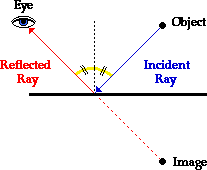
What is the angle of reflection equal to?
The angle of refraction
The angle of incidence
The angle of absorption
The angle of light

What is the angle of incidence?
The angle at which light bends in water.
The angle at which light hits a surface.
The angle at which light is absorbed by an object.
The angle at which light bounces off a surface.

When you look into a mirror, what is happening to the light?
It is increasing in wavelengths.
It is being refracted.
It is being absorbed.
It is being reflected.
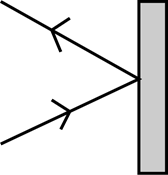
In the illustration, the light ray striking the object is-

