
 Worksheets
REFERENCE
Total questions: 20
Worksheet time: 7mins
What is the binding theory?
A theory of how different kinds of anaphors can refer to particular antecedents in particular syntactic positions.
A theory of how people understand and interpret language that contains anaphors.
A theory of how the brain processes language.
A theory of how people learn a second language.
Which factor is not considered in psycholinguistic theories of anaphoric reference?
Focus
Uniqueness
Salience
Syntax
What is recency?
Anaphors are more easily understood when they are produced soon after the antecedent.
Anaphors are more easily understood when they are produced long after the antecedent.
Anaphors are equally easy to understand regardless of when they are produced.
None of the above.
Which type of anaphor includes proper names?
Regular pronouns
Reflexive pronouns
R-expressions
None of the above
What is the informational load?
The amount of information conveyed by the anaphor.
The amount of information conveyed by the antecedent.
The amount of information conveyed by the context.
The amount of information conveyed by the speaker.
What is one characteristic that makes anaphors easier to understand?
Specificity
Ambiguity
Vagueness
Complexity
Which type of referring expression conveys little or no information?
Regular pronouns
Reflexive pronouns
Full noun phrases like "the bird"
The pronoun "it"
What is the relationship between an anaphor and possible referents?
It affects how listeners resolve the meaning of the anaphor.
It has no effect on how listeners resolve the meaning of the anaphor.
It only affects how speakers produce language.
None of the above.
What is one syntactic cue that can help listeners identify which antecedent is most likely for an anaphor?
The length of the antecedent
The position of the antecedent in the sentence
The gender of the antecedent
The age of the antecedent
Which principle of binding theory says that a reflexive must be bound in the same clause?
Principle A
Principle B
Principle C
None of the above
(a) is the idea that the information conveyed by an anaphor must be appropriate to the context in which it appears.
Chomsky developed three basic rules that explain how different kinds of (a) are distributed in different syntactic environments, and these are called Principles A–C.
The amount of information that is carried by the referring expression itself is referred to as its (a) .
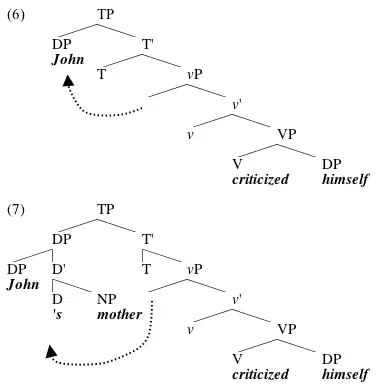
Principle A says that a reflexive must be bound (has to have an antecedent) in the same (a) .
(a) is one important aspect of psycholinguistic theories of anaphoric reference that considers factors such as focus, uniqueness, salience, and accessibility when explaining how listeners identify which referent is being referred to by an anaphor.
Psycholinguistic theories of anaphoric reference seek to explain how people understand and interpret language that contains anaphors
TRUE
FALSE
The informational load refers to the amount of information conveyed by the antecedent.
TRUE
FALSE
Chomsky divides anaphors into two categories: regular pronouns and reflexive pronouns.
TRUE
FALSE
Recency has no effect on how listeners resolve the meaning of an anaphor.
TRUE
FALSE
Syntax is not considered in psycholinguistic theories of anaphoric reference.
TRUE
FALSE

