
 Worksheets
7th Grade EOC Review Part 1
Total questions: 26
Worksheet time: 19mins
The variable that is changed in an investigation (test variable). (a)
The measurable outcome in an investigation.
independent variable
dependent variable
control variable
A scientists does several trials in the same experiment.
hypothesis
question
repetition
replication
Replication is when one scientist
copies another scientist's experiment.
laughs at another scientist's experiment.
repeats their own experiment several times.
clones another scientist.

Nicki Minaj goes to Silver River each week for 4 weeks and collects 5 samples of water to test the pH. What is this an example of? (a)

An environmental group contacts Lil' Kim to get her procedures for dyeing hair pink using elephant earwax so that they can check her results. This is an example of what?
Repetition
Replication
Scientists frequently repeat the experiments of others scientists. Why is this important in science?
Scientists often ask each other for help in performing experiments.
Replication of experiments helps to confirm and verify results.
Scientists frequently perform other scientists’ experiments in order to practice their technique.
Repeating experiments is an effective way to make sure a laboratory is in optimal condition.
Kaylee reads an article that states that the frequency of chirping by crickets is related to the temperature of
their environment. She wants to conduct an experiment to see if this is true. Kaylee states this hypothesis:
Crickets chirp more frequently when the temperature of their environment increases. What is the test
variable (independent variable) and outcome variable (dependent variable) in Kaylee’s experiment?
a.test variable (independent variable): number of crickets; outcome variable (dependent variable): frequency of chirping
b. test variable (independent variable): temperature of environment; outcome variable (dependent variable): frequency of chirping
c. test variable (independent variable): number of crickets; outcome variable (dependent variable): temperature of environment
d. test variable (independent variable): frequency of chirping; outcome variable (dependent variable): temperature of environment
A statement that describes what scientists expect to happen every time under a particular set of conditions is a (a)
If something new is discovered in science, what will most likely happen?
The scientific knowledge may change as long as there is empirical evidence to support it.
Science will be called inaccurate and untrustworrthy.
The scientists that discovered the new information will be fired from their research positions.
None of the above.
How can we collect empirical evidence?
Through our own personal beliefs and bias
Through experimentation, investigations, and observations.
Predictions from only mathematical models.
Predictions from only 3-D physical models.
What are the four layers of the Earth?
crust, mantle, outer core, inner core
lithosphere, hydrosphere, atmosphere, hydrosphere
mantle, lithosphere, crust, core
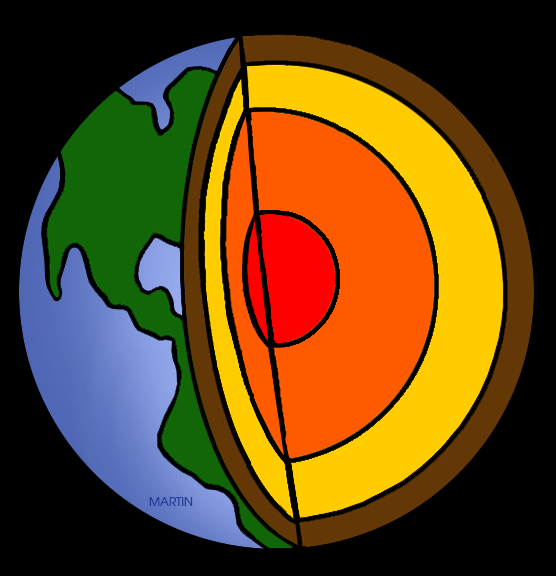
Which layer is shown in red? (a)

Which layer of the Earth is shown in ORANGE?
Crust
Mantle
Inner Core
Outer Core
Which layer of the Earth is shown in YELLOW?
Crust
Mantle
Inner Core
Outer Core
Which layer of the Earth is shown in BROWN?
Crust
Mantle
Inner Core
Outer Core

This layer is a solid ball of metal.
Crust
Mantle
Outer Core
Inner Core

Which of Earth's layers is best described as liquid metal? (a)
Which of the following is true regarding the composition of the lithosphere?
The lithosphere is mostly liquid, with some medium-density materials, such as silicon.
The lithosphere is more plastic and flows slowly compared to the solid crust of Earth.
The lithosphere includes the core and the lower portion of the mantle.
The lithosphere includes the crust and the uppermost portion of the mantle, which is sold and rigid.
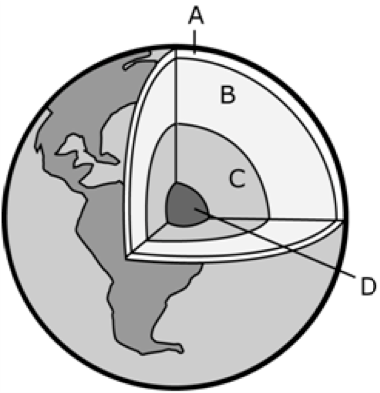
What letter in the diagram identifies the layer that is composed of moving continental and oceanic plates?
layer A
layer B
layer C
layer D

Metamorphic rock transforms to sediment by (a) ?
Heat and ____________ can change sedimentary rock into metamorphic rock.
Pressure
Melting
Coolig

