
 Worksheets
Energy & Conservation of Mechanical Energy
Total questions: 10
Worksheet time: 19mins
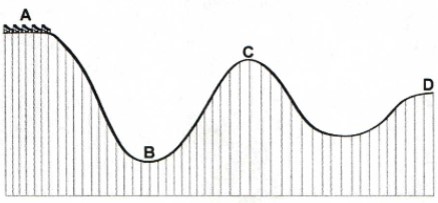
Based on the diagram of a roller coaster car on a roller coaster track, what statement is true?
The car at point A has more kinetic energy than the car at point C
The car at point C has less kinetic energy than the car at point B.
The car at point C has more kinetic energy than the car at point B.
The car at point D has less potential energy than the car at point B.
Which of the following has the largest kinetic energy?


What is the Kinetic Energy at point B?
500,000 J
400,000 J
300,000 J
50,000 J
What is the GPE at point E?
500,000 J
250,000 J
300,000 J
100,000 J
1. A ball has a 17 J of kinetic energy and its mechanical energy is 25 J. If the ball has a mass of 3.2 kg, what is its height above the ground?
0.26 m
0.52 m
5.2 m
25 m
A 1.0 kg ball is stationary at the top of a hill that is 10.0 meters in height. The ball rolls all the way down the hill. What is its gravitational potential energy at the bottom of the hill?
0 joules
98 joules
49 joules
38 joules

A roller coaster uses a motor to take a car to the top of its first hill. The roller coaster then travels down a 35 meter hill and to the top of the next hill. It travels with a speed of 15 m/s at the top of the second hill.
How high is the second hill? Assume no energy is lost to friction and the coaster starts from rest at the top of the first hill.
12.5 m
24 m
34 m
This cannot be determined without the mass of the car.

