
 Worksheets
Electric Charges & fields
Total questions: 20
Worksheet time: 10mins
The surface considered for Gauss’s law is called
(a) Closed surface
(b) Spherical surface
(c) Gaussian surface
(d) Plane surface
The total flux through the faces of the cube with side of length a if a charge q is placed at corner A of the cube is 8 ϵo1 . Do you agree?
Yes
No
An electric dipole in a uniform electric field experiences (When it is placed at an angle θ with the field)
Force and torque both
Force but no torque
Torque but no force
No force and no torque
A mass m=20g has a charge q=3.0mC . It moves with a velocity of 20m/s and enters a region of electric field of 80N/C in the same direction as the velocity of the mass. The velocity of the mass after 3 seconds in this region is
80 m/s
56m/s
44m/s
40m/s

QA and QB are two charges creating an electric field. Based on the diagram, what can we say about the strength electric fields coming from QA and QB

The diagram above shows a point, P, located midway between two oppositely charged parallel plates.
If an electron is introduced at point P, the electron will
accelerate toward the negatively charged plate
travel at constant speed toward the negatively charged plate
travel at constant speed toward the positively charged plate
accelerate toward the positively charged plate
A uniformly charged conducting sphere of 4 m in diameter has a surface charge density of 100 m2μC . Calculate the total electric flux coming out of the sphere
5.6 x 10⁸ Vm
1.4 x 10⁸ Vm
22.4 x 10⁸ Vm
1.1 x 10⁸ Vm

Determine the ratio q2q1 As lines of forces of two point charges are shown in figure
1
2
4
3

Identical charges A, B, and C are located between two oppositely charged parallel plates, as shown in the diagram below. The magnitude of the force exerted on the charges by the electric field between the plates is
least on A and greatest on C
the same on A and C, but less on B
the same for A, B, and C
greatest on A and least on C
A region surrounding a stationary electric dipoles has
Magnetic field only
Electric field only
Both electric and magnetic fields
No electric and magnetic fields

The given diagram shows charges of +2 µC and -2 µC situated at points P and Q respectively. Point X is midway between P and Q.
What is the direction of the electric field and the value of the electric potential at point X?
A
B
C
D
Consider the points lying on a straight line joining two fixed opposite charges. Between the charges there is
No point where electric field is zero
Only one point where electric field is zero
No point where potential is zero
Only one point where potential is zero

Four charges are placed on corners of a square as shown in figure having side of 5cm. If Q is one microcoulomb, then electric field intensity at centre will be
1.02×10⁷ C Nupwards
2.04×10⁷ C Ndownwards
2.04×10⁷ C Nupwards
1.02×10⁷ C Ndownwards
The unit of electric field is not equivalent to
CN
CJ
mV
C−mJ
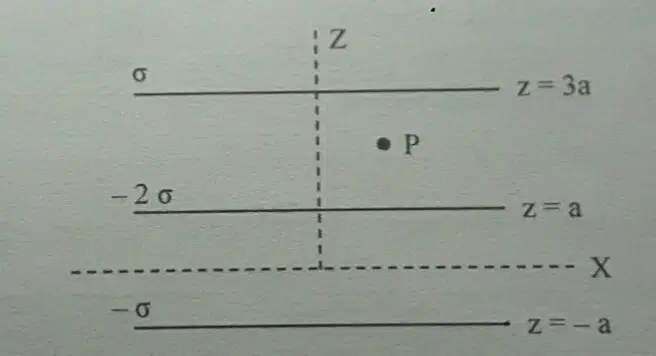
Three infinitely long non-conducting charge sheets are placed as shown in figure. The electric field at point P is
ϵ2σ along -ve Z axis
ϵ2σ along +ve Z axis
ϵ4σ along -ve Z axis
ϵ4σ along +ve Z axis

A moving electron is deflected by two oppositely charged parallel plates, as shown in the diagram above.
The electric field between the plates is directed from
C to D
D to C
A to B
B to A
Electric charges of 1 μC ,-1 μC and 2 μC C are placed in air at the corners A,B and C respectively of an equilateral triangle ABC having length of each side 10 cm. The resultant force on the charge at C
2.7 N
1.8N
0.9 N
3.6 N
The diagram above shows a point, P, located midway between two oppositely charged parallel plates.
If an electron is introduced at point P, the electron will
accelerate toward the negatively charged plate
travel at constant speed toward the negatively charged plate
travel at constant speed toward the positively charged plate
accelerate toward the positively charged plate
Two charges 1C and -4C exists in air. What is the direction of force?
Away from 1C
Away from -4C
From 1C to -4C
From -4C to 1C
Which of the following is not true for electric field lines?
Tangent to the electric field lines gives the direction of electric field
Two electric field lines can't intersect each other
Electric field lines form closed loops
The closer the electric field lines stronger the electric field

