
 Worksheets
4. Final EOC Review- Cells; Microscopes
Total questions: 51
Worksheet time: 35mins

Which statement correctly identifies the two cells in the picture?
Both are prokaryotic cells
Both are eukaryotic cells
Left cell is prokaryotic; right cell is eukaryotic
Left cell is eukaryotic; right cell is prokaryotic

Choose ALL the characteristics of a Prokaryotic cell
It is very small
It is large
Does not have nucleus or other membrane-bound organelles
Has a nucleus and other membrane-bound organelles
Has DNA which is circular

Choose ALL the characteristics of a Eukaryotic cell
It is very small
It is large
Does not have nucleus or other membrane-bound organelles
Has a nucleus and other membrane-bound organelles
Has DNA which is linear and forms chromosomes

What do ALL types of cells have in common? Choose ALL that applies
genetic material (DNA)
cell membrane
cytoplasm
membrane-bound organelles
ribosomes

What are two structures found only in PLANT cells, such as the cells of a leak or a stem?
Cytoplasm and Lysosomes
Chloroplasts and Mitochondria
Cell wall and Chloroplasts
Cell membrane and nucleus

What are two structures found only in ANIMAL cells, such as the cells of a human skin?
Cytoplasm and Lysosomes
Chloroplasts and Mitochondria
Centrioles and Lysosomes
Cell membrane and nucleus

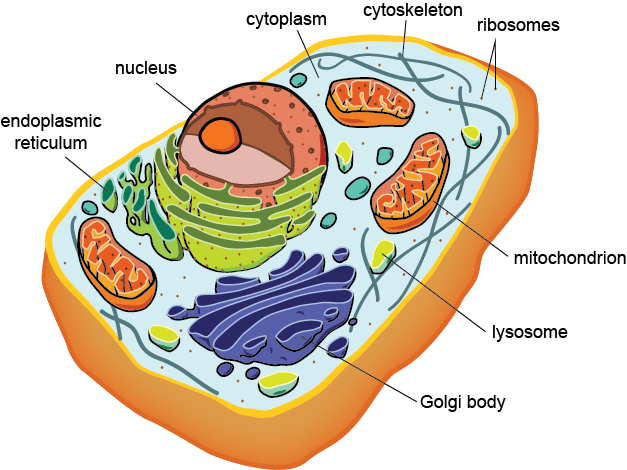
Name the organelle
Nucleus
Chloroplast
Mitochondrion
Golgi apparatus
Endoplasmic reticulum

Name the organelle
Nucleus
Chloroplast
Mitochondrion
Golgi apparatus
Endoplasmic reticulum

Name the organelle
Nucleus
Chloroplast
Mitochondrion
Golgi apparatus
Endoplasmic reticulum

What is the function of the nucleus?
Controls what enters and leaves the cell
Control center of the cell; contains the DNA
Digest molecules
Protein synthesis
Sort, package and distribute molecules in vesicles to be released from the cell

What is the function of the Golgi apparatus?
Controls what enters and leaves the cell
Control center of the cell; contains the DNA
Digest molecules
Protein synthesis
Sort, package and distribute molecules in vesicles to be released from the cell

What is the function of the ribosomes?
Controls what enters and leaves the cell
Control center of the cell; contains the DNA
Digest molecules
Protein synthesis
Sort, package and distribute molecules in vesicles to be released from the cell

What is the function of the plasma membrane?
Controls what enters and leaves the cell
Control center of the cell; contains the DNA
Digest molecules
Protein synthesis
Sort, package and distribute molecules in vesicles to be released from the cell
What is the organelle that does the photosynthesis (produces sugar molecules)?
ribosome
cell wall
chloroplast
vacuole
What is the organelle that stores water, food molecules, and other substances?
ribosome
cell wall
chloroplast
vacuole

Why is the cell membrane called a bilayer?
Because it has two layers of lipids / phospholipids with the the tails in the inner part
Because the heads are polar
Because the tails are non polar
Because it has proteins
Which of the following describes the PASSIVE transport? Choose ALL that applies
Moves substances from low to high concentration
Moves substances from low to high concentration
Requires energy (ATP)
Does not require energy (ATP)
Substances are moved against the concentration gradient
Which of the following describes the ACTIVE transport? Choose ALL that applies
Moves substances from low to high concentration
Moves substances from low to high concentration
Requires energy (ATP)
Does not require energy (ATP)
Substances are moved against the concentration gradient

The sodium - potassium bomb is considered to be a form of ACTIVE transport. Why?
Because the sodium and potassium ions move with the concentration gradient
Because the sodium and potassium ions move against the concentration gradient
Because the sodium and potassium ions are very small
Because sodium and potassium ions are charged

Carbon dioxide molecules move with the concentration gradient and do not require energy (ATP) to move across the membrane. What type of cell transport is described above?
Passive transport
Active transport

Sodium and Potassium ions move against the concentration gradient and require energy (ATP) to move across the membrane. What type of cell transport is described above?
Passive transport
Active transport

Analyze the picture carefully. Plant cells were placed in different solutions . Based on the amount of water that enters and leaves the cell in each scenario and your knowledge about osmosis, which of the 3 cells represents a scenario where the concentration of water is greater inside the cell than outside the cell?


Analyze the picture carefully. Plant cells were placed in different solutions . Based on the amount of water that enters and leaves the cell in each scenario and your knowledge about osmosis, which of the 3 cells represents a scenario where the concentration of water is greater outside the cell than inside the cell?


Multicellular, does not have a cell wall
animal cell
Multicellular, has chloroplasts
plant cell
Unicellular, has a flagella to help it move
bacteria cell

Sponges live their lives attached to the sea floor or onto rocks that are under water. They have no organs, so they feed by allowing nutrient-rich water to flow through them. Based on the diagram of a sponge cell, what best explains if sponges are considered animals or plants?
Sponge cells do not have cell walls, so they must be animals.
Sponge cells do not have mitochondria, so they must be plants.
Sponge cells do not have a nucleus, so they must be plants.
Sponge cells do not have vacuoles, so they must be animals.
Prokaryotic cells have all of the following parts EXCEPT:
Cell membrane
Ribosomes
Cytoplasm
Nuclear membrane

In what organelle is the genetic material found inside?
Endoplasmic Reticulum
Golgi Complex
Nucleolus
Nucleus
The Cell Theory states - (select all that apply)
The cell is the basic unit of life
All cells are crested from existing cells
All cells reproduce sexually
All organisms are made from cells
Gel-like substance that holds all organelles in place -
Chloroplast
Call wall
Cytoplasm
Lysosomes

What is the correct name and function of the organelle pictured here?
Mitochondria- making ATP energy for the cell
Endoplasmic Reticulum- Packaging proteins
Lysosome- digesting waste material for the cell
Chloroplasts- the site of photosynthesis

All living things have hair.
All living things are made of cells and come from other cells.
The cells of all living things have chloroplast.
All living things can move.
What are the parts of the cell theory? Select all that apply.
The cell is the fundamental unit of structure and function in living things.
All organisms are made up of one or more cells.
Cells arise from other cells through cellular division.
Only Animals have cells.
Plants are the only living things with cells
Cells are the basic unit of structure and function in all living things.
All cells are produced from other cells.
Only animal cells are composed of cells.
All living things are composed of cells.

Which microscope took a 3D image of this fly's head?
¿Qué microscopio tomó una imagen 3D de la cabeza de esta mosca?
Compound Light
Transmission Electron
Dissecting
Scanning Electron
Match the following...
Une el siguiente

Dissecting

TEM

SEM
Match the following
Une el siguiente

Dissecting

TEM

Compound

This image shows the detailed structure of the tiny mitochondria organelle. Which microscope most likely took this image?
Esta imagen muestra la estructura detallada del diminuto orgánulo mitocondrial. ¿Qué microscopio probablemente tomó esta imagen?
Compound Light
Scanning Electron
Dissecting
Transmission Electron

Scientists once thought that living things could be generated from non-living things (theory of spontaneous generation). What happened that allowed this idea to be removed from science?
Scientists discussed among themselves and the majority agreed on removing the principle
Scientists read a book saying that the principle was not true, so they removed it
Scientists did not believe on that, so they just decided to remove the principle
Scientists (for example Redi and Pasteur)tested new hypothesis conducting experiments and got new results
Which principle of the original cell theory was removed due to new research and evidence?
All cells come from pre-existing cells.
Cells are the basic structural and functional units of life.
All living things are made of cells.
Cells form through spontaneous generation.

Which of the two microscopes used in high school has higher or more magnification, so it can be used to observe cells?
compound light microscope
dissecting or stereo microscope
both have the same magnification

Which of the two microscopes used in high school has less magnification but produces a 3D image, so it can be used to observe relatively big specimens in more detail like a butterfly's wing?
compound light microscope
dissecting or stereo microscope
both will provide the same type of image

Which of these microscopes is used to observe a 3D image of a very small structure, like the antenna of a bee?
compound light microscope
dissecting or stereo microscope
scanning electron microscope (SEM
transmission electron microscope (TEM)

Which of these microscopes is used to observe a 2D image of organelles, such as the nucleus of a cell?
compound light microscope
dissecting or stereo microscope
scanning electron microscope (SEM
transmission electron microscope (TEM)

Which of the following images was produced by a compound light microscope?

Cork cells

Insect under microscope

Pollen grain under microscope

Chloroplast under microscope

The picture represents Redi's experiment. With this experiment, Redi ....
proved the spontaneous generation was true
proved that maggots are related to flies
disproved the spontaneous generation idea and proved that cells come only from pre-existing cells
proved that animals are heterotrophs

The picture represents Louis Pasteur's experiment. With this experiment, Pasteur ....
proved the spontaneous generation was true
proved that bacteria are prokaryotes
disproved the spontaneous generation idea and proved that cells come only from pre-existing cells
proved that flasks are resistant to heat

