wayground logo

Free Printable Worksheets

Font size

S
M
L
XL
Worksheets

2023 Am. 11 Final

Total questions: 118

Worksheet time: 59mins

Name
Class
Date
1.
Who was the President who sent out Lewis and Clark on their journey?
a)
George Washington
b)
Abraham Lincoln
c)
Andrew Jackson
d)
'Thomas Jefferson
2.
What is the name of the big piece of land that Thomas Jefferson bought in 1803?
a)
Texas Territory 
b)
Louisiana Purchase
c)
Mississippi Expansion
d)
Midwest Territory
3.
What is the name of the group that traveled with Lewis and Clark?
a)
The American Explorers
b)
Journey Men's Club
c)
The Dream Team
d)
Corps of Discovery
4.
Which port did Jefferson want to control?
a)
Savannah
b)
New Orleans
c)
Mexico
d)
Mississippi
5.
How much money did the US pay for the Louisiana Purchase?
a)
$10 million
b)
$12 million
c)
$15 million
d)
$100 million
6.
Who helped as a guide to Lewis& Clark along their expedition of the new territory? 
a)
Sacagewea
b)
Pochahontas
c)
James Monroe
d)
Jean Baptise
7.
The expedition lasted more than _________ years.
a)
one 
b)
two 
c)
three
d)
four
8.
Who lead the Corps of Discovery?
a)
Washington
b)
Hamilton
c)
Adams and Grant
d)
Lewis and Clark
9.
The men were encouraged to keep journals of all that they found.
a)
True
b)
False
10.
How did the United States acquire the land explored by Lewis and Clark? 
a)
They won it from the British during the Revolutionary war
b)
They defeated American Indians in a series of battles 
c)
They bought it from the kingdom of France
d)
They took it from Spanish conquistadors 
11.
Which description of the expedition's encounters with American Indians is most accurate? 
a)
Most encounters were friendly
b)
Most tribes displayed hostility
c)
Translators weren't needed
d)
There were barely any encounters to speak of
12.

The United States _____________ in size when the Louisiana territory was purchased.

a)

tripled

b)

stayed the same

c)

doubled

d)

shrank

13.

What was not a goal of President Jefferson?

a)

Journal about new plants and animals

b)

Make a map of the new land

c)

Find a passage to New Orleans

d)

Meet Native Americans and tell them that the U.S. now owned the Louisiana territory.

14.

What did Lewis and Clark see on their journey? Select all that apply.

a)

plants

b)

animals

c)

native americans

d)

lots of neighborhoods

15.

What is not a way Sacajawea helped on the expedition?

a)

She helped Lewis and Clark speak with Indians. (Interpreter)

b)

She helped guide Lewis and Clark and helped them trade with Indians.

c)

She knew what plants were safe to eat.

d)

She took over as the leader of the expedition.

16.

What river did Lewis and Clark travel on for the majority of the journey?

a)

Mississippi River

b)

Clark River

c)

Colombia River

d)

Missouri River

17.
Who did Thomas Jefferson choose to lead the Corps of Discovery? 
a)
Meriwether Lewis
b)
William Clark
c)
Sacagawea 
18.

The expedition spent their first winter at

a)

Fort Hall

b)

Fort Mandan

c)

Fort Boise

d)

with the Nez Perce Tribe

19.

Sacajawea was married to ___________________________.

a)

Cameahweit

b)

Charbonneau

c)

York

d)

Captain Lewis

20.

A group of people who act together

a)

team

b)

corp

c)

interpreter

d)

core

21.

a person who helps two people of groups understand the languages and customs of each other

a)

interpreter

b)

spokesman

c)

embargo

d)

listener

22.
Which of the following was a belief of many Americans  that the US should expand across the continent to the Pacific Ocean?
a)
Manifest Destiny
b)
Abolition
c)
Secession
d)
Anarchy
23.
What was a 2,000 mile trail stretching to the Oregon territory?
a)
Oregon Trail
b)
Santa Few Trail
c)
California Trail
d)
Mormon Trail
24.
________ included all of what is now Washington, Oregon, Idaho and parts of Wyoming and British Colombia
a)
Washington Country
b)
Mountain Country
c)
Wyoming Country
d)
Oregon Country
25.
What was the name of a trend during the 1830’s where settler moved to the Oregon Country for land and the climate?
a)
Oregon Fever
b)
California Gold Rush
c)
Donner Party
d)
Rendezvous
26.
1,300 mile route the Church of Latter Day Saints took to Salt Lake City, Utah from Illinois.
a)
Mormon Trail
b)
California Trail
c)
Santa Fe Trail
d)
Oregon Trail
27.
______ was an important path west and trade route for clothing and other manufacturing ending in New Mexico.
a)
Mormon Trail
b)
California Trail
c)
Santa Fe Trail
d)
Oregon Trail
28.
Became head of the Mormon church and led the group to settle in Utah.
a)
Brigham Young
b)
Joseph Smith
c)
James Donner
d)
Levi Strauss
29.
Which of the following was a Members of the church of Jesus Christ of the latter day Saints?
a)
Forty-Niners
b)
Pioneers
c)
Mormons
d)
Mountain Men
30.
Which of the following were fur traders and trappers who moved west were known as this.
a)
Mormons
b)
Forty-Niners
c)
Mountain Men
d)
Pioneers
31.
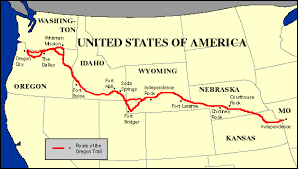
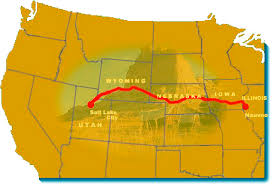
Which trail does the map represent?
a)
Oregon Trail
b)
Mormon Trail
c)
California Trail
d)
Santa Fe Trail
32.
Which trail does the map represent?
a)
Oregon Trail
b)
Mormon Trail
c)
California Trail
d)
Santa Fe Trail
33.
Which trail does the map represent?
a)
Oregon Trail
b)
Mormon Trail
c)
California Trail
d)
Santa Fe Trail
34.
______ was an organized place for trappers to come and trade their beaver fur. Place for the mountain men to gamble, shoot guns, race horses, and compete in wrestling contests.
a)
Secession
b)
Donner Party
c)
Rendezvous
d)
Abolition
35.

Why was the Kansas-Nebraska Act viewed by many people as a violation of the Missouri Compromise?

a)

The Kansas-Nebraska Act declared all remaining territories in the U.S. would be slave territories.

b)

Popular sovereignty would be used to decide slavery in Kansas & Nebraska, despite slavery being banned in that area by the Missouri Compromise.

c)

The Kansas-Nebraska Act removed all remaining Native Americans to Indian Territory.

36.

Why did groups that supported slavery and others that support abolitionism recruit people to move to Kansas?

a)

They were trying to set up militias in Kansas to protect their cause.

b)

The U.S. government required an equal number of people on each side of the slavery issue to live in Kansas.

c)

Each side wanted supporters to move their to vote in the elections that would decide the issue of slavery in Kansas.

37.

Why did abolitionists refuse to accept the 1855 Kansas election?

a)

There were many people who did not receive their ballot in time and were unable to vote.

b)

They claimed voting machines switched the votes to the pro-slavery candidates

c)

People from Missouri illegally voted in Kansas' election.

38.

Why did Representative Preston Brooks physically attack Senator Charles Sumner?

a)

Sumner had made fun of Preston Brooks' wife.

b)

Sumner had criticized Senators from the south who supported slavery.

c)

Sumner accused Preston Brooks of tax fraud the day before.

39.

How did most southerners feel about Preston Brooks' attack on Charles Sumner?

a)

They believed that Sumner deserved the beating he received.

b)

They were shocked that such a violent act would be committed against a well respected Senator like Sumner.

c)

They believed Brooks should pay for all of Sumner's medical bills.

40.

As a result of which law did John Brown and his sons attack pro-slavery settlers?

a)

Missouri Compromise

b)

Gag Rule

c)

Fugitive Slave Act

d)

Kansas Nebraska Act

41.

What term can BEST be used to describe John Brown?

a)

prohibitionist

b)

suffragette

c)

abolitionist

d)

evangalist

42.

When the raid on Harper's Ferry occurred, in which state was it located?

a)

Pennsylvania

b)

Maryland

c)

Virginia

d)

West Virginia

43.

What was John Brown's goal in planning the raid at Harper's Ferry?

a)

arm the slaves to free themselves

b)

free the slaves

c)

kill the slave owners

d)

organize peaceful protests

44.

What happened to John Brown at Harper's Ferry?

a)

he escaped

b)

he was captured and arrested

c)

he was killed in a shoot out

d)

he died in the armory fire

45.

What was the outcome of his trial?

a)

found not guilty and released

b)

found guilty and then released

c)

found guilty and sentenced to life in prison

d)

found guilty and hanged

46.
Brown was active in the Underground Railroad and helped slaves.
a)
True
b)
False
47.
Why did Brown move his family to Kansas?
a)
Good farmland
b)
To support them in the fight against slavery
c)
to go to KU
d)
to fight the South
48.
What did Brown do to unarmed pro-slavery men in Kansas?
a)
talk to them sternly
b)
protest in front of their house
c)
hacked them to death with swords
d)
agreed with them
49.
What is an abolitionist?
a)
A person against slavery
b)
A person who is a slave
c)
A person for slavery
d)
A person who owns slaves
50.

Football fan

a)

Mr. Brown

b)

John Brown

51.

Born in Wichita, KS

a)

Mr. Brown

b)

John Brown

52.

Has/had a son named John

a)

Mr. Brown

b)

John Brown

53.

Moved to Ohio when he was 36

a)

Mr. Brown

b)

John Brown

54.

Drinks/drank a lot of coffee every day

a)

Mr. Brown

b)

John Brown

55.
John Brown was raiding....
a)
A plantation
b)
A farm rich in resources
c)
The White House
d)
a United States arsenal
56.

How did John Brown justify his actions?

a)

God

b)

He was doing what President Lincoln wanted

c)

He had the laws on his side

d)

He did not justify his actions

57.

What was the cause of Bleeding Kansas?

a)

civil war

b)

people were bleeding in Kansas

c)

Kansas's follower base was higher than Nebraska's

d)

violence between pro-slavery and anti-slavery

58.

Fourth of Owen Brown's 8 children

a)

Mr. Brown

b)

John Brown

59.

Which statement accurately describes the scene show in the political cartoon?

a)

Representative Preston Brooks attacked Senator Charles Sumner because Sumner insulted other senators for supporting the Kansas-Nebraska Act

b)

Representative Preston Brooks attacked Senator Charles Sumner because Sumner refused to support the abolitionist movement

c)

Representative Preston Brooks attacked Senator Charles Sumner because Sumner insulted other other senators who supported the Dred Scott v. Sanford decision

d)

Representative Preston Brooks attacked Senator Charles Sumner because they were political rivals from Massachusetts

60.

What was the effect of Preston Brooks' attack on Charles Sumner?

a)

increased tensions between North and South

b)

decreased tensions between the North and South

c)

increased tensions between states and territories

d)

decreased tensions between states and territories

61.

Who supported Preston Brooks after he attacked Charles Sumner in the Senate?

a)

Southerners who thought he defended the dignity of the South

b)

abolitionists who praised him for fighting against slavery

62.

Who supported Charles Sumner after he protested the Kansas-Nebraska Act?

a)

Southerners who thought he defended the dignity of the South

b)

abolitionists who praised him for fighting against slavery

63.

Who led a raid on a government weapons storehouse in Harpers Ferry in 1859?

a)

Charles Sumner

b)

Preston Brooks

c)

Dred Scott

d)

John Brown

64.

Why was the raid on Harpers Ferry in 1859 significant in the road to the Civil War? (Choose 2)

a)

The raid further divided the North and South

b)

Abolitionists showed their willingness to use force to end slavery

c)

The South showed their willingness to go to war to protect slavery

d)

Slaves now had weapons to help them fight for their freedom

65.

What did the Supreme Court decide in Dred Scott v. Sandford? (Choose 2)

a)

African Americans are not citizens

b)

Outlawing slavery in a territory is unconstitutional

c)

The national government can prohibit the expansion of slavery in new territories

d)

African Americans who live in free states are still free

e)

Slavery is unconstitutional

66.

The South __________ the decision in Dred Scott v. Sandford.

a)

disliked

b)

supported

67.

The decision in Dred Scott v. Sandford made the North __________.

a)

angry

b)

happy

68.

Sectionalism __________ as a result of the decision in Dred Scott v. Sandford.

a)

increased

b)

decreased

69.

Determine whether Abraham Lincoln or Stephen Douglas made each argument about slavery in the Lincoln-Douglas debates of 1858.


Popular sovereignty is wrong because it allows slavery to spread to new areas

a)

Abraham Lincoln

b)

Stephen Douglas

70.

Determine whether Abraham Lincoln or Stephen Douglas made each argument about slavery in the Lincoln-Douglas debates of 1858.


"A house divided against itself cannot stand"

a)

Abraham Lincoln

b)

Stephen Douglas

71.

Determine whether Abraham Lincoln or Stephen Douglas made each argument about slavery in the Lincoln-Douglas debates of 1858.


Each state should decide for itself whether to allow slavery

a)

Abraham Lincoln

b)

Stephen Douglas

72.

Determine whether Abraham Lincoln or Stephen Douglas made each argument about slavery in the Lincoln-Douglas debates of 1858.


"The right of the people to make a slave territory or a free territory is perfect and complete under the Nebraska bill."

a)

Abraham Lincoln

b)

Stephen Douglas

73.

Determine whether Abraham Lincoln or Stephen Douglas made each argument about slavery in the Lincoln-Douglas debates of 1858.


If slavery spreads, it will eventually become legal throughout the country.

a)

Abraham Lincoln

b)

Stephen Douglas

74.

Determine whether Abraham Lincoln or Stephen Douglas made each argument about slavery in the Lincoln-Douglas debates of 1858.


Popular sovereignty allows for compromise.

a)

Abraham Lincoln

b)

Stephen Douglas

75.

Read the definition. Then choose the vocabulary term defined.

a place where weapons and ammunition are stored

a)

currency

b)

militia

c)

debt

d)

armory

76.

Choose the correct definition of martyr

a)

someone who changes their beliefs

b)

someone who suffers, or even dies, for their beliefs

c)

someone who compromises their beliefs

d)

someone who writes about their beliefs

77.

Choose the correct word or phrase to complete the dictionary definition

censure- the expression of formal _______

a)

approval

b)

agreement

c)

disapproval

d)

disagreement

78.

Choose the correct definition of insurrection

a)

a peaceful division of a political party

b)

an expansion of territory

c)

a violent uprising against an authority

d)

a plan to avoid violence against an authority

79.

Read the definition. Then choose the vocabulary term defined.

a major discussion or disagreement between opposing views

a)

consideration

b)

negotiation

c)

controversy

d)

compromise

80.

Choose the correct definition of incumbent

a)

losing an election for office

b)

running for office

c)

previously holding office

d)

currently holding office

81.

Read the definition. Then choose the vocabulary term defined.

showing great intensity of spirit or enthusiasm

a)

extreme

b)

debatable

c)

fervent

d)

brutal

82.

Choose the correct definition of immoral.

a)

something that is encouraged or supported

b)

something that is informed or considered

c)

something that is bad, wrong, or unethical

d)

something that is allowed or permitted

83.

Choose the correct definition of imbecile

a)

a foolish or unintelligent person; someone who is weak or incapable

b)

a person who is extremely committed to a cause

c)

a person who avoid commitment to a cause

d)

an intelligent or gifted person; someone who is capable

84.
Choose the best definition of the term "border state".  A border state is a state . . . 
a)
that had slaves but officially remained loyal to the United States. 
b)
that was on the border between Canada and the United States. 
c)
that was on the border between Mexico and the United States.
d)
that bordered one of the western territories. 
85.
Of the following, which is synonymous with the term, "Union".
a)
The slave states. 
b)
 The United States of America. 
c)
The free states. 
d)
 The border states. 
86.
Why were slaves an advantage for the South? They were an advantage because . . .
a)
slaves freed up more white men to go and fight since they knew that slaves would work their farms in their absence.
b)
 slaves could be used as soldiers. 
c)
slaves could be used as spies and report the movement of US soldiers.
d)
slaves knew the local terrain better than most whites. 
87.
Of the following, which one was an advantage held by the South during the war?  The South . . . 
a)
 had greater industrial resources than the North. 
b)
 had more transportation resources than the North. 
c)
was defending their own territory. 
d)
 could count on the support of Native Americans. 
88.
Of the following, which one is an advantage of the North during the Civil War?  The North . . .
a)
 had more military schools than the South did. 
b)
 had greater industrial resources. 
c)
knew the local terrain better than the South did. 
d)
could depend on Great Britain to help them defeat the South. 
89.
Where were the first shots of the Civil War fired?
a)
Richmond, Virginia 
b)
 Washington, DC. 
c)
Charleston Harbor, South Carolina 
d)
 Wilmington, North Carolina. 
90.
Which Union fort was bombarded for 34 hours before surrendering to the Confederates?
a)
Fort Pickens 
b)
 Fort Sumter 
c)
Fort Moultrie 
d)
Fort Wagner 
91.
Where did General Lee surrender?
a)
Atlanta, Georgia
b)
Appomattox Court House, Virginia
c)
Gettysburg, Pennsylvania
d)
Durham, North Carolina
92.
Two inequalities experienced by black soldiers during the Civil War included:
a)
Not being paid at all and not receiving any uniforms
b)
Not being paid equally and not being allowed to become officers
c)
Being beaten and killed by their Generals
d)
Being forces into slavery in the North
93.
The Emancipation Proclamation
a)
freed only Union Slaves
b)
allowed slaves to fight for the South
c)
freed only Confederate slaves
d)
freed Union and Confederate slaves
94.
The Union army gained control of the Mississippi River after winning the Battle of
a)
Antietam
b)
Appomattox
c)
Chancelorsville
d)
Vicksburg
95.
One Southern advantage during the Civil War was
a)
having more supplies
b)

having better leaders
c)
having more men
d)
having a stronger navy
96.
Which battle was considered a "turning point" of the Civil War?
a)
Shiloh
b)
Ft. Sumter
c)
Gettysburg
d)
Bull Run
97.
Which Union "victory" in Maryland had 23,000 casulties, otherwise known as the "bloodiest day" of the war?
a)
Second Bull Run
b)
Gettysburg
c)
Antietam
d)
Vicksburg
98.
In which battle did "Stonewall" Jackson earn his nickname by standing firm, then chasing his enemy off the field?
a)
Gettysburg
b)
Bull Run
c)
Chancellorsville
d)
Antietam
99.
What is total war?
a)
a military strategy that includes destroying the enemy's ability and will to fight
b)
a military strategy that includes flanking the enemy
c)
a military strategy put into effect by Southern Generals
d)
a military strategy put into effect by Southern Generals
100.
This woman was a nurse during the Civil War, and later founded the Red Cross.
a)
W. O. Hair Hall 
b)
 Clara Barton 
c)
Molly Pitcher 
d)
 Francis Spinner 
101.
When a navy tries to prevent its enemy from trading overseas they create
a)
 an embargo 
b)
 a cut-off attack 
c)
 a flank attack
d)
 a blockade 
102.
Had more men, weapons, and naval technology throughout the war
a)
 Union 
b)
Confederacy
103.
What is an ironclad?
a)
 a submarine 
b)
a treaty or agreement 
c)
 a cannon 
d)
 a ship covered by metal plates 
104.
Most immigrants on the East Coast were processed where?
a)
Washington, D.C.
b)
Ellis Island
c)
Angel Island
d)
Baltimore
105.
What group of immigrants were arriving in large numbers on the West Coast in the middle to late 1800's?
a)
Greek
b)
Chinese
c)
British
d)
French
106.
In general, why did most people immigrate to the U.S. in the late 19th and early 20th Century?
a)
Escape difficult conditions
b)
A bETTER life
c)
religious persecution
d)
all of the above
107.
What is the term for the mixture of people of different cultures and races together into Americans?
a)
Mixing Bowl
b)
Angel Food Cake
c)
Fish Tank
d)
Melting Pot
108.
Which term  is the name of a restriction on immigration passed by Congress?
a)
Melting Pot Act
b)
Nativism Act  of 1902
c)
Chinese Exclusion Act
d)
None of the above
109.
Which amendment to the United States Constitution defines citizenship?
a)
16th
b)
14th
c)
13th
d)
None of the above
110.
All of the following are challenges immigrants face except
a)
clothing
b)
jobs
c)
language
d)
prejudice
111.
How long did it take for European immigrants to get to the US (shortest time possible)?
a)
5 days
b)
7 days
c)
9 days
d)
12 days
112.
Most immigrants traveled
a)
first class
b)
second class
c)
steerage
d)
fourth class
113.
Immigrants had to pass a ___ inspection
a)
literature
b)
social studies
c)
health
d)
naturalization
114.
A written record of the passengers aboard a ship.
a)
journal
b)
diary
c)
ship's log
d)
manifest
115.
Each immigrant had to answer ___ questions
a)
22
b)
29
c)
19
d)
9
116.
All of the following are ways that immigrant groups dealt with discrimination except
a)
maintaining a strong support group
b)
Living in communities with immigrants of the same ethnicity
c)
Their children adapted to the new environment
d)
taking jobs of native born citizens
117.
Unlike citizens, immigrants may not: 
a)
Hold Jobs
b)
Vote
c)
Own property
d)
Attend public schools
118.
Which of the following is a right of a LEGAL immigrant?
a)
Right to vote
b)
Right to run for governmental office
c)
Right to own property 
d)
None of these responses.