Wayground logo

Free Printable Worksheets

Font size

S
M
L
XL
Worksheets

Graphing Quadratics

Total questions: 99

Worksheet time: 4hrs 51mins

Name
Class
Date
1.

Which equation is Vertex Form?

a)

y=ax2+bx+c

b)

y=a(x-h)2+k

2.

Which equation is in standard form?

a)

y=a(x-h)2+k

b)

y=ax2+bx+c

3.
Given the equation for this parabola:
 y=-(x-4)2-3,
does this parabola have a maximum or minimum value?
a)
Maximum
b)
Minimum
4.

What is the vertex of this quadratic equation?

y = 2(x + 2)2 + 5

a)

(-2,5)

b)

(2,5)

c)

(5,-2)

d)

(-5,-2)

5.
a)
y=(x-4)2+1
b)
y=(x-4)2-1
c)
y=(x+4)2+1
d)
y=(x+4)2-1
6.

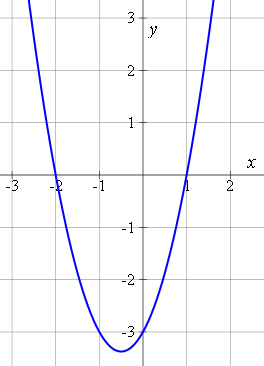
Which equation matches the graph?

a)

y=(x-2)2+3

b)

y=(x-2)2-3

c)

y=(x+2)2+3

d)

y=(x+2)2-3

7.
Where is the axis of symmetry for this parabola?
a)
x = −1
b)
x = 0
c)
y = 3
d)
x = −3
8.
What is the axis of symmetry?
f(x) = x2 - 8x + 15.
a)
x = -4
b)
x = 4
c)
y = 4
d)
y = -4
9.
What is the axis of symmetry?
y = 3x2 - 6x + 4
a)
x=1
b)
x=-6
c)
x=2
d)
x=-1
10.
What is the vertex?
f(x) = 2(x - 5)2 + 12
a)
(-5, -12)
b)
(5,-12)
c)
(5, 12)
d)
(-5, 12)
11.

Find the Vertex: y= -5x2 -20x - 26

a)

(-2, -6)

b)

(2, 6)

c)

(6,2)

d)

(3, 6)

12.
What is the vertex?
f(x) = -x2 - 4x + 12.
a)
(-2, 16)
b)
(2, 0)
c)
(2, 4)
d)
(-2, 4)
13.
What is the vertex?
y = -2x2 + 4x + 3
a)
(0, 3)
b)
(-1, 5)
c)
(1, 5)
d)
(1, -5)
14.
If given the equation y = 3(x + 5)2 - 4, what is the vertex of the parabola?
a)
(5, -4)
b)
(-5, -4)
c)
(-15, -4)
d)
(15, -4)
15.

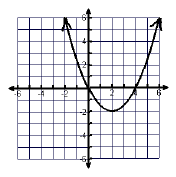
What is the range of the function graphed above?

a)

y ≥ -2

b)

y ≤ 4

c)

y ≥ 4

d)

y ≤ -2

16.

What is the range of the parabola above?

a)

y ≤ 2

b)

y ≥ 2

c)

y ≤ 3

d)

y ≥ 3

17.
What is the equation for axis of symmetry?
a)
y=3
b)
x=3
c)
x=5
d)
x=1
18.
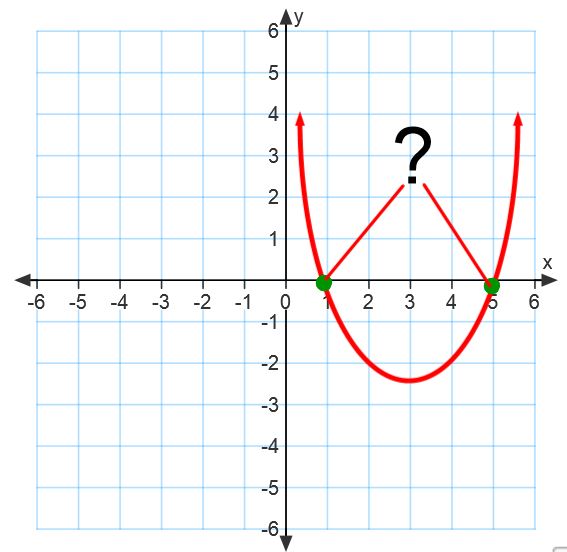
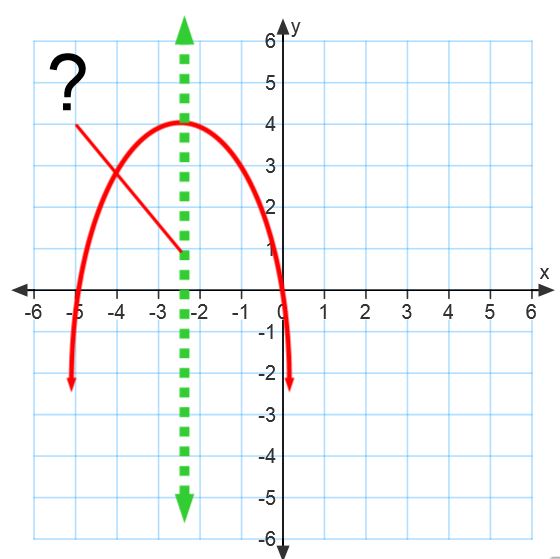
What are the green dots called?
a)
axis of symmetry
b)
vertex
c)
parabola
d)
roots or x-intercepts
19.
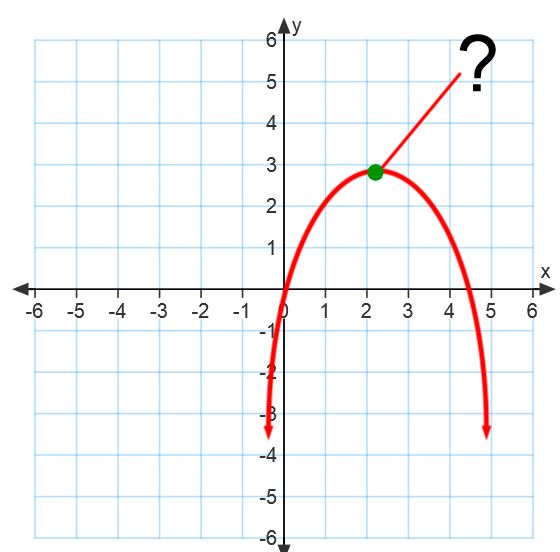
What is the green dot on the parabola called?
a)
maximum
b)
minumum
c)
roots
d)
zeros
20.
Does this parabola have a maximum or minimum?
a)
Maximum
b)
Minimum
21.
Find the y-intercept of f(x) = 2x2 - 2x + 1
a)
2
b)
-2
c)
1
d)
-1
22.
What is the vertex of the quadratic function:
y = x2 - 6x + 11?
a)
(3,2)
b)
(-3,-2)
c)
(-3,2)
d)
(3,-2)
23.
Determine the vertex of the parabola:
y = 5x2 - 20x + 13
a)
(5, -7)
b)
(-2, -7)
c)
(2, -7)
d)
(-7, -2)
24.
The axis of symmetry line passes through which point?
a)
y-intercept
b)
any random point
c)
vertex
d)
none of these
25.
What are the x- intercepts?
a)
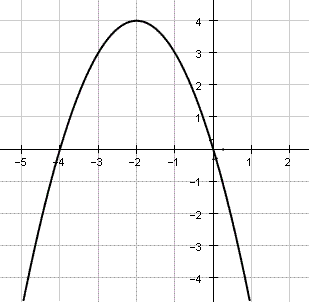
x= 0 and x= -4
b)
x= 0 and x= 4
c)
y= 0
d)
x= 2
26.
What is the vertex?
a)
(2, 4)
b)
(3, -1)
c)
(0, 8)
d)
(4, 2)
27.
Factor
n2-13n+40
a)
(n-5)(n-8)
b)
(n+5)(n-8)
c)
(n-5)(n+8)
d)
(n+6)(n+1)
28.

Which equation is graphed above?

a)

y=−(x−1)2+4y=-\left(x-1\right)^2+4

b)

y=(x−1)2+4y=\left(x-1\right)^2+4

c)

y=−(x−4)2+1y=-\left(x-4\right)^2+1

d)

y=(x−4)2+1y=\left(x-4\right)^2+1

29.

Which equations matches the graph above?

a)

h(x)= (x+1)2−4h\left(x\right)=\ \left(x+1\right)^2-4

b)

h(x)=−(x+1)2−4h\left(x\right)=-\left(x+1\right)^2-4

c)

h(x)=(x+4)2−1h\left(x\right)=\left(x+4\right)^2-1

d)

h(x)=−(x+4)2+1h\left(x\right)=-\left(x+4\right)^2+1

30.

f(x)=−(x−4)2+1f\left(x\right)=-\left(x-4\right)^2+1  

Choose the correct graph of the equation.

a)
b)
c)
d)
31.

Which equation matches the  graphed above?

a)

p(x)=(x−1)2+4p\left(x\right)=\left(x-1\right)^2+4

b)

p(x)=(x−4)+1p\left(x\right)=\left(x-4\right)+1

c)

p(x)=−(x+1)2−4p\left(x\right)=-\left(x+1\right)^2-4

d)

p(x)=−(x+4) 2−1p\left(x\right)=-\left(x+4\right)\ ^2-1

32.

Which equation matches the graph above?

a)

r(x)=−(x+4)2−1r\left(x\right)=-\left(x+4\right)^2-1

b)

r(x)=(x+4)2−1r\left(x\right)=\left(x+4\right)^2-1

c)

r(x)=−(x−4)2+1r\left(x\right)=-\left(x-4\right)^2+1

d)

r(x)=(x−4)2+1r\left(x\right)=\left(x-4\right)^2+1

33.

Which equation matches the graph?

a)

f(x)=(x−1)2+4f\left(x\right)=\left(x-1\right)^2+4

b)

f(x)=(x+4)2−1f\left(x\right)=\left(x+4\right)^2-1

c)

f(x)=−(x−1)2+4f\left(x\right)=-\left(x-1\right)^2+4

d)

f(x)=−(x+4)2−1f\left(x\right)=-\left(x+4\right)^2-1

34.

What is the vertex of the following equation? f(x)=−12(x−5)2+6f\left(x\right)=-\frac{1}{2}\left(x-5\right)^2+6  

a)

(−5,−6)\left(-5,-6\right)  

b)

(−5,6)\left(-5,6\right)  

c)

(5,−6)\left(5,-6\right)  

d)

(5,6)\left(5,6\right)  

35.
What piece of information does h identify in the following equation?
y=a(x-h)2+k
a)
y value of the vertex
b)
Axis of Symmetry
c)
Direction (facing up or down)
d)
x-intercept
36.
If given the equation y = 3(x + 5)2 - 4, what is the vertex of the parabola?
a)
(5, -4)
b)
(-5, -4)
c)
(-15, -4)
d)
(15, -4)
37.
Given the equation for this parabola:
 y=-(x-4)2-3,
does this parabola have a maximum or minimum value?
a)
Maximum
b)
Minimum
c)
Not enough information
38.
What is the axis of symmetry for the following quadratic function: f(x)=1/2(x-4)2+3
a)
x=4
b)
x=-4
c)
x=1/2
d)
x=3
39.
What is the vertex of the parabola: y=2(x-3)2+4
a)
(3,4)
b)
(-3,4)
c)
(3, -4)
d)
(-3,-4)
40.
What causes the graph of y = x2 to open downward?
a)
multiply the x2 by a fraction
b)
multiply the x2 by a decimal
c)
multiply the x2 by a negative number
d)
multiply the x2 by a number greater than 1
41.
Identify the vertex and whether the graph opens up or down.
a)
(5, 2); opens up
b)
(5, 2); opens down
c)
(-5, 2); opens up
d)
(-5, 2); opens down
42.
Which of the following is the correct equation for the given graph?
a)
f(x) = -(x + 2)2 - 4
b)
f(x) = -(x - 2)2 - 4
c)
f(x) = -3(x - 2)2 - 4
d)
f(x) = -3(x + 2)2 - 4
43.

What are the green dots called?

a)

axis of symmetry

b)

vertex

c)

parabola

d)

roots or x-intercepts

44.

What is the green dot on the parabola called?

a)

maximum

b)

minumum

c)

roots

d)

zeros

45.

The axis of symmetry line passes through which point?

a)

y-intercept

b)

any random point

c)

vertex

d)

symmetrical point for the vertex

46.

What is the green dashed line called?

a)

roots or x-intercepts

b)

parabola

c)

axis of symmetry

d)

line of dashes

47.

Which variable, when negative, can cause the parent function to reflect across the x-axis (face downwards)?

a)

a

b)

h

c)

k

48.
Compared to the parent function, f(x) = x2, which of the following is the equation of the function after a vertical stretch by a factor of 3?
a)
A
b)
B
c)
C
d)
D
49.
Compared to the parent function, f(x) = x2, which of the following is the equation of the function after a vertical shrink by a factor of 1/3?
a)
A
b)
B
c)
C
d)
D
50.
af(x) is a...
a)
Vertical translation
b)
Horizontal stretch/compression
c)
Horizontal translation
d)
Vertical stretch/compression
51.
Vertical stretch is af(x) when...
a)
a is greater than 0
b)
a is less than 0
c)
a is greater than 1
d)
a is a fraction/decimal
52.
Vertical compression is af(x) when a is...
a)
a fraction/decimal and the graph flattens
b)
a number greater than 1 and the graph becomes steeper
c)
any type of number 
d)
any number less than 1
53.
f(x-c)
a)
slides left
b)
slides right
c)
slides up
d)
slides down
54.
Vertical translation
a)
af(x)
b)
f(x-c)
c)
f(x)+d
d)
f(bx)
55.
Describe the transformation that occurred
3f(x)
a)
Up 3 units
b)
Narrower / Steeper
c)
Wider / Less Steep
d)
Right 3 units
56.
Match the equation to its description.
a)
Vertical Stretched by 2 and translation up 4
b)
 Vertical Compressed by 2 and translation up 4
c)
Horizontal Stretched by 2 and translation left 4
d)
Horizontal Compressed by 2 and translation right 4
57.
In the equation f(x)=5(x+3)2-10 what does the 5 do?
a)
Vertical stretch by 5
b)
Horizontal compress by 5
c)
Reflect
d)
Move up 5
58.

Does the equation vertically stretch, compress, or reflect?

f(x)=0.75x2f\left(x\right)=0.75x^2  
*Always compare to the parent function (graph first)*

a)

Stretch by a factor of 2

b)

Compress by a factor of 0.75

c)

Reflect across the x-axis

d)

Both stretch by a factor of 2 and reflect across the x-axis

59.

Does the equation vertically stretch, compress, or reflect?

f(x)= 2x2f\left(x\right)=\ 2x^2  
*Always compare to the parent function (graph first)*

a)

Stretch by a factor of 2

b)

Compress by a factor of 2

c)

Reflect across the y-axis

d)

Both Stretch by a factor of  12\frac{1}{2}  & Reflect across the x-axis

60.

Does the equation vertically stretch, compress, or reflect?
f(x)=−x2f\left(x\right)=-x^2  
*Always compare to the parent function (graph first)*

a)

Stretch by a factor of 2

b)

Compress by a factor of  −2-2  

c)

Reflect across the x-axis

d)

Both Compress by 2 and Reflect across the x-axis

61.

Does the equation vertically stretch, compress, or reflect?
f(x)=−5x2f\left(x\right)=-5x^2  
*Always compare to the parent function (graph first)*

a)

Stretch by a factor of 5

b)

Compress by a factor of  52\frac{5}{2}  

c)

Reflect across the x-axis

d)

Both Stretch by a factor of 5 & Reflect across the x-axis

62.

Does the equation vertically stretch, compress, or reflect?
f(x)=14x2f\left(x\right)=\frac{1}{4}x^2  
*Always compare to the parent function (graph first)*

a)

Stretch by a factor of  14\frac{1}{4}  

b)

Compress by a factor of  14\frac{1}{4}  

c)

Reflect across the x-axis

d)

Both Compress by a factor of 2 & Reflect across the x-axis

63.

Does the equation vertically stretch, compress, or reflect?
f(x)=0.5x2f\left(x\right)=0.5x^2  
*Always compare to the parent function (graph first)*

a)

Stretch by a factor of 0.5

b)

Compress by a factor of 0.5

c)

Reflect across the x-axis

d)

Both Compress by a factor of 0.5 & Reflect across the x-axis

64.

Does the equation vertically stretch, compress, or reflect?
f(x)=10x2f\left(x\right)=10x^2  
*Always compare to the parent function (graph first)*

a)

Stretch by a factor of 10

b)

Compress by a factor of 2

c)

Reflect across the x-axis

d)

Both Compress by a factor of 10 & Reflect across the x-axis

65.

Does the equation vertically stretch, compress, or reflect?
f(x)=−7x2f\left(x\right)=-7x^2  
*Always compare to the parent function (graph first)*

a)

Stretch by a factor of 7

b)

Compress by a factor of  −7-7  

c)

Reflect across the x-axis

d)

Both Stretch by a factor of 7 & Reflect across the x-axis

66.

Does the equation vertically stretch, compress, or reflect?
f(x)=17x2f\left(x\right)=\frac{1}{7}x^2  
*Always compare to the parent function (graph first)*

a)

Stretch

b)

Compress

c)

Reflect

d)

Both Compress & Reflect

67.

What is the parent function of a quadratic?

a)

y=x2y=x^2

b)

y=xy=x

c)

y=xy=\sqrt{x}

d)

y=∣x∣y=\left|x\right|

68.

Identify the steps for identifying the translations of quadratic functions.

a)

Graph the parent function

b)

Solve for y

c)

Solve for x

d)

Graph the given equation

69.
What do we call the graph of a quadratic?
a)
line
b)
vertex
c)
equation
d)
parabola
70.
What is the green dot on the parabola called?
a)
maximum
b)
minumum
c)
roots
d)
zeros
71.
Does this parabola have a maximum or minimum?
a)
Maximum
b)
Minimum
72.
The axis of symmetry line passes through which point?
a)
y-intercept
b)
any random point
c)
vertex
d)
none of these
73.
What is the vertex?
f(x) = -x2 - 4x + 12.
a)
(-2, 16)
b)
(2, 0)
c)
(2, 4)
d)
(-2, 4)
74.

What are the coordinates of the vertex? Is it a maximum or a minimum?

a)

(2, 3); minimum

b)

(2, 5); maximum

c)

(2, 3); maximum

d)

(2, -3); minimum

e)

(2, -3); maximum

75.
Determine the vertex of the parabola:
y = 5x2 - 20x + 13
a)
(5, -7)
b)
(-2, -7)
c)
(2, -7)
d)
(-7, -2)
76.

Find the Vertex: y= -5x2 -20x - 26

a)

(-2, -6)

b)

(2, 6)

c)

(6,2)

d)

(3, 6)

77.
Graph the quadratic.
a)
A
b)
B
c)
C
d)
D
78.
Graph the quadratic.
a)
A
b)
B
c)
C
d)
D
79.
What is the vertex of y= x2 - 8x + 14 ?
a)
(2, 4)
b)
(-4, -2)
c)
(4, -2)
d)
(-2, 4)
80.
Find the vertex of the quadratic:
y = -2x2 + 4x + 3
a)
(0, 3)
b)
(-1, 5)
c)
(1, 5)
d)
(1, -5)
81.
a)
A
b)
B
c)
C
d)
D
82.
a)
A
b)
B
c)
C
d)
D
83.
a)
A
b)
B
c)
C
d)
D
84.
a)
A
b)
B
c)
C
d)
D
85.
a)
A
b)
B
c)
C
d)
D
86.
a)
A
b)
B
c)
C
d)
D
87.

Which is the vertex of y = x2+ 16x + 71 ?

a)

V(-8, 7)

b)

V(-8, 3)

c)

V(8, 10)

d)

V(16, -2)

88.

Find the y-intercept y = x2 - 6x + 5

a)

(0, 8)

b)

(0, - 6)

c)

(5, 0)

d)

(0, 5)

89.

Find the y-intercept of f(x) = 2x2 - 2x + 1

a)

(1,0)

b)

(-2,0)

c)

(0,1)

d)

(0, -1)

90.
Does the equation open up or down? 
Y = -3x2 +7x - 2
a)
up
b)
down
c)
Neither; it opens to the right.
d)
Neither; it opens to the left.
91.
What is the name of this form:
y = ax2 + bx + c
a)
vertex form
b)
standard form
c)
factored form
d)
zero form
92.
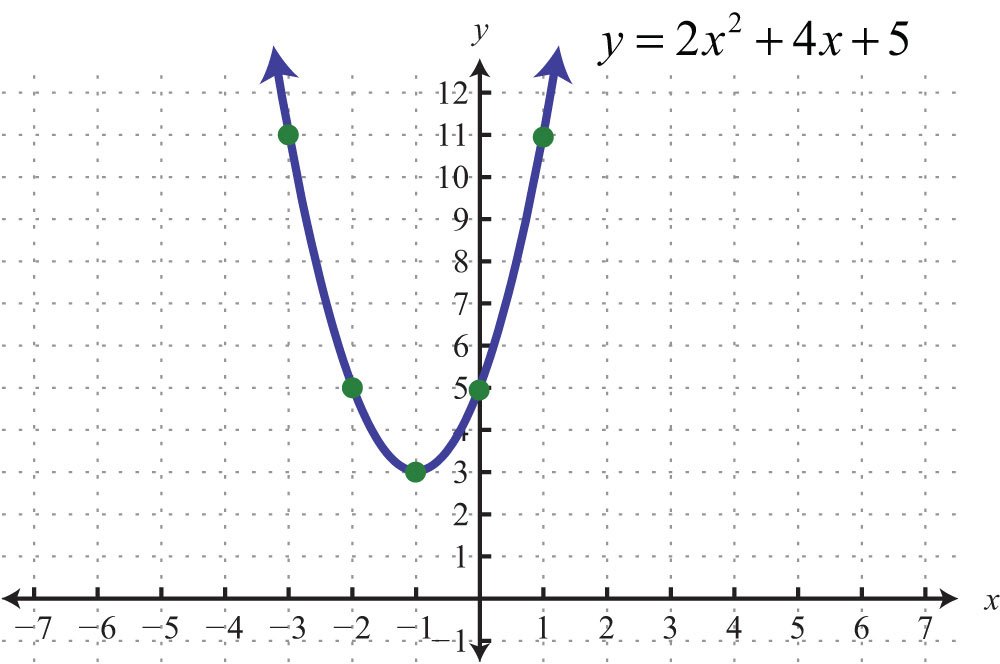
What is the vertex of this parabola?
a)
(−1, 3)
b)
(−3, 11)
c)
(−2, 5)
d)
(0, 5)
93.
What is the y-intercept of this parabola?
a)
(−1, 3)
b)
(−3, 11)
c)
(−2, 5)
d)
(0, 5)
94.
Where is the axis of symmetry for this parabola?
a)
x = −1
b)
x = 0
c)
y = 3
d)
x = −3
95.
What is the vertex?
y = -2x2 + 4x + 3
a)
(0, 3)
b)
(-1, 5)
c)
(1, 5)
d)
(1, -5)
96.
What is the axis of symmetry?
f(x) = x2 - 8x + 15.
a)
x = -4
b)
x = 4
c)
y = 4
d)
y = -4
97.
What is the axis of symmetry?
y = 3x2 - 6x + 4
a)
x=1
b)
x=-6
c)
x=2
d)
x=-1
98.
What is the vertex?
f(x) = -x2 - 4x + 12.
a)
(-2, 16)
b)
(2, 0)
c)
(2, 4)
d)
(-2, 4)
99.
What is the y-intercept?
f(x) = -2x2 + 4x - 6
a)
(0, 6)
b)
(0, -6)
c)
(6, 0)
d)
(-6, 0)