
 Worksheets
HS CHEMISTRY PRACTICE QUESTIONS III
Total questions: 26
Worksheet time: 13mins

1. Which of the examples is NOT an example of a chemical change?
(Refer to the picture for options.)
A. Calcium carbonate --> Calcium oxide + Carbon dioxide
B. Saltwater --> Water vapor + Salt
C. Magnesium + Oxygen --> Magnesium oxide
D. Water --> Hydrogen + Oxygen
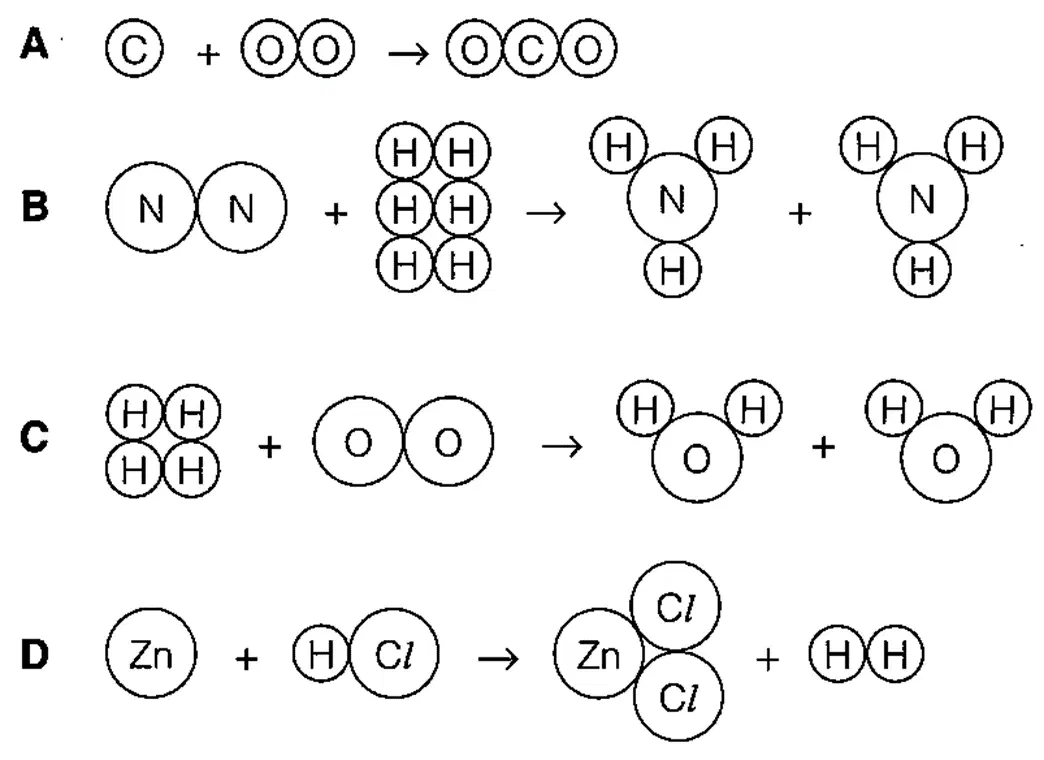
2. Which of these chemical equations is INCORRECT?
(Refer to the diagram for the options)
Option A
Option B
Option C
Option D
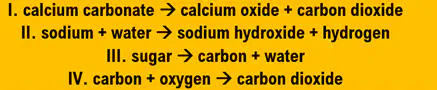
3.Which of the following equations are examples of combination reaction?
A. I and II only
B. I and III only
C. II and IV only
D. I, II and III only
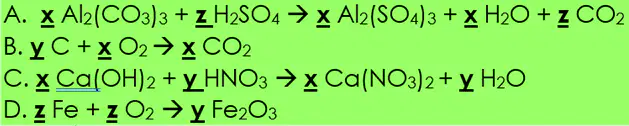
4. Which chemical equation is correctly balanced where x=1, y=2, z= 3 ?
(Refer to the diagram for option)
Option A
Option B
Option C
Option D

For number 5-7, refer to the chemical equation :
5. The skeleton equation represents a chemical reaction. Which of these are the reactants?
A. Zn and HCl
B. ZnCl2 and H2
C. HCl and ZnCl2
D. Zn and H2
For number 5-7, refer to the chemical equation :
6.The chemical reaction represented by the equation would be classified as a —
A. synthesis reaction
B. decomposition reaction
C. single-replacement reaction
D. double-replacement reaction
For number 5-7, refer to the chemical equation :
7.The skeleton equation for this chemical reaction violates the law of conservation of mass. Which of these is the correct balanced chemical equation?


8. What are the missing coefficients for the skeleton equation below?
A. 4,6,6,2
B. 2,3,2,3
C.2,3,3,2
D.1,3,3,1
9. When heated in a closed container in the presence of a catalyst, potassium chlorate decomposes into potassium chloride and oxygen gas via the following reaction:
2KClO3 (s) → 2KCl(s) + 3O2 (g)
If 12.25 g of potassium chlorate decomposes, how many grams of oxygen gas will be generated?
A. 1.60 g
B. 3.20 g
C. 4.80 g
D. 18.37 g
10. In a redox reaction, which of the following is true for the substance that is reduced?
A. It is also the reducing agent.
B. It always gains electrons.
C. It never contains oxygen
D. It must contain hydrogen.
11. Which equation shows an oxidation reaction?
A. C + O2 → CO2
B. CaCO3 → CaO + CO2
C. CaO + 2HCl → CaCl2 + H2O
D. N2O4 → 2 NO2

12. The red colour in some pottery glazes may be formed as a result of the reactions shown.
CuCO3 -->CuO + CO2
CuO + SnO --> Cu + SnO2
These equations show that ......1...... is oxidised and ......2...... is reduced.
Option A
Option B
Option C.
OptionD
13. Which substance is oxidized in the following redox reaction?
2H2S + O2 --> 2H2O + 2 S
A. H2S
B. O2
C. H2O
D. S

13. b. When chlorine gas dissolves in water a reaction occurs.
Cl2 + H2O → HCl + HClO
Which row of the table identifies the oxidation number for chlorine in the chlorine-containing species?
Option A
Option B.
Option C.
Option D.
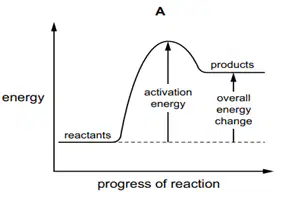
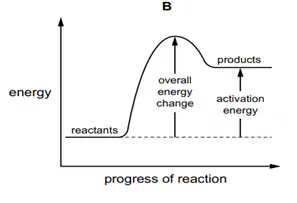
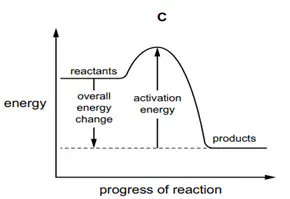
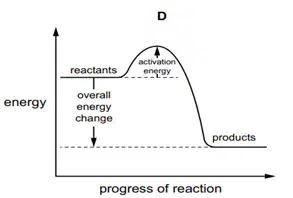
14. Which diagram is correctly labelled reaction pathway diagram for an endothermic reaction?
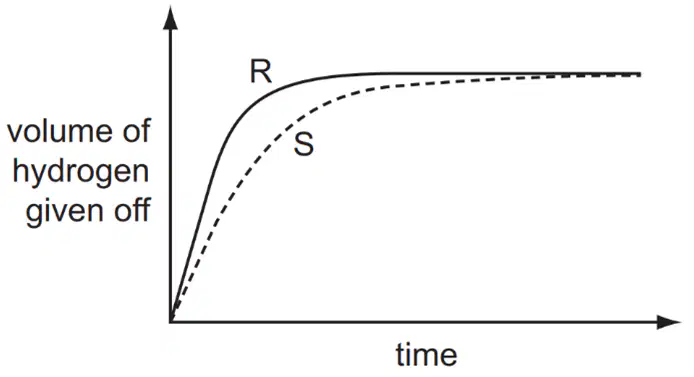
15. A student investigates the rate of reaction between magnesium and excess sulfuric acid.
The volume of hydrogen given off in the reaction is measured over time.
The graph shows the results of two experiments, R and S.
Which change in conditions would cause the difference between R and S?
A. A catalyst is added in S.
B. The acid is more concentrated in R than in S.
C. The magnesium is less finely powdered in R than in S.
D. The temperature in R is lower than in S.
16. Water is a critical component of life due to its unique structural and chemical properties.
Which of the following does NOT describe a way that the exceptional characteristics of water are used in nature to sustain life?
A. The high heat capacity of water prevents lakes and streams from rapidly changing temperature and freezing completely solid in the winter.
B. The high surface tension and cohesiveness of water facilitates capillary action in plants.
C. The low polarity of water prevents dissolution of cells and compounds.
D. The high intermolecular forces of water, such as hydrogen bonding, result in a boiling point which exceeds the tolerance of most life on the planet.

17. Both starch and protein consist of large molecules made from smaller basic units.
Which basic units form these molecules? (Refer to the table)
Option A.
Option B.
Option C.
Option D.
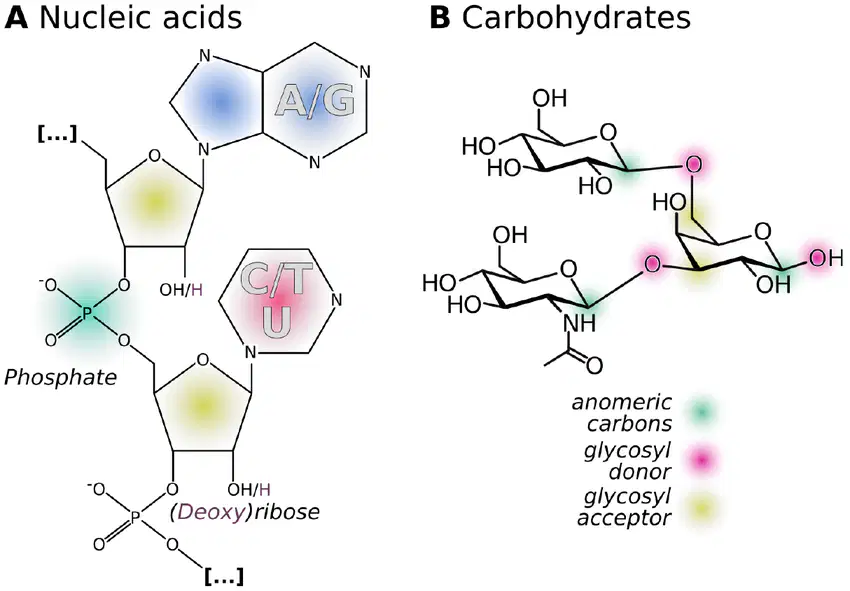
18. Which statement best compares a carbohydrate and a nucleic acid?
A. The sequence of monomers in a carbohydrate stores genetic information, and the bonds in a nucleic acid store energy.
B. The bonds in a carbohydrate store energy, and the sequence of nucleotides in a nucleic
acid stores genetic information.
C. A carbohydrate has a unique structure to assist diffusion across a plasma membrane, and a nucleic acid has a unique structure to assist chemical reactions.
D. A carbohydrate has a unique structure to assist chemical reactions, and a nucleic acid has a unique structure to assist diffusion across a plasma membrane.

19. The table shows the results of food test carried out on a fruit.
What did the fruit contain?
A. fat and reducing sugar
B, fat and starch
C. protein and starch
D. protein and reducing sugar
20. Four drops of cooking oil were added to 2 cm3 of ethanol in a clean, dry test-tube. The tube was shaken for a few seconds and 2 cm3 of water were added.
What would be observed?
A. A brick-red precipitate
B. A cloudy white emulsion
C. A clear solution
D. A pink color
21. If a molecule of DNA is composed of approximately 16.3% adenine (A) and 33.4% guanine (G), the percentages of thymine (T) and cytosine (C) must be approximately
A. 16.3% T and 16.3% C.
B. 34.1% T and 34.1% C.
C. 34.1% T and 16.3% C.
D. 16.3% T and 33.4% C.
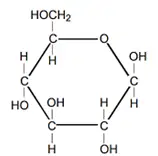
22. Use the diagram below to answer the question that follows.
The structural formula shown above is the monomer of which of the following molecules?
A. polysaccharide
B. polypeptide
C. phospholipid
D. nucleotide polymer
23. An amino acid contains which of the following functional groups?
A. Carboxyl group and amino group
C. Hydroxyl group and amino group
B. Carbonyl group and amino group
D. Carboxyl group and hydroxyl group
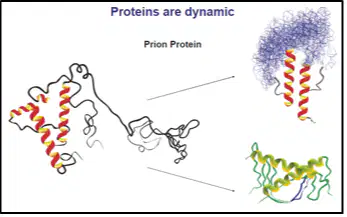
24. Stabilization of the unique coiled structure of an alpha helix in a protein is primarily attributed to:
A. hydrogen bonding between peptide backbone atoms
B. Disulfide bridges between cysteine side chains
C. carbohydrate moieties attached to polar amino acids
D. peptide linkages that covalently bond amino acids
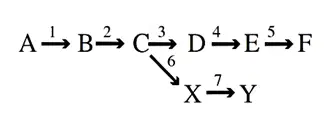
25.b Consider the following pathway of reactions catalyzed by enzymes (shown in numbers):
An increase in substance F leads to the inhibition of enzyme 3. All the following are results of the process EXCEPT:
A. an increase in substance X
B. increased activity of enzyme 6
C. decreased activity of enzyme 4
D. increased activity of enzyme 5

