
NEW
Font size
S
M
L
XL
 Worksheets
Spring Semester Test Part 1
Total questions: 50
Worksheet time: 25mins
Name
Class
Date
1.
A sense of pride and loyalty to a nation:
a)
Republican Pride
b)
Loyalist
c)
Nationalism
d)
Self-reliance
2.
As Francis Scott Key witnessed the Battle at Fort McHenry he was inspired to?
a)
Join the United States Army
b)
Join the British Navy
c)
Write the poem “Star Spangled Banner”
d)
Write the Missouri Compromise
3.
Which one was a cause of the War of 1812?
a)
The U.S. government claimed British territory
b)
The British began impressing American sailors
c)
The British navy attacked U.S. citizens living in Mexico
d)
The United States refused to allow British ships in its ports
4.
This stated the U.S. would not interfere with European nations or colonies that already existed in the Americas. It also said the Western Hemisphere was off limits to future colonization and any attempt to colonize or interfere with the nations in the Western Hemisphere would be considered a hostile act.
a)
Missouri Compromise
b)
Monroe Doctrine
c)
Convention of 1818
d)
Rush-Bagot Agreement
5.
How did the decisions in McCulloch v. Maryland and Gibbons v. Ogden cases strengthen the feelings of national unity in the United States and address taxation issues?
a)
By reinforcing the power of the federal government
b)
By agreeing with the opinion of the majority of Americans
c)
By strengthening pride in state governments
d)
By permitting all Americans to use the same currency
6.
During the 1820’s sectionalism grew in the United States. What is sectionalism?
a)
When citizens develop increased feelings of pride and devotion to their nation
b)
When politicians become divided over the interests of the regions they represent
c)
When the federal government places a group on a reservation to prevent conflict
d)
When a state breaks off from a nation and declares its independence
7.
The Missouri Compromise had a significant effect on the United States because it:
a)
Established the present border with Canada
b)
Prohibited slavery north of Missouri’s southern border
c)
Led to the expansion of roads and canals
d)
Settled conflicts between Native Americans in the West and the federal government
8.
Why did John Quincy Adams lose popular support after the election of 1824?
a)
He enacted an unpopular tax on alcohol
b)
People were opposed to the Monroe Doctrine
c)
Supporters of Jackson claimed that he made a “corrupt bargain” with Henry Clay
d)
He supported the Clay Doctrine
9.
Jacksonian Democracy led to the expansion of:
a)
Media attention to the election
b)
Nominating Conventions and expansion of voting rights
c)
A voting system based on majority rule
d)
Increased presidential candidates popularity
10.
Why was Andrew Jackson considered the popular choice for president during the Election of 1824?
a)
He was a famous writer
b)
He came from a wealthy family
c)
He understood and supported the “common man”
d)
He fought in the American Revolution
11.
Which of the following claims were made by some southern states during the Nullification Crisis in response to a growing opposition to tariffs?
a)
States should vote on policies imposed by the president
b)
States can control trade agreements with foreign nations
c)
States should use their militia to enforce unpopular legislation
d)
States can reject federal laws that they believe are unconstitutional
12.
President Andrew Jackson responded to the Worcester vs. Georgia decision by:
a)
Filling another petition against the Cherokee Nation
b)
Ordering the state officials in Georgia to negotiate with the Cherokee nation
c)
Asking Congress to pay reparations to the Cherokee Nation
d)
Ignoring the ruling and allowing Georgia to evict the Cherokee Nation
13.
Which of the following best explains why Native Americans were removed from the East to Indian Territory?
a)
The United States government wanted to create a buffer between the Eastern states and the Republic of Texas
b)
White Americans wanted the Native American lands in the East for themselves
c)
The Second Seminole War proved that white Americans and Native Americans could not live together in peace
d)
Native American wanted more land than was available in the increasingly populated Eastern states
14.
Which of the following describes why Jackson supported the Indian Removal Act?
a)
He believed that Native Americas were unable to adapt to the culture of white society
b)
He desired to protect Native American from aggressive attacks by neighboring militias
c)
He wanted to reduce the ability of Native Americans to influence political and legal matters
d)
He argued that opening Native American lands to white settlement would improve the economy
15.
Settling land all the way to the Pacific Ocean in order to spread American ideals or “manifest destiny” can be stated as?
a)
“Clear choice”
b)
“Obvious fate”
c)
“People’s future”
d)
“Humanity’s end”
16.
How did the idea of “manifest destiny” affect the slavery debate in the 1840’s and 1850’s?
a)
Manifest Destiny kept the balance of free and slave states in Congress
b)
Slavery went against the democratic values implied by the philosophy of “manifest destiny”
c)
American did not know if the institution of slavery would be allowed in the new territories
d)
Southern slaveholders thought expansion in the spirit of “manifest destiny” would cause their region to lose power
17.
What was the cause of the population explosion in California?
a)
Issuing of free land
b)
Lure of an adventure
c)
Opening territory to slavery
d)
Discovery of gold
18.
What drove the Mormon Church to move westward?
a)
To escape religious persecution
b)
To avoid the high taxes in New York
c)
The gold rush fever
d)
To help fight the Mexican-American War
19.
The Industrial Revolution and Transportation Revolution benefited from the use of Samuel Morse’s
a)
Telegraph
b)
Walkie Talkie
c)
Cell Phone
d)
Email
20.
How did slavery change as a result of the invention of the cotton gin?
a)
Decreased slavery
b)
Outlawed slavery
c)
Increased slavery
d)
No change
21.
What event prompted many states to strengthen their slave codes?
a)
Daniel Vesey’s Conspiracy
b)
Nat Turner’s Rebellion
c)
Haiti’s Revolution
d)
Gabriel’s Uprising
22.
Which escaped slave made dangerous trips back into the South to help other enslaved African Americans escape freedom using the Underground Railroad?
a)
Sojourner Truth
b)
Harriet Tubman
c)
Nathaniel Hawthorne
d)
Nat Turner
23.
Who were two of the country’s leading abolitionists in the mid 1800’s?
a)
Susan B. Anthony and Elizabeth Cady Stanton
b)
Dorthea Dix and Sarah Grimke
c)
William Lloyd Garrison and Frederick Douglass
d)
Frederick Douglass and Lucretia Mott
24.
“Religion without humanity is very poor human stuff.” - Sojourner Truth Sojourner Truth along with many others were inspired to fight for abolition and women’s rights due to:
a)
The influence of the First Great Awakening
b)
The influence of the Second Great Awakening
c)
The influence of the American Colonization Society
d)
The influence of the American Anti-Slavery Society
25.
What was the significance of the Seneca Falls Convention in 1848?
a)
It forced the government to recognize women’s rights in the U.S.
b)
It began the organized women’s rights movement in the U.S.
c)
It granted women the right to participate in the voting process in the U.S.
d)
It revealed the need for social and educational reforms in the U.S.
26.
Sojourner Truth was:
a)
an advocate for the freedom of slaves and women's rights
b)
a spokesperson for jobs for men
c)
married to John Adams
d)
An advocate for education and prison reform
27.
What was the significance of the Compromise of 1850?
a)
It illustrated that the issue of slavery was becoming less important
b)
It made the divisions between North and South more distinct
c)
It destroyed the economic benefits of the slave trade in all parts of the nation
d)
It kept the balance between free and slave states in the Union
28.
What was the impact of Uncle Tom’s Cabin by Harriet Beecher Stowe on America?
a)
It encouraged slavery in America
b)
It was non-fiction
c)
It gained sympathy for slave owners
d)
It affected slavery attitudes in both the North and the South
29.
How did the idea of popular sovereignty in the Kansas Nebraska Act lead to growing hostilities between pro-slavery and anti-slavery groups?
a)
Added to the restrictions on slavery
b)
Postponed the restrictions on slavery
c)
Removed the Missouri Compromise of 1820 restrictions on slavery
d)
Increased the amount of runaway slaves
30.
The Supreme Court’s decision in Dred Scott v. Sandford included all of the following rulings except which?
a)
The laws prohibiting slavery north of Missouri were unconstitutional
b)
Slaves were not citizens and had no right to bring claims to American courts
c)
Slaves were considered property and could not be taken from their owners
d)
Congress had the legal power to prohibit slavery in all federal territories
31.
The main attraction of Texas for many Americans in the 1820’s and the 1830’s was the:
a)
Freedom to practice the Catholic faith
b)
Availability of cheap or free land
c)
Desire to become a citizen of Mexico
d)
Mexican rebellion against Spain
32.
The first machines of the Industrial Revolution were powered by:
a)
Electricity
b)
Water
c)
Steam
d)
Coal
33.
Eli Whitney’s idea of interchangeable parts resulted in:
a)
The dominance of American manufacturing
b)
An increase in slavery
c)
A rapid expansion of railroads
d)
The mass production of goods
34.
Which statement about Harriet Beecher Stowe’s Uncle Tom’s Cabin is true?
a)
It angered many northerners because it described slavery as a positive experience for the slave
b)
It enraged many southerners because they felt it did not portray slavery accurately
c)
It convinced some northerners to support the Fugitive Slave Act
d)
It caused proslavery settlers to attack antislavery settlers in Kansas
35.
During the Lincoln/Douglas debates, Lincoln’s view of slavery was that:
a)
It was a legal issue
b)
Slavery would cause the Union to dissolve
c)
The nation could continue as half free and half slave
d)
Slavery should not expand beyond where it already existed
36.
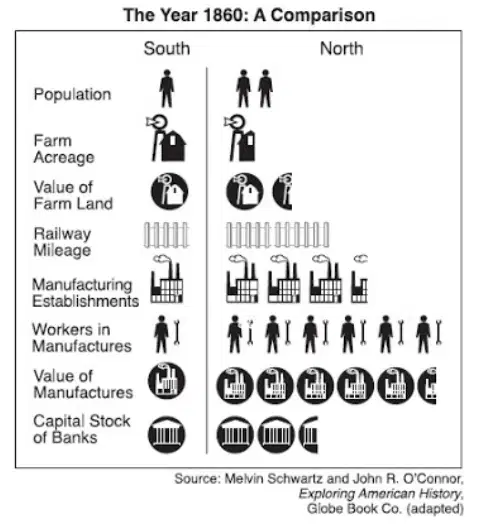
At the beginning of the Civil War, the South had an advantage over the North in: (use the chart below)
a)
Capital stock of banks
b)
Value of farmland
c)
Farm acreage
d)
Railway mileage
37.

What does the following political cartoon illustrate?
a)
The plan to destroy the South’s economy with a naval blockade of southern ports
b)
The plan to defend the South by establishing an impenetrable perimeter
c)
The plan to divide the South by seizing control of the Atlantic and Pacific coasts
d)
The plan to repel a Northern invasion using guerilla warfare tactics
38.
Which of these events marked the beginning of the Civil War?
a)
The election of Abraham Lincoln
b)
The abolition of slavery in the South
c)
The declaration of war from President Lincoln
d)
The firing of Confederate guns of Fort Sumter
39.
Lincoln waited until the Union had won a victory at Antietam to
a)
Promote General Grant
b)
Issue the Emancipation Proclamation
c)
Announce his candidacy for reelection
d)
Draft plans for reconstruction
40.
The terms of surrender at Appomattox Courthouse can be best described as:
a)
Harsh
b)
Excessive
c)
Generous
d)
Ineffective
41.
The Emancipation Proclamation was an order from Lincoln
a)
Granting slaves U.S. citizenship
b)
Requiring slaves to join Union troops
c)
Calling for all slaves in the rebelling states to be freed
d)
Ending slavery in the United States
42.

What is the main idea of Lincoln’s Second Inaugural Address?
a)
The nation has already made great progress in healing the wounds of war, but more must be done.
b)
The war was God’s punishment to the nation for perpetuating the great sin of slavery.
c)
Both sides share responsibility for the war and must work together to end it and heal from it.
d)
The South forced the nation into war and therefore bears full moral responsibility for it.
43.
What was the purpose of Lincoln’s Gettysburg Address?
a)
To dedicate a cemetery and honor those who died there
b)
To surrender to certain demands of the Confederacy
c)
To remind Americans of the reasons that the Civil War was being fought
d)
To declare the official end of the Civil War
44.
Juneteenth is the name given to which day?
a)
The day Texas was admitted back to the Union after the Civil War
b)
The day the end of slavery in the United States is celebrated
c)
The day the annual cotton harvest begins
d)
The day the Civil War ended
45.
The main purpose of the Monroe Doctrine was to:
a)
Improve relations with Britain following the War of 1812
b)
Motivate Spain to sell territory in Louisiana to the United States
c)
Prevent European expansion and colonization in North and South America
d)
Provide an opportunity for the U.S. to go to war with Mexico
46.
The purpose of the doctrine of Nullification under Andrew Jackson's presidency was…
a)
to stop the northerners from manufacturing goods.
b)
to give the president more power.
c)
to decrease the rights of the states within the national government.
d)
to give the states more power than the federal government.
47.
What did Jackson do that ended the nullification crisis?
a)
passed a higher tariff
b)
burned down every home in South Carolina
c)
fired his Vice President
d)
threatened to use Army to enforce the law
48.
Why was the Battle of the Alamo significant to the outcome of the Texas Revolution?
a)
Frontiersman Davy Crockett and Colonel Jim Bowie joined the Texan defenses.
b)
Prisoners who had surrendered at Goliad were released, adding to the Texan defenses
c)
The Texans were beaten, but Sam Houston’s forces were inspired to win the Battle of Jacinto
d)
The Texans suffered heavy losses, but the survivors overcame Antonio López de Santa Anna’s army
49.
How did the cotton gin contribute to the expansion of the plantation system?
a)
By reducing the number of slaves needed for growing cotton
b)
By increasing the time needed to cultivate cotton
c)
By increasing the demand for slavery
d)
By reducing the demand for raw cotton
50.
Which of these correctly describes an effect of the Compromise of 1850 on escaped slaves and freedmen?
a)
Members of both groups were captured under the Fugitive Slave Law.
b)
Unlike freedmen, escaped slaves were welcome in the gold mines of California.
c)
Members of both groups could be sold in Washington, D.C., slave markets.
d)
Unlike escaped slaves, freedmen could vote in the territories of the Mexican Cession.
Reset

