wayground logo

Free Printable Worksheets

Font size

S
M
L
XL
Worksheets

Science fast test prep

Total questions: 131

Worksheet time: 2hrs 57mins

Name
Class
Date
1.

independent variable

a)

Manipulated

b)

Responding

c)

Controlled

2.

Dependent variable

a)

Manipulated

b)

Responding

c)

Controlled

3.

Used to compare

a)

Manipulated

b)

Responding

c)

Controlled

4.

The flower is 8 cm tall.

a)

qualitative data

b)

quantitative data

5.

I use rulers, scales and calculators to make these observations.

a)

qualitative data

b)

quantitative data

6.

What are observations made using our five senses called?

a)

qualitative data

b)

quantitative data

7.

The center of the flower is yellow and fuzzy.

a)

qualitative data

b)

quantitative data

8.

The flower has 25 petals.

a)

qualtitative data

b)

quantitative data

9.

The bearded iris smells sweet.

a)

qualitative data

b)

quantitative data

10.

The bug was 5cm long.

a)

Qualitative

b)

Quantitative

11.

The clouds are grey and ground is wet.

a)

qualitative

b)

quantitative

12.

The candy was sour.

a)

Qualitative

b)

Quantitative

13.
My cat is twelve years old.
a)
Qualitative data
b)
Quantitative data
14.
I caught a fifteen foot shark.
a)
Qualitative data
b)
Quantitative data
15.
The plant has purple flowers on it.
a)
Qualitative data
b)
Quantitative data
16.

It makes a loud crackling sound.

a)

Qualitative

b)

Quantitative

17.
Which observation is quantitative?
a)
It is 5 cm long
b)
It is smooth
c)
It looks red
d)
It is dry
18.
Dolphins have smooth skin.
a)
quantitative observation
b)
qualitative observation
19.
Dolphins eat the equivalent of 4% of their body mass each day.
a)
quantitative observation
b)
qualitative observation
20.
There are nine dolphins in a pod.
a)
quantitative observation
b)
qualitative observation
21.
Your teacher has asked you to explain the difference between quantitative and qualitative observations. Which statement is correct?
a)
Quantitative observations use numbers, qualitative uses the senses.
b)
Quantitative observations use the senses, qualitative uses numbers.
c)
Quantitative observations use measurement, qualitative uses numbers.
d)
Quantitative observations use colors, qualitative uses the senses.
22.
This form of data would be considered ______
a)
Quantitative
b)
Qualitative
23.

The mass of the chocolate cake is 250 g.

a)

qualitative

b)

quantitative

24.
What tool would you use to check the temperature of the water?
a)
ruler
b)
microscope
c)
thermometer
d)
ruler
25.
When might you use a meter stick?
a)
to measure a caterpillar
b)
to find how much a gummy bear weighs
c)
to find the length of a wall
d)
to closely examine a butterfly wing
26.
What tool is used to measure the volume of a liquid?
a)
thermometer
b)
hand lens
c)
graduated cylinder
d)
ruler
27.
Name the tool.
a)
spring scale
b)
hand lens
c)
graduated cylinder
d)
ruler
28.
Name the tool.
a)
hand lens
b)
graduated cylinder
c)
meter stick
d)
balance
29.
Name the tool.
a)
spring scale
b)
graduated cylinder
c)
hand lens
d)
ruler
30.

This tool helps to measure very small amounts of liquid for exact measurements.

a)

magnifying glass

b)

dropper

c)

bucket

31.
A Microscope is a 
a)
tool to help you see objects that are far away
b)
tool to make objects appear much larger
c)
tool to help you weigh an object
d)
tool to protect your eyes
32.
A magnet will pick up
a)
a penny
b)
a rubber band
c)
a paper clip
d)
a pizza
33.

Which of the following is a test tube?

a)
b)
c)
d)
34.
Measures length and distance
a)
Computer
b)
Balance
c)
Thermometer
d)
Metric Ruler
35.
Measures Mass
a)
Thermometer
b)
Balance
c)
Telescope
d)
Hand Lens
36.
Protect eyes while doing an experiment
a)
Goggles
b)
Microscope
c)
Balance
d)
Hans Lens
37.

What is this science tool?

a)

jar

b)

beaker

c)

thermometer

d)

ruler

38.

What is this tool used for?

a)

looking at objects in space

b)

viewing germs and bacteria

c)

views bugs and other small objects

39.

What are variables?

a)

an educated guess

b)

things you notice around you

c)

things you change during an experiment

40.

What is the name of this tool and what is it used for?

a)

clock, to measure mass

b)

stopwatch, to measure distance

c)

clock, to measure volume

d)

stopwatch, to measure time

41.
Which planet is the hottest?
a)
Earth
b)
Neptune
c)
Mercury
d)
Venus
42.
Which planet is closest to the sun?
a)
Uranus
b)
Mercury
c)
Neptune
d)
Earth
43.
What holds the planets in their orbits around the sun?
a)
gravity
b)
speed
c)
string
d)
air currents
44.

Where is the Asteroid Belt located in the Solar System?

a)

near Neptune

b)

between Mercury and Venus

c)

between Mars and Jupiter

d)

around the Sun

45.
A ball of ice and dust with a tail of gas and dust pointing away from the sun.
a)
Asteroid
b)
Comet
c)
Moon
d)
Meteor
46.
The inner planets are called terrestrial planets because they are composed of
a)
water
b)
gas
c)
frozen surfaces
d)
rocks
47.
Which planet is tipped on its side nearly 90 degrees?
a)
Jupiter
b)
Saturn
c)
Uranus
d)
Neptune
48.

Which of these has the strongest gravitational field?

a)

sun

b)

earth

c)

saturn

d)

jupiter

49.
The middle layer of the sun's interior that contains very tightly packed gas is called the _____________.
a)
photosphere
b)
chromosphere
c)
radiation zone
d)
convection zone
50.
What is the water cycle?
a)
the 3 forms of water
b)
the movement of water on, above, or below the surface of the Earth
c)
when water melts
d)
when clouds form
51.
What is the energy source for the water cycle?
a)
the sun
b)
the earth
c)
water
d)
the moon
52.
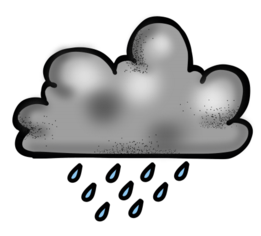
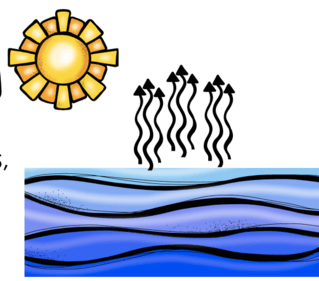
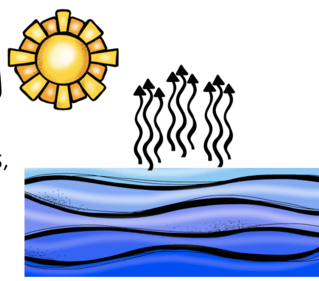
What part of the water cycle does this picture show?
a)
condensation
b)
precipitation
c)
evaporation
53.
What part of the water cycle does this picture show?
a)
condensation
b)
precipitation
c)
evaporation
54.
What part of the water cycle does this picture show?
a)
condensation
b)
precipitation
c)
evaporation
55.
What is evaporation?
a)
The part of the water cycle when the sun heats up water, turning it from a liquid into water vapor or steam. It rises from the ground into the air.
b)
The part of the water cycle when the water vapor in the air gets cold. The water turns back into a liquid and forms clouds.
c)
The part of the water cycle when clouds get heavy and can no longer hold the liquid water. This causes the water to fall from the sky to the earth as rain, snow, sleet, or hail.
56.
What is condensation?
a)
The part of the water cycle when the sun heats up water, turning it from a liquid into water vapor or steam. It rises from the ground into the air.
b)
The part of the water cycle when the water vapor in the air gets cold. The water turns back into a liquid and forms clouds.
c)
The part of the water cycle when clouds get heavy and can no longer hold the liquid water. This causes the water to fall from the sky to the earth as rain, snow, sleet, or hail.
57.
What is precipitation?
a)
The part of the water cycle when the sun heats up water, turning it from a liquid into water vapor or steam. It rises from the ground into the air.
b)
The part of the water cycle when the water vapor in the air gets cold. The water turns back into a liquid and forms clouds.
c)
The part of the water cycle when clouds get heavy and can no longer hold the liquid water. This causes the water to fall from the sky to the earth as rain, snow, sleet, or hail.
58.
When water condenses, the water vapor in the air gets ___________ and changes back into liquid.
a)
cold
b)
hot
c)
warm
d)
solid
59.
When water condenses, the liquid water forms ______________.
a)
water vapor
b)
steam
c)
air
d)
clouds
60.
Precipitation happens when clouds of water droplets are too ______________.
a)
cold
b)
light
c)
heavy
d)
hot
61.
Evaporation happens when the sun ___________ water and turns it into vapor.
a)
cools
b)
heats up
c)
freezes
d)
lights up
62.
Which of these is not an example of precipitation?
a)
rain
b)
clouds
c)
sleet
d)
snow
63.
Which of these is an example of precipitation?
a)
snow
b)
air
c)
clouds
d)
vapor
64.
Does evaporation happen before or after condensation?
a)
before
b)
after
c)
during
65.
Does precipitation happen before or after condensation?
a)
before
b)
after
c)
during
66.

Weather ____________ every day.

a)

changes

b)

is the same

67.

Weather in any area tends to follow a ____________.

a)

pattern

b)

map

68.

_______________ is the average weather pattern of a region over time.

a)

Climate

b)

Maps

69.

Climate ___________ from weather.

a)

is the same

b)

differs

70.

Average temperature and average rainfall, in addition to other weather information, are important parts of _____________.

a)

climate

b)

changes

71.

The United States can also be divided into many specific local climate ____________.

a)

patterns

b)

zones

72.

Climate is closely related to latitude, which is a location's distance north or south of the ________________.

a)

equator

b)

north pole

73.

Because Earth is shaped like a sphere, areas closer to the equator receive _________ direct energy from the sun than do areas farther from the equator.

a)

more

b)

less

74.

A ___________ is the constant movement of ocean water.

a)

current

b)

pool

75.

Ocean currents moderate worldwide ________________ throughout the year.

a)

zones

b)

temperatures

76.

Several factors affect ____________ in different places on Earth.

a)

climate

b)

clouds

77.

Being near an __________ or other large body of water affects climate.

a)

pond

b)

ocean

78.

How high in the atmosphere a place is affects its climate. This is called __________________.

a)

elevation

b)

distance

79.

Mountains can also affect how wet a climate is. Air cools and loses _________________ as it moves up and over a mountain.

a)

moisture

b)

heat

80.

How are rocks sorted?

a)

by their size

b)

by how they are formed

c)

by their color

d)

by their shape

81.

What type of rock forms from the cooling of magma or lava?

a)

igneous

b)

metamorphic

c)

sedimentary

82.

What type of rock forms from sediment that settles to form layers?

a)

igneous

b)

metamorphic

c)

sedimentary

83.

What type of sedimentary rock forms from ribbons of different sand?

a)

limestone

b)

conglomerate

c)

sandstone

84.

What type of sedimentary rock forms from bones and shells of sea creatures?

a)

limestone

b)

conglomerate

c)

sandstone

85.

What type of sedimentary rock is made of chunks of rock glued together by other rock?

a)

limestone

b)

conglomerate

c)

sandstone

86.

What type of rockis formed by heat and pressure?

a)

igneous

b)

metamorphic

c)

sedimentary

87.

Which of the following statements is true about the rock cycle?

a)

Sedimentary rock can be changed only to metamorphic rock

b)

Any rock can be changed into any other type of rock

c)

Igneous rock can be changed to only sedimentary rock

88.

Which type of rock is most likely to form at plate boundaries?

a)

sedimentary

b)

metamorphic

c)

igneous

89.

Which type of rock usually forms near places where sediment builds up?

a)

sedimentary

b)

metamorphic

c)

igneous

90.

solar

a)

renewable

b)

non-renewable

91.

oil

a)

renewable

b)

non-renewable

92.

water

a)

renewable

b)

non-renewable

93.

iron

a)

renewable

b)

non-renewable

94.

sheep

a)

renewable

b)

non-renewable

95.

steam

a)

renewable

b)

non-renewable

96.

bricks

a)

renewable

b)

non-renewable

97.

rocks

a)

renewable

b)

non-renewable

98.

wind

a)

renewable

b)

non-renewable

99.

coal

a)

renewable

b)

non-renewable

100.

wood

a)

renewable

b)

non-renewable

101.

natural gas

a)

renewable

b)

non-renewable

102.

renewable resource

a)

can be replaced

b)

limited amounts

c)

is being used up too quickly

103.

non-renewable resource

a)

can be replaced

b)

limited amounts

c)

there is plenty of

104.
Which of these best completes the circuit?
a)
rubber band
b)
metal nail
c)
leather shoelace
d)
wooden toothpick
105.
A fifth grade class constructed this circuit.  Which of these objects most likely made the light glow when connected to points X and Y?
a)
plastic straw
b)
cotton string
c)
aluminum foil
d)
rubber eraser
106.
The electrician in this picture is wearing rubber gloves for protection.  The purpose of the rubber gloves is to --
a)
keep the electrician dry
b)
create an electrical circuit
c)
produce electricity
d)
protect the electrician
107.
Which of these substances conducts electricity the best?
a)
wood
b)
brick
c)
copper
d)
plastic
108.
What material would be safest to use as an insulator to cover electrical wires?
a)
rubber
b)
tin
c)
aluminum
d)
water
109.
This image represents what type of circuit?
a)
open
b)
closed
c)
series
d)
parallel
110.
Will the light bulb in this circuit light and why/why not?
a)
yes, because it has two batteries
b)
no, because the switch is open
c)
yes, because it is in a circuit
d)
no, because the bulb is burned out
111.
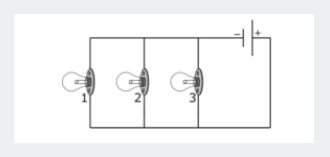
What type of circuit is represented by the diagram?
a)
closed
b)
series
c)
open
d)
parallel
112.
If bulb 1 burns out, what will occur?
a)
bulbs 2 and 3 will go out
b)
bulbs 2 and 3 receive more volts
c)
bulbs 2 and 3 will stay lit
d)
nothing will happen
113.

A student builds a circuit made up of a battery, two light bulbs, and a switch. What will the student most likely observe in this circuit?

a)

Light bulb 1 and light bulb 2 will both be on

b)

Light bulb 1 will be off, but light bulb 2 will be on

c)

Light bulb 1 and light bulb 2 will both be off

d)

Light bulb 1 will be on, but light bulb 2 will be off

114.

The diagram shows a series circuit with three lit bulbs. How many of the bulbs will remain lit if the wire is cut a the point shown by the arrow?

a)

0

b)

1

c)

2

d)

3

115.

A group of students built the circuit shown above. The lightbulb does not glow. Which statement explains this observation?

a)

The battery is not charged

b)

The lightbulb is not part of a complete circuit

c)

The circuit does not have a switch

d)

The bell uses most of the energy from the battery

116.

Students constructed a circuit using different-colored lightbulbs. What will happen if Switch 3 is closed and the other switches are left open?

a)

Only the white bulb will operate

b)

None of the bulbs will operate

c)

Only the white and yellow bulbs will operate

d)

Only the red and blue bulbs will operate

117.

The diagram shows an electric circuit with four bells that a student plans to build. When the student connects the wire as shown, which of the bells will ring?

a)

Bell 1 only

b)

Bells 1 and 4 only

c)

Bells 3 and 4 only

d)

Bells 1, 2, 3, and 4

118.
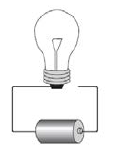
Is the following photo of an open circuit or closed circuit? 
a)
A closed circuit which allows electricity to flow
b)
An open circuit which does not allow electricity to flow
119.
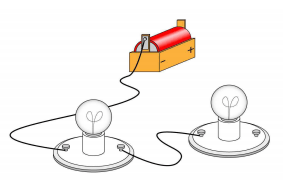
Why won’t the light bulb in the circuit pictured to the right light up?
a)
The wires from the second light bulb are not connected to the battery
b)
The wires are not connected between the light bulbs 
c)
The wires are not connected to both sides of the first light bulb
d)
The wires are too long to complete the circuit 
120.
What kind of circuit is this?
a)
series
b)
parallel
121.
What is a Parallel circuit? 
a)
Has only one path 
b)
Has more than one path 
c)
Allows energy to travel through easily 
d)
Has only one light bulb
122.
What do plants use to absorb water from the ground?
a)
stems
b)
roots
c)
leaves
d)
flower petals
123.
True or false... Plants are living things. 
a)
true
b)
false
124.
What carries water from the roots to the leaves?
a)
leaves
b)
stem
c)
seeds
d)
flower
125.
Which part of the plant holds it in the soil?
a)
stem
b)
leaves
c)
seeds
d)
roots
126.
What does the stem of the plant do?
a)
It makes food for the plant
b)
It soaks up the water from the ground
c)
It delivers water to the other parts of the plant
d)
It makes seed
127.
What do the leaves of a plant do?
a)
They make the food for the plant.
b)
They soak up the water from the ground.
c)
They deliver water to the other parts of the plants
d)
They make seeds
128.
Why do plants make and spread seeds?
a)
to create food for animals
b)
to drink up the nutrients
c)
to make more plants
d)
to make food
129.
Vegetables that are roots grow above ground
a)
true
b)
false
130.

Which part of a plant is this?

a)

leaf

b)

root

c)

stem

d)

flower

131.

TRUE or FALSE. Roots help a plant take in water and nutrients from the soil.

a)

TRUE

b)

FALSE