
 Worksheets
American Revolution - American Government
Total questions: 22
Worksheet time: 2hrs 50mins
Common good is when __________.
people think about what is best for everyone
one group makes the rules
What does it mean when the President "vetoes" a bill?
He/she protests it
He/she refuses to approve it
He/she refuses to obey it
If you were a colonist, why would you have been upset about the Quartering (as in quarters you might stay in) Act?
It would've made all of your Colonial money worthless
It would've prevented you from being represented in Parliament
It forced you to let British soldiers live in your house
If you were boycotting British tea, what would you be doing?
Tarring and feathering British tea merchants
Dumping British tea into Boston Harbor
Refusing to buy British tea
Paying high prices for British tea
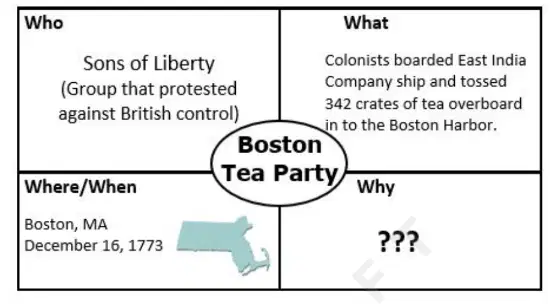
What was a major cause for the Boston Tea Party?
To protest the lack of time given to tea during the work day.
To protest Britain's new tea tax and demonstrate against "taxation without
representation".
To protest the lack of parties in the colonies during the American Revolution.
The 13 colonies declared their independence from who?
Great Britain
Spain
Africa
What was a leading cause of the American Revolution?
taxes without representation
taxes on food
slavery
How could the British government have prevented the American Revolution?
By forcing King George III to give up the throne
By allowing colonists to elect representatives to Parliament
By overruling the decisions of the colonial legislatures
By increasing taxes on the colonists

Which of the following best completes the reasons for the founding fathers writing the Declaration of Independence?
They wanted to formally declare a separation from Great Britain.
They wanted to remove British troops from the homes of colonial families.
They wanted to compromise on the amount of taxes colonists paid the King.

The Declaration of Independence says that because the king had taken natural rights away, the people should –
move to a country with a different government
create a government that guarantees life, liberty, and the pursuit of happiness

Who was the primary (main) author of the Declaration of Independence?
John Hancock
Thomas Jefferson
John Adams

What contributions did Founding Father, James Madison, have on the development of our nation?
He was known as the "Father of the Constitution" because he helped write the Constitution and framework for our government.
He was an anti-federalist who refused to sign the Constitution because he thought it gave the federal government too much power.

One purpose of the U.S. Constitution described in its Preamble is to "establish justice." What does "establish justice" mean?
to join the colonies together
define and protect the rule of law
limiting a presidential term of office
The document that protects individual rights in the United States is called:
the Emancipation Proclamation
the Charter of Privileges
the Bill of Rights

The Bill of Rights is an important addition to the U.S. Constitution because it ―
includes individual rights that are protected by law.
outlines the requirements for becoming President of the United States.
lists the grievances the American colonists had against the British king.
How many Bill of Rights are there ?
10
13
20

Roger Sherman suggested a two-house system as a solution to the heated debate between larger and smaller states over their representation. How did this Great Compromise solve the conflict?
States get equal representation in the Senate and representation based on population in the House
All states send representatives based on their population.
Some states would be represented in the house and some in the Senate.

According to the chart above, what is a responsibility of the Legislative Branch?
make laws and can override a Presidential veto
declare laws unconstitutional to protect the rights of citizens
negotiate treaties with other nations

How do the three branches of the U.S. government operate in the system of checks and balances?
Each branch of government pays taxes to the other.
Each branch of government checks on the others as they perform their duties.
The Judicial branch is the only branch that is balanced.

What power does the executive branch have over the judicial branch?
The power to ignore court decisions
The power to appoint judges
The power to write and interpret laws

Which of the following is a power given to the national government, but not the state governments?
printing money
establishing public schools
borrowing money
collecting taxes
Three natural rights that cannot be taken away are:
life, liberty, and the pursuit of happiness
truth, justice, and equality
common good, honesty, and freedom
freedom, liberty, and equality

