
 Worksheets
Quiz Magnetism and Electromagnetism
Total questions: 31
Worksheet time: 16mins
Name
Class
Date
1.
Name
4 lines
2.
Grade
a)
9A
b)
9B
c)
9C
d)
9D
3.
Email
4 lines
4.
which statement describes a property of a magnet?
a)
A It attract to ferrous materials
b)
B It could have only one pole (North or Souh)
c)
C It points in a random direction when suspended
d)
D it repel non-ferrous materials
5.
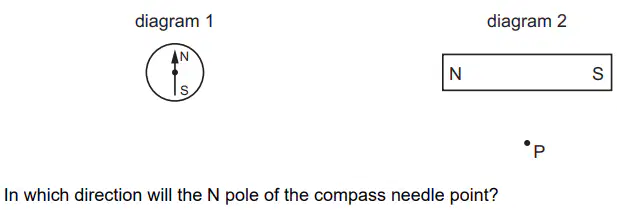
Diagram 1 shows a small compass needle with its poles marked. It is not near any magnetic materials. Diagram 2 shows a bar magnet with its poles marked. The compass needle is placed at point P.
a)
to the left
b)
to the right
c)
down the page
d)
up the page
6.
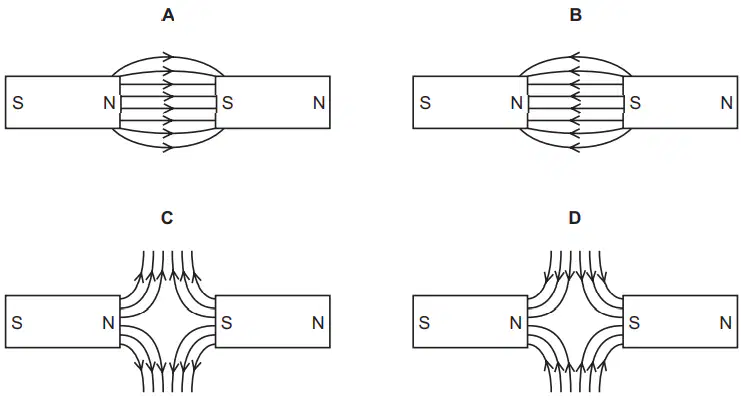
The diagrams show two bar magnets which are attracting each other. Which diagram shows the magnetic field pattern between the poles?
a)
A
b)
B
c)
C
d)
D
7.
Which diagram shows the pattern and direction of the magnetic field lines around a bar magnet?
a)
A
b)
B
c)
C
d)
D
8.
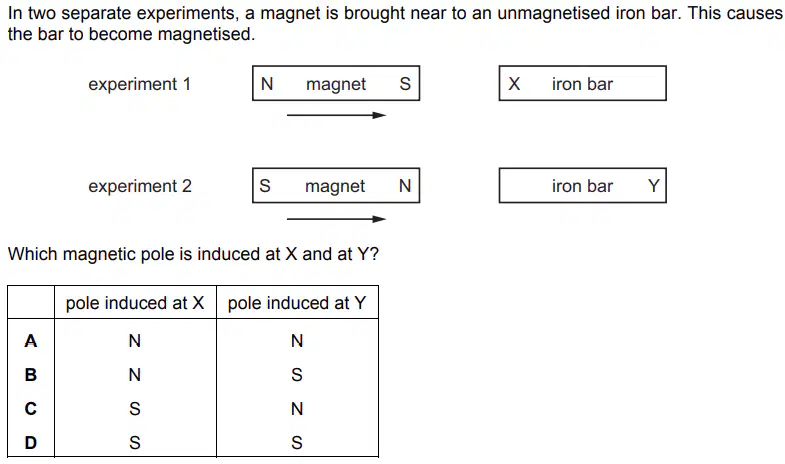
a)
A
b)
B
c)
C
d)
D
9.
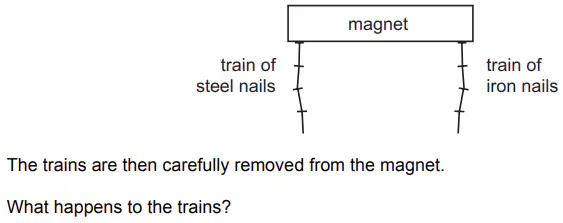
A train of steel nails and a train of iron nails hang from a strong magnet.
a)
A Both trains fall apart.
b)
B Both trains stay together.
c)
C Only the train of iron nails falls apart.
d)
D Only the train of steel nails falls apart.
10.
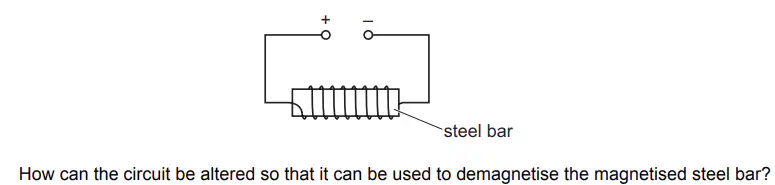
The circuit shows one method of magnetising a steel bar.
a)
remove the steel bar from the coil whilst the current is switched on
b)
replace the d.c. supply with an a.c. supply and gradually reduce the supply voltage to zero
c)
reverse the polarity of the d.c. supply
d)
reverse the polarity of the d.c. supply and gradually reduce the supply voltage to zero
11.
How can a permanent magnet be demagnetised?
a)
A Cool the magnet for a long time.
b)
B Place it next to another magnet.
c)
C Slowly pull it out of a coil connected to an a.c. supply.
d)
D Slowly pull it out of a coil connected to a d.c. supply.
12.
How can a permanent magnet be demagnetised?
a)
A Cool the magnet for a long time.
b)
B Place it next to another magnet.
c)
C Slowly pull it out of a coil connected to an a.c. supply.
d)
D Slowly pull it out of a coil connected to a d.c. supply.
13.
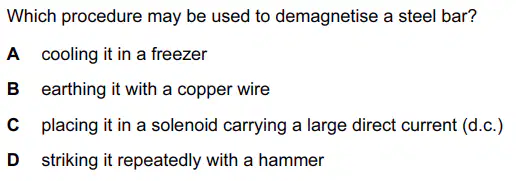
a)
A
b)
B
c)
C
d)
D
14.
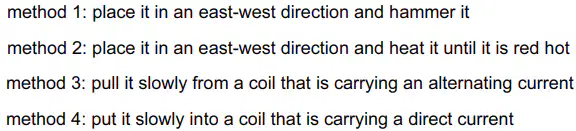
Which methods could be used to demagnetise a magnet?
a)
A methods 1, 2 and 3
b)
B methods 2, 3 and 4
c)
C methods 1 and 2 only
d)
D methods 3 and 4 only
15.
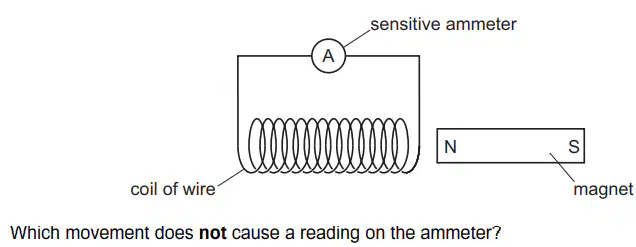
A student investigates electromagnetic induction. She has a bar magnet and a coil of wire that is connected to a sensitive ammeter.
a)
A moving the coil to the right
b)
B moving both the magnet and the coil to the left at the same speed
c)
C moving both the magnet and the coil towards each other at the same speed
d)
D moving the magnet to the left
16.
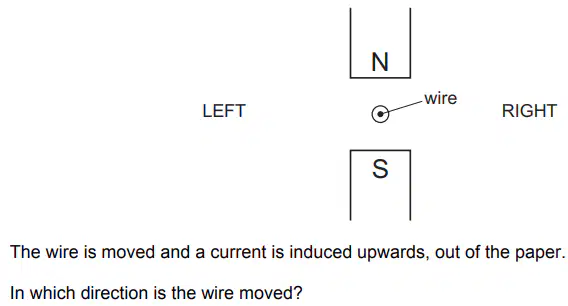
The diagram shows a wire between the poles of a magnet. The wire is perpendicular to the page.
a)
Left to right
b)
right to left
c)
up the page
d)
down the page
17.
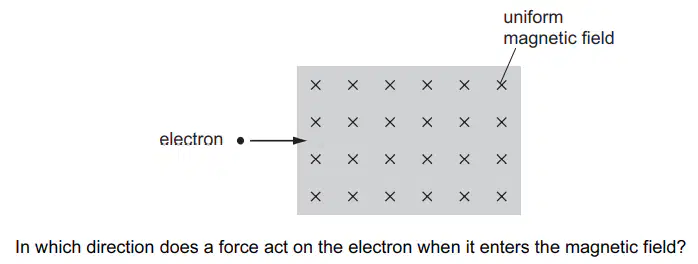
An electron moves into a uniform magnetic field. The arrow shows the initial direction of motion of the electron. The direction of the magnetic field is into the plane of the page (away from you).
a)
A into the page
b)
B out of the page
c)
C towards the bottom of the page
d)
D towards the top of the page
18.
Which diagram represents the voltage output of a simple a.c. generator?
a)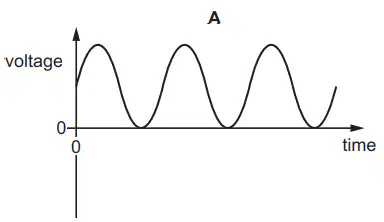
A
b)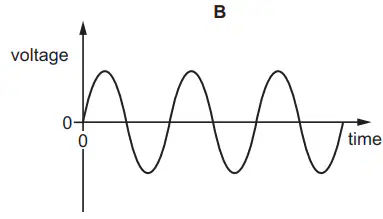
B
c)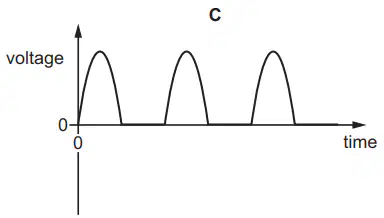
C
d)![]()
D
19.
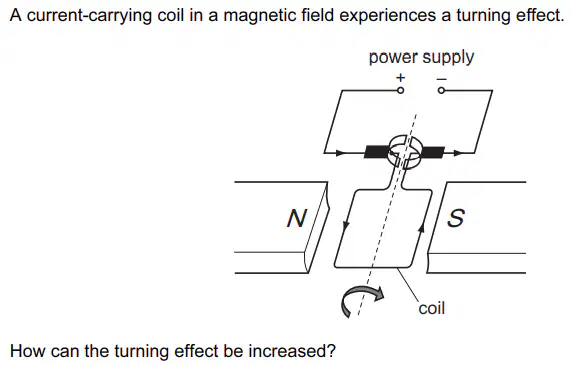
a)
A Increase the number of turns on the coil.
b)
B Reduce the size of the current.
c)
C Reverse the direction of the magnetic field.
d)
D Use thinner wire for the coil.
20.
Which transformer can change a 240V a.c. input into a 15V a.c. output?
a)
A
b)
B
c)
C
d)
D
21.
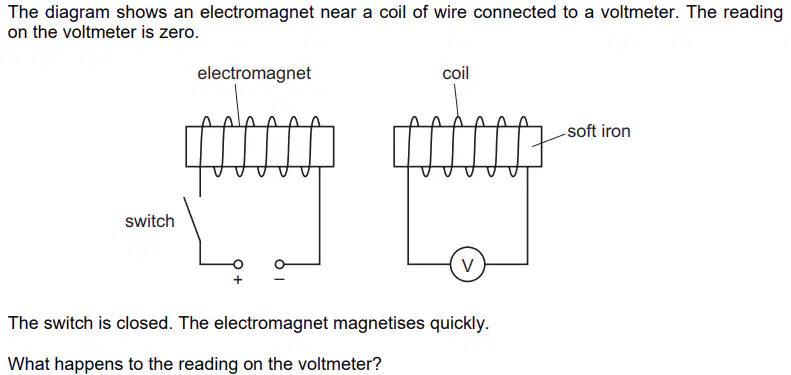
a)
It keeps increasing.
b)
It quickly increases and stays at maximum.
c)
dcx
d)
It stays on zero.
22.
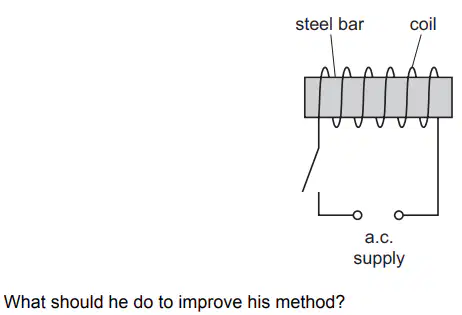
A student wants to demagnetise a steel bar. He uses the apparatus shown. He switches on the circuit for a few seconds and then switches off. He finds that the steel bar is still magnetised.
a)
change the supply from an alternating to a direct voltage
b)
use a lower alternating voltage
c)
remove the steel bar from the coil whilst the circuit is switched on
d)
use a coil that has fewer turns on it
23.
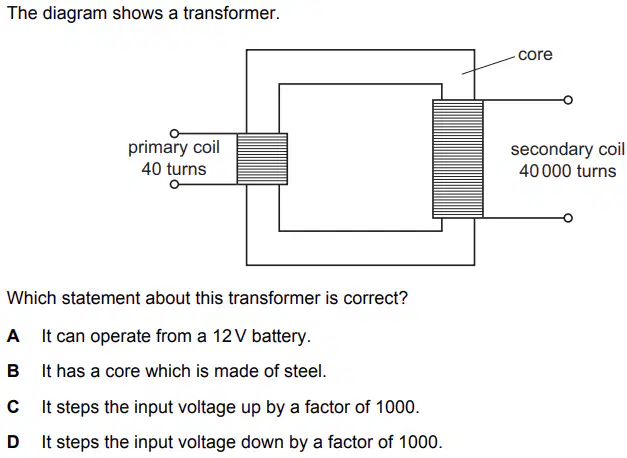
a)
A
b)
B
c)
C
d)
D
24.
A 100% efficient transformer converts a 240V input voltage to a 12V output voltage. The output power of the transformer can be a maximum of 20W. The output is connected to two 0.30A bulbs in parallel. One of the bulbs fails. How does the current in the primary coil change?
a)
It decreases by 0.30A.
b)
It decreases by 0.015A.
c)
It increases by 0.15A.
d)
It remains unchanged.
25.
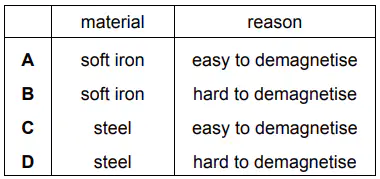
A permanent magnet is to be made. Which row gives the correct material to use and the correct reason for choosing this material?
a)
A
b)
B
c)
C
d)
D
26.
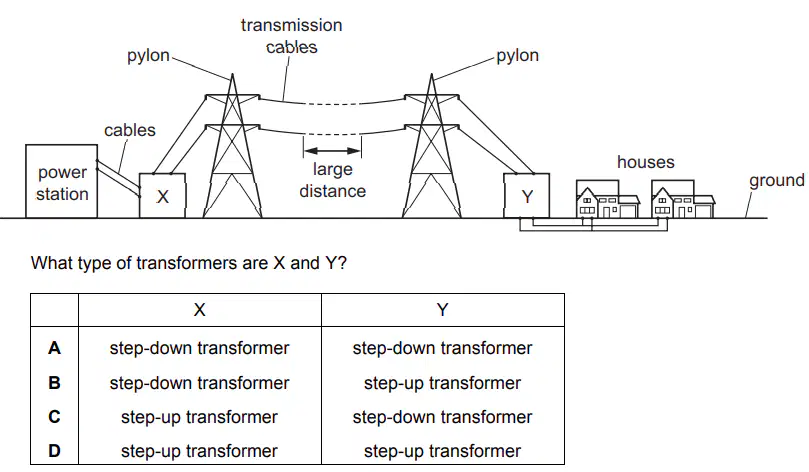
The diagram represents the transmission of electricity from a power station to homes that are many kilometres away. Two transformers are labelled X and Y.
a)
A
b)
B
c)
C
d)
D
27.
A transformer has 200 turns on its primary coil and is connected to a 240V a.c. supply. The output voltage of the transformer is 60V a.c.. How many turns are on the secondary coil of the transformer?
a)
A 20
b)
B 50
c)
C 72
d)
D 800
28.
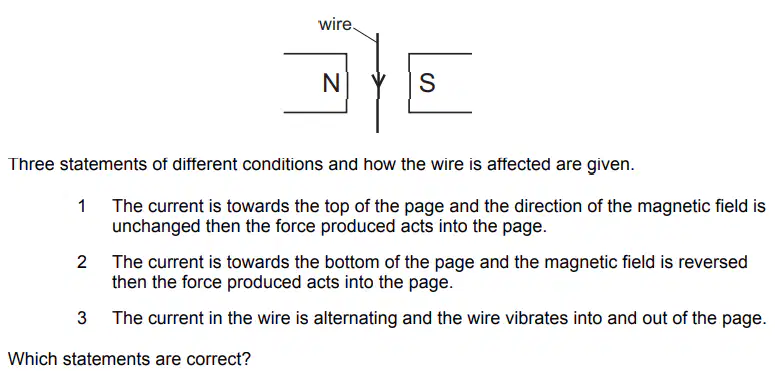
A conducting wire is placed between the poles of a magnet. When an electric current in the wire is in the direction shown, then the force on the wire acts out of the page.
a)
A 1 and 2 only
b)
B 1 and 3 only
c)
C 2 and 3 only
d)
D 1, 2 and 3
29.
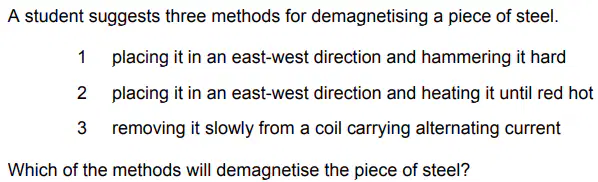
a)
A 1 only
b)
B 2 only
c)
C 3 only
d)
D 1, 2 and 3
30.
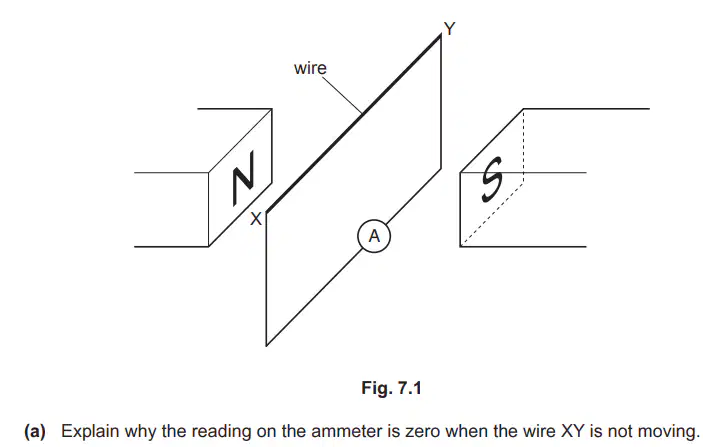
Fig. 7.1 shows a horizontal conducting wire XY between two opposite magnetic poles. Wire XY forms a circuit with an ammeter.
4 lines
31.
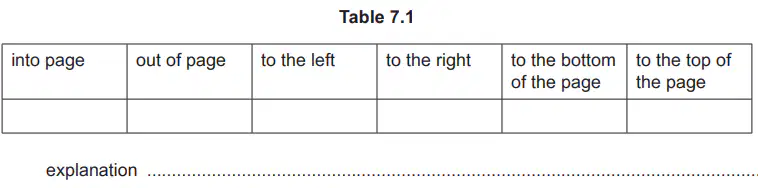
7(b) fig 7.1. The wire XY is moved and there is a deflection on the ammeter that indicates there is a current in the wire from X to Y. On Table 7.1, tick one box to indicate the direction of the movement of the wire XY and explain your answer.
4 lines
100 %

