
NEW
Font size
 Worksheets
Our solar system
Total questions: 20
Worksheet time: 10mins
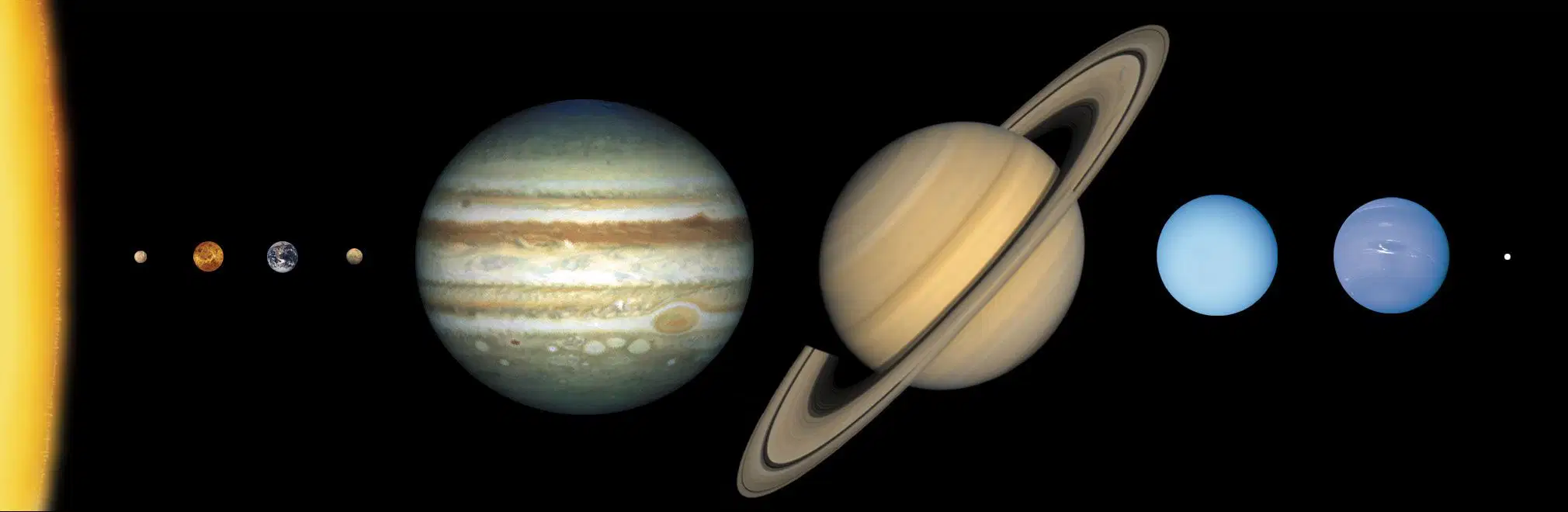
Whats the correct order of the planets in our solar system?
Neptune, venus,mars,earth,
Saturn, jupiter, uranus, mecury
Mercury, Venus, Earth, Mars, Jupiter, Saturn, Uranus, and Neptune
Mars,
jupiter,saturn,uranus,neptune,
mercury,venus earth
Football,soccer,
hockey,baseball,
basketball,

About how much of Earth's atmosphere is oxygen?
20%
40%
60%
80%
Which planet has extreme temperatures because it has no atmosphere?
Earth
Jupiter
Saturn
Mercury
A student is looking at a model of the solar system noted there is a belt of objects in orbit in between Mars and Jupiter. What are these orbiting objects?
Comets
Moons
Asteroids
Pluto
Which is the eighth planet from the Sun and orbits the Sun once every 164.8 years and is blue in color?
Neptune
Jupiter
Saturn
Mars
Which of the following is ordered from largest to smallest?
Universe -> Galaxy -> Solar System -> Planet
Planet -> Galaxy -> Solar System -> Universe
Planet -> Solar System -> Galaxy -> Universe D.) Universe
Universe -> Solar System -> Galaxy -> Planet
What do Mercury, Venus, Earth, and Mars all have in common?
They are all very cold planets.
They are considered terrestrial planets, that is rocky or have metals with hard surface.
They are about the same size.
They are considered gas giants
Which contributes to Earth’s ability to sustain life?
The atmosphere allows all of the sun’s radiation to enter due to Earth’s distance from the sun.
The atmosphere prevents all space debris from reaching the surface due to the ozone layer.
The atmosphere is extremely thin due to the temperatures of the sun.
The atmosphere is breathable due to the unique mixture of gases.

Which is the smallest celestial body in our Solar System?
meteoroid
planet
dwarf planet
asteroid
Which planet has the most extensive ring structure, the second largest in solar system, has at least 31 moons (the largest being Titan), and has thick outer rings of hydrogen, helium, ammonia, methane, and water vapor?
Jupiter
Neptune
Saturn
Pluto

Which is true about Mercury, Venus, Earth, and Mars
they all have an atmosphere
they all have many moons
they all have rings made of rocks and ice
they all have a rocky surface
Which planet is home to the tallest mountain , has the largest dust storms in the solar system and is also known as the 'Red Planet' because of the presence of iron oxide in it's rock.
Earth
Venus
Jupiter
Mars
Which property makes Earth unique compared to other planets in the solar system?
It orbits the Sun.
It is a rocky planet
It has liquid water
It rotates on its axis.
What planet has a very hot surface and is most like Earth in size?
Venus
Mercury
Mars
Uranus
Where is the asteroid belt found?
Between Earth and Mars
Between Uranus and Neptune
Between Mercury and Venus
Between Mars and Jupiter

What gases make the Sun so hot and bright?
carbon dioxide & sulfuric acid
nitrogen & oxygen
helium & hydrogen
methane & helium

Which is NOT a rocky planet?
Earth
Neptune
Mercury
Mars
What do Mercury, Venus, Earth, and Mars all have in common?
They are all very cold planets.
They are considered terrestrial planets, that is rocky or have metals with hard surface.
They are about the same size.
They are considered gas giants
Which contributes to Earth’s ability to sustain life?
The atmosphere allows all of the sun’s radiation to enter due to Earth’s distance from the sun.
The atmosphere prevents all space debris from reaching the surface due to the ozone layer.
The atmosphere is extremely thin due to the temperatures of the sun.
The atmosphere is breathable due to the unique mixture of gases.

What is the hottest planet?
Mercury
Venus
Mars
Jupiter

