
 Worksheets
World Cultures Exam Review
Total questions: 45
Worksheet time: 30mins
What is the definition of salinization?
Availability of water throughout the region
the process of removing salt from seawater to make fresh water
the buildup of toxic salts in the soil from centuries of irrigation
The process of salt to the soil to improve the nutrients
Australia was first established by Europeans as a...
Hunting colony
Religious colony
Resort
Prison colony
The indigenous people of Australia are called?
Maoris
Aborigines
Native Americans
Aussies
The availability of water throughout a region is _______.
Arid
Scarcity
Climate
Desalinization

In what way did European colonization of Sub-Saharan Africa affect this region?
It caused conflict between ethnic groups
It made local people wealthy
Europeans brought only positive changes
What is a Cultural Hearth?
When culture spreads from one place to another
The birthplace or starting point of a culture, idea, language, religion, innovation
How culture only truly comes from the heart
The concept that culture does not exist in many modern societies

What is the major climate is found in Northern Africa?
tropical wet
Semiarid
arid desert
Humid Subtropical

The greatest and most impactful resource in North Africa and Southwest Asia.
Minerals
Oil
Water
Gems
The most important export in the SWANA region.
(a)
Population is evenly distributed in Sub-Saharan Africa.
Population is centered around the deserts.
Settlement is concentrated along the Equator.
People settle where there are available water sources.
Under colonial Africa, which type of rule is placing a governor from Europe in power?
(a)
What was the impact of Nelson Mandela?
South African leading religious leader who led the prison outbreak of 1994.
South Africa's current president.
South Africa's first black president and the first elected in a fully representative democratic election.
United States Ambassador to South Africa.
How did European colonization of Sub-Saharan Africa impact this region?
It made local people wealthy.
It caused conflict between ethnic groups.
Europeans brought only positive changes.
There was no long term impact by the Europeans.
Which demographic characteristic is an indicator of an African country with a poor quality of life?
High GDP per capita
Low GDP per capita
High literacy rate
High Life expectancy
What is another name for the 0˚ line of latitude?
(a)
What physical geographic features are seen as part of Sub-Saharan Africa region?(multi-select)
Deserts
Savannahs
Frozen tundra
Tropical Rainforests
Colonization
Decolonization
Democratic Elections
Communism
Industrialization
Green Revolution
Second World War
British colonization
How do the annual monsoon rains impact the environment of South Asia region?
Monsoons bring steady rain to the region all year long.
The mountains in the north keep the rains from reaching South Asia's east coast.
Southwest winds from the Indian Ocean bring light rain along the west coast.
The rains cause flooding, but help the region grow enough food for its people.
The region of Southeast Asia is located south of China and north of Australia.
True
False
What are the key physical geographic features of Southeast Asia?
Mountainous and dry
Rainforest and very wet
Ice caps and arctic
Savannah and arid
Why are rivers important to the economic development in the Southeast Asia region?
rivers are important for farming
ports are important for transporting oil overseas
rivers are not important due to the infrastructure created to move goods and people
rivers are important for military control over the region
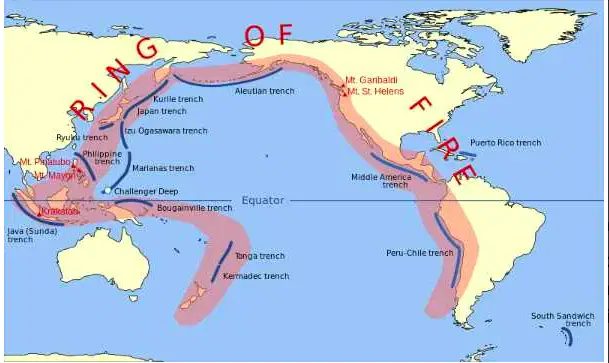
Around what body of water will you find the region known as the Ring of Fire?
(a)
evacuation plans involving air lifts
early warning systems for limiting drought impacts
warning systems, land use planning, and public education
people are encouraged to move their homes further inland
The name of the indigenous people of Australia.
Aboriginals
Maori
Maya
Apaches
What country first colonized Australia?
England
France
India
United States
Great White Sharks
Alligators
Whales
Kangaroos
Many cultures in WHAT REGION are scattered and isolated on islands?
(a)

Letter E represents which continent?
North America
Africa
Antarctica
ASia

Letter D represents which continent?
Asia
Antarctica
Australia
North America

Letter F represents which continent?
South America
Europe
Asia
Australia

Letter H represents which ocean?
Atlantic
Indian
Southern
Pacific

Letter L represents which ocean?
Indian
Southern
Pacific
Arctic
What does monotheistic mean?
Believe in no gods
Believe in one god
Believe in many gods
What does polytheistic mean?
Believe in no gods
Believe in one god
Believe in many gods

