wayground logo

Free Printable Worksheets

Font size

S
M
L
XL
Worksheets

Geometry Vocabulary Review

Total questions: 137

Worksheet time: 7hrs 51mins

Name
Class
Date
1.

If two segments have the same length, then the segments are ______________.

a)

congruent segments

b)

midpoints

c)

segment bisectors

d)

linear pairs

2.

____________ are two angles whose measure have a sum of 180.

a)

supplementary angles

b)

complementary angles

c)

vertical angles

d)

adjacent angles

3.

____________ are two angles whose measure have a sum of 90.

a)

supplementary angles

b)

complementary angles

c)

vertical angles

d)

adjacent angles

4.

The ___________ is the sum of the lengths of the sides of a polygon.

a)

perimeter

b)

area

c)

circumference

d)

volume

5.

The _____ of a polygon is the number of square units it encloses.

a)

perimeter

b)

area

c)

circumference

d)

volume

6.

Which is the formula for the area of a rectangle?

a)

A=bhA=bh

b)

A=12bhA=\frac{1}{2}bh

c)

A=πr2A=\pi r^2

d)

A=s2A=s^2

7.

Which is the formula for the area of a triangle?

a)

A=bhA=bh

b)

A=12bhA=\frac{1}{2}bh

c)

A=πr2A=\pi r^2

d)

A=s2A=s^2

8.

Which is the formula for the area of a circle?

a)

A=bhA=bh

b)

A=12bhA=\frac{1}{2}bh

c)

A=πr2A=\pi r^2

d)

A=s2A=s^2

9.

What is a unit of measurement used to describe the size of an angle?

a)

measure

b)

point

c)

degree

d)

angle

10.

What type of lines intersect and form 90-degree angles at the intersection?

a)

polygon

b)

parallel lines

c)

quadrilateral

d)

perpendicular lines

11.

What is an angle that measures 90 degrees called?

a)

right angle

b)

acute angle

c)

obtuse angle

d)

congruent

12.

What is a closed figure with at least three straight sides?

a)

obtuse angle

b)

point

c)

quadrilateral

d)

polygon

13.

What is a four-sided polygon called?

a)

angle

b)

polygon

c)

obtuse angle

d)

Quadrilateral

14.

Two co-planar lines that never touch are called: ___________ lines

a)

Perpendicular

b)

Right

c)

Parallel

d)

Congruent

15.

What type of angle measures LESS than 90 degrees?

a)

Acute angle

b)

Right angle

c)

Obtuse angle

d)

Angle

16.

What type of angle is LARGER than 90 degrees?

a)

Right angle

b)

Acute angle

c)

Polygon

d)

Obtuse angle

17.

1. Which angle is vertical to ∠ LNR?

a)

∠RNL

b)

∠YNE

c)

∠LNP

d)

∠ANE

18.

1. Which angle is complementary to ∠PNY?

a)

∠RNA

b)

∠RNL

c)

∠YNE

d)

∠PLN

19.

1. Which angle is supplementary to ∠RNA?

a)

∠ENY

b)

∠PNY

c)

∠RNL

d)

∠ANR

20.

1. Which angle is adjacent to ∠ ENY?

a)

∠RNA

b)

∠ANE

c)

∠RNL

d)

∠LNP

21.
Name a line skew to AD
a)
EH
b)
AB
c)
CG
d)
EH
22.
Name a line skew to AB
a)
EH
b)
DC
c)
AE
d)
HG
23.
Name the intersection of Plane ADE and Plane W
a)
Point E
b)
Point A
c)
Line AD
d)
Line EA
24.

Which angle is vertical to ∠ AXS?

a)

∠EXL

b)

∠AXN

c)

∠LXG

d)

∠EXS

25.
A/an ___________ triangle has ALL sides equal.
a)
equilateral
b)
isosceles
c)
scalene
d)
obtuse
26.
Quadrilateral with 4 right angles is a/an _____________________.
a)
rectangle
b)
parallelogram
c)
square
d)
trapezoid
27.
Quadrilateral with 2 pairs of parallel sides is called a/an _________________.
a)
parallelogram
b)
trapezoid
c)
rectangle
d)
square
28.
A/an _______________ is a quadrilateral with all sides equal.
a)
rhombus
b)
rectangle
c)
trapezoid
d)
kite
29.
A/an ____________ triangle has at least 2 equal sides.
a)
isosceles
b)
scalene
c)
equilateral
30.
A triangle with NO equal sides is known as a/an _____________triangle.
a)
isosceles
b)
scalene
c)
equilateral
31.
A ____________ is a quadrilateral with 4 right angles AND 4 equal sides.
a)
trapezoid
b)
rectangle
c)
rhombus
d)
square
32.
A five-sided polygon is a/an ______________.
a)
Triangle
b)
Quadrilateral
c)
Hexagon
d)
Pentagon
33.
A/an _____________ is a quadrilateral w/ 1 pair of parallel sides.
a)
parallelogram
b)
trapezoid
c)
rectangle
d)
square
34.
A six-sided polygon is a/an ______________.
a)
triangle
b)
quadrilateral
c)
hexagon
d)
pentagon
35.
A ______________ is a 2D, flat, non-curved shape that is enclosed.
a)
3D figure
b)
polygon
c)
net
d)
circle
36.
A/an ___________ is a four-sided polygon.
a)
triangle
b)
quadrilateral
c)
hexagon
d)
pentagon
37.
Volume uses __________ units.
a)
square
b)
cubic
38.
A/an ____________ is a 3D shape made of 2 triangles and 3 rectangles.
a)
triangular pyramid
b)
triangular prism
c)
rectangular prism
d)
square pyramid
39.
A/an ______________ has a square base.
a)
triangular pyramid
b)
triangular prism
c)
rectangular prism
d)
square pyramid
40.
A ___________ is a "flattened" 3D shape.
a)
cube
b)
sphere
c)
pancake
d)
net
41.
A/an ___________ is a 3D shape made of 6 squares.
a)
cube
b)
rectangular prism
c)
polygon
d)
volume
42.
Another name for ______________ is solid figures.
a)
3-D figures
b)
2-D figures
43.
_____________ is the sum of areas of ALL faces of 3D shapes.
a)
volume
b)
surface area
c)
area
d)
surface volume
44.
A _____________ is a 3D shape made of 6 rectangular faces.
a)
triangular pyramid
b)
triangular prism
c)
cube
d)
rectangular prism
45.
A seven-sided polygon is called a ________________.
a)
decagon
b)
dodecagon
c)
nonagon
d)
heptagon
46.
A nine-sided polygon is called a/an ________________.
a)
decagon
b)
dodecagon
c)
nonagon
d)
heptagon
47.
A _____________ is a 12-sided polygon.
a)
decagon
b)
dodecagon
c)
nonagon
d)
heptagon
48.
Any number of sided polygon is called a/an _____________.
a)
decagon
b)
dodecagon
c)
nonagon
d)
n-gon
49.

What are the names of the sides to a 45-45-90 special right triangle?

a)

leg

b)

hypotenuse

c)

shorter leg

d)

longer leg

50.

What are the names of the sides to a 30-60-90 special right triangle?

a)

leg

b)

hypotenuse

c)

shorter leg

d)

longer leg

51.

Note: The shorter leg is always opposite of the (a)   degree angle
52.

Note: The longer leg is always opposite of the (a)   degree angle

53.
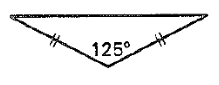
Classify the following triangle in as many ways as possible. 
a)
Isosceles, Acute
b)
Isosceles, Obtuse
c)
Scalene, Obtuse
d)
Equilateral, Acute
54.
What is the value of the missing angle?
a)
61
b)
50
c)
60
d)
69
55.
What type of triangle is this? 
a)
equilateral
b)
obtuse
c)
scalene
d)
isosceles
56.
What type of triangle? 
a)
Acute
b)
Obtuse
c)
Right
d)
Isosceles
57.
What type of triangle is this? 
a)
Acute
b)
Isosceles
c)
Right
d)
scalene
58.

Classify this triangle by its sides and angles.

a)

right & scalene

b)

acute & isosceles

c)

right & isosceles

d)

acute & scalene

59.
Classify the following triangle in as many ways as possible. 
a)
Isosceles, Acute
b)
Isosceles, Obtuse
c)
Scalene, Obtuse
d)
Equilateral, Acute
60.

What is this called?

a)

Chord

b)

Minor arc

c)

Secant

d)

Diameter

61.

What is this called?

a)

Diameter

b)

Secant

c)

Tangent Line

d)

Radius

62.

What is this called?

a)

Tangent Line

b)

Secant

c)

Chord

d)

Diameter

63.

What is this called?

a)

Diameter

b)

Secant

c)

Central Angle

d)

Radius

64.

What is the length L called?

a)

major arc

b)

tangent

c)

minor arc

d)

sector

65.

Which of the following lines intersects a circle only ONCE?

a)

Chord

b)

Tangent

c)

Secant

d)

Diameter

66.
The long way around a circle that is greater than 180 o.
a)
Minor Arc
b)
Major Arc
c)
Semi-Circle
d)
Central Angle
67.
If a circle has a radius of 16 ft. then which statement is true?
a)
The radius is 8 ft. 
b)
 The diameter is 8 ft
c)
The radius is 32 ft.
d)
The diameter is 32 ft.
68.
What is the part of the circle highlighted in red called?
a)
semi-circle arc
b)
major arc
c)
minor arc
d)
sector
69.
The radius of a circle is
a)
The measurement from the center of a circle to an edge of the circle.
b)
The measurement around the circle
c)
The measurement from and edge of the circle to another edge through the center
d)
A line perpendicular to the diameter of the circle
70.
An arc is...
a)
A line that passes through the center and goes from edge to edge.
b)
A part of the circumference.
c)
A boat.
d)
A line that touches the circle once.
71.
The diameter of a circle is:
a)
The measurement around the circle.
b)
The distance from an edge of a circle to another edge.
c)
The distance from the center of the circle to an edge of a circle
d)
The distance from an edge of a circle to another edge through the center. 
72.
Which best describes segment AB?
a)
chord
b)
secant
c)
tangent
d)
diameter
73.
A segment that has one endpoint at the center and the other endpoint on the circle is the __________.
a)
diameter
b)
chord
c)
radius
d)
secant
74.
How many degrees are in a semicircle?
a)
90
b)
180
c)
270
d)
360
75.
A segment whose endpoints lie on a circle is a _______.
a)
tangent
b)
chord
c)
diameter
d)
secant
76.
An angle whose vertex is the center of a circle is a(n) ______.
a)
inscribed angle
b)
acute angle
c)
obtuse angle
d)
central angle
77.
Two circles are congruent if they have the same __________
a)
Center 
b)
Radius
c)
Inscribed Angle
d)
Central Angle
78.
What is the part of the circle highlighted in red called?
a)
semi-circle arc
b)
major arc
c)
minor arc
d)
sector
79.
Which of the following names a radius?
a)
segment AC
b)
segment DB
c)
segment AB
d)
segement BC
80.
What is the part of the circle highlighted in red called?
a)
semi-circle arc
b)
major arc
c)
minor arc
d)
sector
81.
What can this formula be used to find?
a)
area of a circle
b)
arc length of an arc
c)
sector area
d)
circumference of a circle
82.
This is a picture of ___________.
a)
Major Arc
b)
Minor Arc
c)
Central Angle
d)
Inscribed Angle
83.
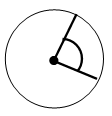
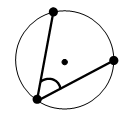
An angle whose vertex (corner) is on the circle.
a)
Major Arc
b)
Minor Arc
c)
Central Angle
d)
Inscribed Angle
84.
This is a picture of ___________.
a)
Major Arc
b)
Minor Arc
c)
Central Angle
d)
Inscribed Angle
85.

a2+b2=c2 a^2+b^2=c^2\  is the

a)

Pythagorean Theorem

b)

Distance Formula

c)

Midpoint Formula

d)

slope formula

86.

M=(x1+x22, y1+y22) M=\left(\frac{x_1+x_2}{2},\ \frac{y_1+y_2}{2}\right)\  is the formula for

a)

Midpoint 

b)

Distance 

c)

Slope

87.

PQ=(x2x1)2+(y2y1)2PQ=\sqrt{\left(x_2-x_1\right)^2+\left(y_2-y_1\right)^2}  

a)

is the formula for midpoint

b)

is the formula for distance

c)

is the formula for slope

88.
We can use SOH-CAH-TOA for...
a)
Any triangle ever
b)
Non-right triangles only
c)
Right Triangles only
d)
Never
89.
The ratio in a right triangle of adjacent to hypotenuse is _____
a)
sine
b)
cosine
c)
tangent
d)
inverse cosine
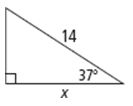
90.

Choose the correct trig equation.

a)
sin(37)=x/14
b)
cos(37)=x/14
c)
tan(37)=x/14
d)
sin(37)=14/x
91.

What is the ratio for Tangent

a)

Opp/Adj

b)

Adj/Opp

c)

Opp/Hyp

d)

Hyp/Opp

92.
What is the ratio for Sine?
a)
Hyp/Opp
b)
Opp/Hyp
c)
Opp/Adj
d)
Adj/Opp
93.
What is the ratio for Cosine?
a)
Opp/Hyp
b)
Opp/Adj
c)
Adj/Opp
d)
Adj/Hyp
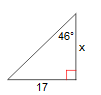
94.
What is the correct equation to solve for x ?
a)
tan( 46 ) = 17/x
b)
sin ( 46 ) = x/17
c)
tan (46 ) = x/17
d)
cos (46) = x/17
95.
What is the correct equation to solve for x?
a)
tan (45) = x/13
b)
cos (45) = x/13
c)
sin (45) = 13/x
d)
sin (45) = x/13
96.
cos B = ?
a)
12/13
b)
12/5
c)
5/13
d)
5/12
97.
sin A = ?
a)
7/25
b)
24/25
c)
7/24
d)
25/7
98.

If you are given the two sides that are NOT the hypotenuse, which trig function should you use?

a)

sine

b)

cosine

c)

tangent

d)

cotangent

99.

If you are given the length of a hypotenuse and the length of an adjacent side, what trigonometry ratio could you use .

a)

sine

b)

cosine

c)

tangent

d)

trigonometry

100.

The ratio of the length of the side opposite of the angle to the length of the hypotenuse is the _____________

a)

Sine

b)

Cosine

c)

Tangent

101.

What is the green side labelled as using the starred angle as a starting point?

a)

adjacent

b)

opposite

c)

hypotenuse

102.

What is the green side labelled as from the starred angle?

a)

adjacent

b)

opposite

c)

hypotenuse

103.

What is the simplified ratio for sin∠Z?

a)

12/37

b)

37/35

c)

12/35

d)

35/37

e)

37/12

104.

What is the simplified ratio for cos∠C?

a)

3/5

b)

4/5

c)

4/3

d)

5/4

e)

5/3

105.

What does 19 represent?

a)

Adjacent leg

b)

Opposite leg

c)

Hypotenuse

d)

the angle

106.

What is the rule for a 45-45-90 triangle?

a)

x, x, x2x,\ x,\ x\sqrt{2}

b)

x, x3, 2xx,\ x\sqrt{3},\ 2x

107.
What type of special triangle is this?
a)
45°-45°-90°
b)
30°-60°-90°
c)
Equiangular
d)
Equilateral
108.

What is the rule for a 3-60-90 triangle?

a)

x, x, x2x,\ x,\ x\sqrt{2}

b)

x, x3, 2xx,\ x\sqrt{3},\ 2x

109.
What type of special triangle is this?
a)
45°-45°-90°
b)
30°-60°-90°
c)
Isosceles
d)
Obtuse
110.
In this 45-45-90 triangle, I have been given a leg, so to find the other leg I...
a)
Multiply that leg by 2
b)
Use the same length for the second leg
c)
Multiply that leg by √2
d)
Divide that leg by √2
111.
What is the length of y in this picture?
a)
45
b)
5√2
c)
90
d)
5
112.
In this 45-45-90 triangle, I have been given the length of a leg.  How do I find the length of the hypotenuse?
a)
It is the same length as the given leg.
b)
Multiply that leg's length by √2.
c)
Multiply that leg's length by 2.
d)
Divide that leg's length by √2.
113.
What is the length of x in this 45-45-90 triangle?
a)
4√2
b)
4
c)
8
d)
4√3
114.
What is the length of y in this 45-45-90 triangle?
a)
8√2
b)
4√2
c)
4
d)
8
115.
Which side is the long leg in this 30-60-90 triangle?
a)
4
b)
u
c)
v
116.
Which side is the short leg of this 30-60-90 triangle?
a)
6
b)
m
c)
n
117.
I have been given the short leg in this 30-60-90 triangle.  How do I find the long leg?
a)
Multiply 4 by 2
b)
Multiply 4 by √3
c)
Multiply 4 by √2
d)
Divide 4 by 2
118.
I have been given the short leg in this 30-60-90 triangle.  How do I find the length of the hypotenuse?
a)
Multiply 4 by 2
b)
Multiply 4 by √3
c)
Multiply 4 by √2
d)
Divide 4 by √3
119.
What is the opposite of squaring a number?
a)
divide
b)
multiply 
c)
fractions
d)
square root
120.

What does this picture show?

a)

Diagonals bisect each other

b)

Opposite angles parallel

c)

Opposite angles are congruent

d)

Opposite sides are congruent

121.

What does this picture show?

a)

Diagonals bisect each other

b)

Opposite sides are parallel

c)

Opposite sides are congruent

d)

Opposite angles are congruent

122.

What does this picture show?

a)

Opposite sides parallel

b)

Opposite angles equal and consecutive angles are supplementary.

c)

Opposite sides equal and parallel

d)

Diagonals bisect each other

123.

Define Kite

a)

A trapezoid where the non-parallel sides are congruent

b)

A quadrilateral with two distinct pairs of adjacent congruent sides

c)

A quadrilateral with opposite sides parallel

d)

A quadrilateral with four right angles

124.

Define Parallelogram

a)

A quadrilateral with opposite sides parallel

b)

A quadrilateral with four right angles

c)

A quadrilateral with four congruent sides

d)

A quadrilateral that is both a rectangle and a rhombus

125.

Define Isosceles Trapezoid

a)

A trapezoid where the non-parallel sides are congruent

b)

A quadrilateral with two distinct pairs of adjacent congruent sides

c)

A quadrilateral with opposite sides parallel

d)

A quadrilateral with four right angles

126.

Define Rectangle

a)

A quadrilateral with opposite sides parallel

b)

A quadrilateral with four right angles

c)

A quadrilateral with four congruent sides

d)

A quadrilateral that is both a rectangle and a rhombus

127.

Define Rhombus

a)

A quadrilateral with opposite sides parallel

b)

A quadrilateral with four right angles

c)

A quadrilateral with four congruent sides

d)

A quadrilateral that is both a rectangle and a rhombus

128.

Define Square

a)

A quadrilateral with opposite sides parallel

b)

A quadrilateral with four right angles

c)

A quadrilateral with four congruent sides

d)

A quadrilateral that is both a rectangle and a rhombus

129.

Give the most specific name for this quadrilateral.

a)

Trapezoid

b)

Isosceles Trapezoid

c)

Quadrilateral

d)

Parallelogram

130.

Give the most specific name for this quadrilateral.

a)

Trapezoid

b)

Isosceles Trapezoid

c)

Rhombus

d)

Quadrilateral

131.

Give the most specific name for this quadrilateral.

a)

Rhombus

b)

Rectangle

c)

Trapezoid

d)

Square

132.
Which quadrilateral is also considered a rhombus, rectangle, and parallelogram?
a)
Trapezoid
b)
Triangle
c)
Square
d)
Hexagon
133.
A rectangle can be a trapezoid.
a)
True
b)
False
134.
Which quadrilateral has only one set of parallel sides?
a)
Rhombus
b)
Rectangle
c)
Square
d)
Trapezoid
135.
Which quadrilateral has all right angles and all sides the same length?
a)
Rhombus
b)
Parallelogram
c)
Square
d)
Trapezoid
136.

The most specific name for this quadrilateral is:

a)

quadrilateral

b)

parallelogram

c)

trapezoid

d)

kite

e)

rhombus

137.

The most specific name for this quadrilateral is:

a)

quadrilateral

b)

parallelogram

c)

trapezoid

d)

kite

e)

isosceles trapezoid