
 Worksheets
#9) DNA and Genetic Mutations
Total questions: 9
Worksheet time: 5mins
individual atoms from existing DNA strands
individual sugars from existing DNA strands
the sequence of bases from existing DNA strands
the sequence of phosphates from existing DNA strands
Original DNA is duplicated during replication and then distributed into two new cells.
Original RNA is duplicated during replication and then distributed into two new cells.
Original DNA is duplicated during replication and then distributed into four new cells.
Original RNA is duplicated during replication and then distributed into four new cells.
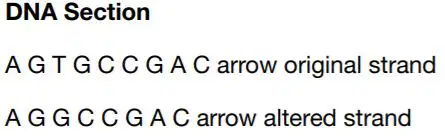
deletion
insertion
duplication
nondisjunction
Both types of organisms transform energy from sunlight into chemical energy.
Both types of organisms assemble proteins through transcription and translation.
Both types of organisms are made of cells, tissues, and organs that work together.
Both types of organisms have DNA contained within a nucleus as genetic material.

TCCA
AGGT
UCCU
AGGU
They study alleles that contain chromosomes, which are RNA.
They study alleles that contain genes, which are chromosomes.
They study chromosomes that contain DNA segments, which are RNA.
They study chromosomes that contain genes, which are DNA segments.
DNA is located in the nucleus.
DNA is a large macromolecule.
DNA is made of repeating sugar-phosphate subunits.
DNA is made of two strands of complementary nucleotides.
deletion of two nucleotides
deletion of three nucleotides
insertion of six nucleotides
insertion of twelve nucleotides
silent
nonsense
frame-shift
substitution

