wayground logo

Free Printable Worksheets

Font size

S
M
L
XL
Worksheets

Bio Final 2023

Total questions: 25

Worksheet time: 27mins

Name
Class
Date
1.

What is the term for a feature that allows an organism to survive better in its environemtn?

a)

variation

b)

adaptation

c)

homologous structure

d)

vestigial structure

2.
What is the process in which humans breed organisms for certain traits?
a)
natural selection
b)
inheritance
c)
artificial selection
d)
descent withOUT modification
3.
To adjust to a changing environment
a)
Mutation
b)
Adapt
4.
The gradual change in species over time is...
a)
Evolution
b)
Nucleotide 
c)
Adaptation
d)
Natural Selection
5.
Who is the father of evolution?
a)
Darwin
b)
Mendel
c)
Newton
d)
Einstein
6.
What is another name for natural selection?
a)
survival of the smartest
b)
survival of the fastest
c)
survival of the biggest
d)
survival of the fittest
7.
Another word for adapt is ____________.
a)
change
b)
create
8.
Which term refers to the process by which individuals that are better suited to the environment survive and reproduce therefore passing down their genes to their offspring? 
a)
Evolution 
b)
Variation 
c)
Adaptation
d)
Natural Selection 
9.
WHERE does photosynthesis take place? 
a)
cell wall 
b)
chlorophyll 
c)
nucleus 
d)
chloroplast 
10.
During photosynthesis energy comes from......
a)
the sun 
b)
oxygen
c)
chemicals 
d)
water 
11.
Mutations are important because they bring about
a)
death of the organism in which they develop
b)
genetic variation needed for a population to evolve
c)
benefits for the individual, not for the population
d)
Hardey-Weinberg equilibrium within a population
12.
What is the process in which humans breed organisms for certain traits?
a)
natural selection
b)
inheritance
c)
artificial selection
d)
descent withOUT modification
13.
The gradual change in species over time is...
a)
Evolution
b)
Nucleotide 
c)
Adaptation
d)
Natural Selection
14.
This is the trace or remains of an organism that lived long ago, most commonly preserved in sedimentary rock.
a)
Competiton
b)
Extinction
c)
Evidence
d)
Fossil
15.
What would indicate that a series of fossils represent evolution?
a)
the fossils were identical
b)
the fossils were found in the same layers of rock
c)
the fossils show similarities
d)
the fossils were completely different
16.
Another word for adapt is ____________.
a)
change
b)
create
17.
Which term refers to the process by which individuals that are better suited to the environment survive and reproduce therefore passing down their genes to their offspring? 
a)
Evolution 
b)
Variation 
c)
Adaptation
d)
Natural Selection 
18.
Two organisms that are closely related would have
a)
very similar DNA sequence
b)
exactly the same DNA sequences
c)
no proteins in common
d)
completely different DNA sequence
19.

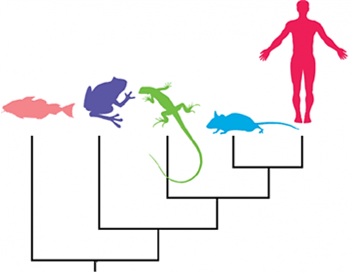
According to this phylogenetic tree, which creature is the least related out of all pictured?

a)

Fish

b)

Frog

c)

Salamander

d)

Human

20.

The diagram shows a cladogram of six species based on amino acid similarities. Which two species are MOST CLOSELY related.

a)

I and II

b)

II and IV

c)

I and V

d)

V and VI

21.

Why do populations change over time?

a)

different traits are passed on depending on which traits are favored by the environment

b)

they mutate

c)

they lose abilities that are no longer useful

22.

Where do the genes that determine an individual's traits come from?

a)

An individual can be born with any genes, since genes are random.

b)

Individuals grow genes specific to their environment.

c)

Parents pass their genes down to their offspring

d)

Parents choose which genes their offspring have when each individual is born

23.

Identify each of the following as a reactant or product of cellular respiration.

a)
1.

Reactant

b)
2.

Reactant

c)
3.

Product

24.

In this food web, how many different organisms feed on the producer?

a)

2

b)

3

c)

4

d)

5

25.

______ are organisms in an ecosystem that eat only producers. They are herbivores.

a)

Primary Consumers

b)

Secondary Consumers

c)

Tertiary Consumers

d)

Decomposers