
 Worksheets
Kinematics Unit Review
Total questions: 35
Worksheet time: 29mins
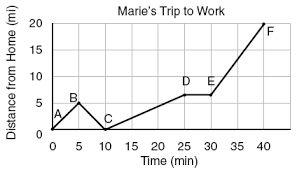
When was Marie driving the fastest?
C to D
D to E
E to F
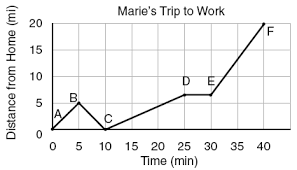
During what period of time was Marie stopped?
0-5 minutes
5-10 minutes
10-25 minutes
25-30 minutes
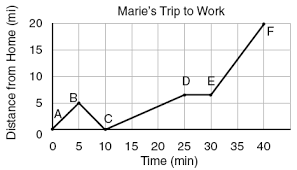
What could account for Marie’s motion at 27 minutes?
She was late so she broke the speed limit
She forgot something at home and ran back to get it
She was stopped at a red light
She was driving across the top of a hill
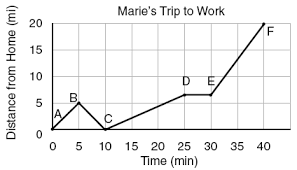
How far did Marie go before she turned around?
20 mi
5 mi
10 mi
25 mi
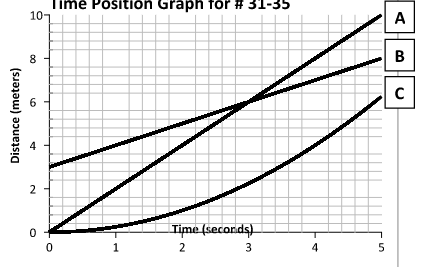

from 3rd second to 5th second, the object is
moving at a constant speed
speeding up
not moving
slowing down

What is happening at E?
Stationary
Accelerating
Fast steady speed; moving away from the starting position
Steady speed; returning to start position

This position vs. time graph shows an object...
not moving
moving with constant velocity
moving with changing velocity

This position vs. time graph shows an object...
not moving
moving with constant velocity
moving with changing velocity

This position vs. time graph shows an object...
not moving
moving with constant velocity
moving with changing velocity


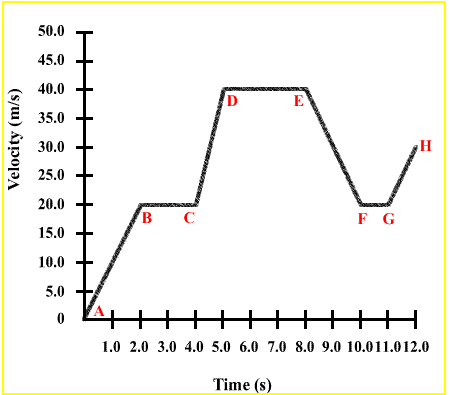

How fast is this object going at 1 second?
20 cm/s
30 cm/s
-40 cm/s

What is happening at 0 m/min in the middle of segment C - D?
Nothing is happening
Change in speed
Change in position
Change in direction

Select the two correct statements that describe the object's motion.
The object is moving in the positive direction.
The object is moving in the negative direction.
The object is moving at a constant speed.
The object is speeding up.
The object is slowing down.

Select the two correct statements that describe the object's motion.
The object is moving in the positive direction.
The object is moving in the negative direction.
The object is moving at a constant speed.
The object is speeding up.
The object is slowing down.

Select the two correct statements that describe the object's motion.
The object is moving in the positive direction.
The object is moving in the negative direction.
The object is moving at a constant speed.
The object is speeding up.
The object is slowing down.
If you double the mass of an object but apply the same force apply on it, the acceleration will __________________.
double
cut in half
the same
zero
A 20 kg bike accelerates at 10 m/s2. What was the net force?
25 Newtons
20 Newtons
200 Newtons
10 Newtons

Which one of Newton’s Laws of Motion best explains why the dishes do not move when the tablecloth is removed?
Newton's 1st Law
Newton's 2nd Law
Newton's 3rd Law
Which type of force(s) will cause a change in an object's motion?
gravity
zero net force
balanced forces
unbalanced forces
Newton's third law states that any action will have a(n) _______ and ______ reaction.
Equal and similar
Equal and opposite
Equal and different
Greater and opposite
Which of Newton's laws are illustrated with a rocket launch?
1st Law, the Law of Inertia.
2nd Law, the Law of Acceleration.
3rd Law, the Law of Action - Reaction
What is the standard unit that force is measured in?
Newtons
pounds
grams
meters
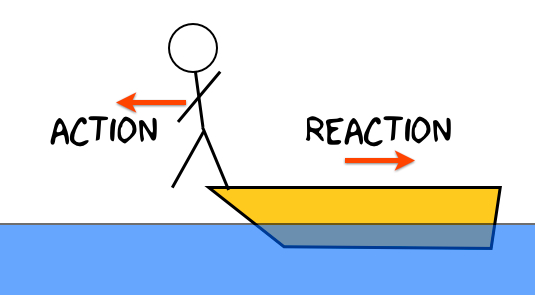
Two astronauts are playing catch in space. The first astronaut throws the ball; and
the ball moves, but the astronaut doesn’t.
the ball moves, and so does the astronaut.
the ball doesn’t move, but the astronaut does.
the ball doesn’t move, and neither does the astronaut.
Motion is any change in ___________.
accelration
distance
position
velocity

This graph shows that as an object’s mass increases its
inertia increases
inertia decreases
acceleration increases
acceleration decreases
The law of inertia states that a body in motion will remain in motion and a body at rest will remain at rest unless acted upon by a(n) ________________ force.
balanced
unbalanced
equal
strong

