
 Worksheets
Final Exam Review: Topic 6
Total questions: 229
Worksheet time: 19hrs 28mins
Select the equations that show exponential growth.
f(x) =3(1.01)x
f(x)=4000(0.95)x+1
f(x)=4x
f(x)= 0.5(3)x
f(x)=25(0.25)x
Select the equations that show exponential decay.
f(x) =3(1.01)x
f(x)=4000(0.95)x+1
f(x)=4x
f(x)= 0.5(3)x
f(x)=25(0.25)x
A population of 1500 deer decreases by 1.5% per year. At the end of 10 years, there will be approximately 1290 deer in the population. Which function can be used to determine the number of deer, y, in this population at the end of t years?
y= 1500(0.985)t
y= 1500(0.015)t
y= 1500(1.015)t
y= 1500(1.5)t

f(x) = 25(0.95)x
f(x) = 36(0.05)x
f(x) = 25(1.05)x
f(x) = 36(1.5)x
What is the initial value for the function: f(x) = 300(1.16)x?
300
1.16
.16
x
Samantha's hair was known to grow very rapidly. It began at a length of 6 in and grew at a rate of 14% a week.

What is the range of this graph?
y = 6
(0, -3)
y > -4
y < -4
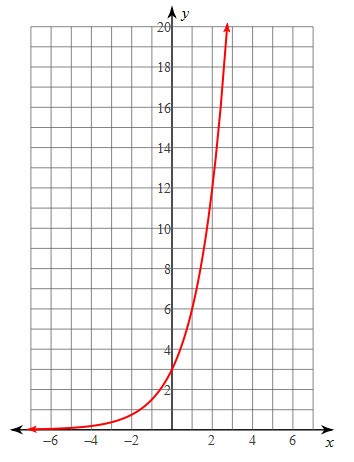

What is the y-intercept?
5
1/3
1
0
Which of the following statement about the graph of y=6(.5)x is true?
The equation of the asymptote is x=0.
The coordinates of the y-intercept are (0,6)
The graph includes the point (1.5, 2).
The coordinates of the x-intercept are (.75, 0)

Based on the graph, which statement does not appear to be true?
The graph has a horizontal asymptote at y=0
The y-intercept is at the point (0, 3)
The graph represents exponential growth.
The graph of the function shows a decrease over time.
Which investment would have a larger balance after 5 years?
Option 1 - 4% compounded monthly
Option 2 - 3.9% compounded daily.
Caiden earned $475 from mowing lawns last summer.He deposited this money in an account that pays an interest rate of 3.8% compounded annually. What will be his balance after 15 years?
$827.52
$831.10
$839.45
$846.80

What does the P stand for in this formula?
Initial amount
Final amount
Rate
Time
The number of times compounded per year

What does the n stand for in this formula?
Initial amount
Final amount
Rate
Time
The number of times compounded per year
Maggie would like to buy some new furniture for her home. She decides to buy the furniture on credit with 9.5% interest compounded quarterly. If she spent $7,400, how much total will she have paid after 8 years?
$15,415.94
$15,683.28
$15,927.56
$16,109.05
Approximately what interest rate would be needed in order to grow Christian's investment of $1400 to $2500 in 10 years if the interest was compound monthly?
5.96%
5.84%
5.81%
5.88%
Treasure won $3,000 from a radio contest. If she puts this money in a bank account that earns 2.9% interest compounded quarterly, how much total will she earn in 10 years?
$4915.59
$3933.28
$2979.81
$4005.09
Cora invested $400 at a rate of 35% for 8 months, compounded continuously. How much is her investment worth after 8 months?
$520.07
$505.12
$460.11
$7,643.74
How long will it take $3000 to double if it is invested in an account that pays 3% compounded continuously?
23.1 years
22.1 years
21.1 years
20.1 years
$799.06
$520.36
$807.26
$877.61

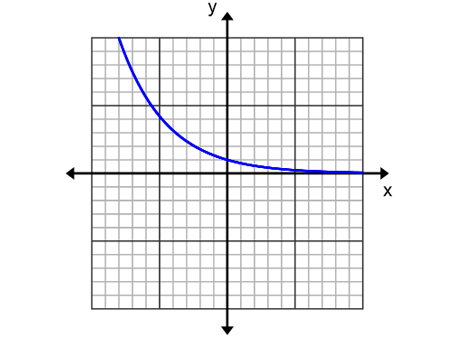
Samantha's hair was known to grow very rapidly. It began at a length of 6 in and grew at a rate of 14% a week.
Every year the population drops by 4.5%. What is the population after 3 years?
The city of Whoville has been much more stable since the Grinch turned his life around. The population of 900 is increasing at a rate of 7.5% per year. If the population continues growing at the same rate, how many people will there be in 11 years?
424288
1994
10642
900
The Country of Puerto has 3,370,000 people in it and is decreasing at a rate of 4.5%. Estimate the population after 40 years.
534,275
19,601,148
1,350,756
2,521,541
How long would it take $7,000 to grow to $35,000 at 6% compounded continuously?
27.6 years
27.1 years
26.0 years
26.9 years
Chelsea put $7500 into an account paying 5% compounded continuously. She now has $10,643.01. How long has the money been in the account?
7 years
6 years
5 years
4 years

What does the A stand for in this formula?
Initial Amount
Final Amount
Rate
Time
The number of times compounded per year

What does the P stand for in this formula?
Initial amount
Final amount
Rate
Time
The number of times compounded per year.

Which formula is shown?
Monthly compounded interest formula
Annually compounded interest formula
Continuously compounded interest formula
Simple interest formula

What does the r stand for in this formula?
Rate as a percent
Rate as a decimal
number of times interest is compounded

What does the t stand for in this formula?
time in weeks
time in months
time in years
the number of times interest is compounded per year
A student solves a problem about continuously compounded interest and determines that r = .3
They should conclude that the interest rate is .3%
They should conclude that the interest rate is 3%
They should conclude that the interest rate is 30%
They should conclude that the interest compounded for .3 years
Mr. Thomas invested $15,000 in an account that pays 5% interest compounding continuously, how much is in the account after 5 years?
$15,500.50
$19,260.38
$19,260.40
$21,500.25
If You Compounded Continuously an investment of $400 at a rate of 35% for 2 years
$280
$680
$1,034.47
$805.50
Caiden earned $475 from mowing lawns last summer. He deposited this money in an account that pays an interest rate of 3.8% compounded continuously. What will be his balance after 15 year?
$827.52
$839.93
$839.45
$846.80
Evaluate.
log232=3x
5/3
3/5
5
3
logx1000=3
1
10
30
3
log2(x+3)=4
16
13
3
10
logx 25 = 2
Convert log(x) = 5 to exponential form
15=x
10x=5
x5=10
105=x
logx(64)=3
5x = 17
log2(1/8) = -3
Evaluate the following logarithm:
log416
1
-2
2
1/2
Evaluate the following logarithm:
log55
1
0
-1
1/2
Evaluate the following logarithm:
log327
3
2
-3
1/3
log (x) = ¼
ln(2) = x
Solve for x:
e2x = 11
x = (ln 11)/2
x = 2loge11
x = 2e(log11)
x = ln (11/2)
logx1000 = 3
1
10
30
3
42x + 1 = 17
x = 1
x = -1
x = 2
x = -2
Solve for x:
23x - 1 = 32
0
-1
5/3
2
Logarithms and Exponentials are _______________?
parallel
perpendiular
inverses
congurent
5x = 1
"e"
natural logarithm (ln)
common logarithm (log)
natural log, base "e" lne
53 = 125
42x + 1 = 17
log8(1/2) = x
-1/3
1/3
1/2
-1/2
Solve for x.
logx100 = 2
10
50
10,000
0.02

0.0005
5.5
121
3.32

-2
2
4
-4
Solve for x.
log6x = 3
2
729
216
18
Solve for x.
log312 = x
2.262
0.442
4
1.401
Evaluate the logarithmic expression without a calculator:
1000
4
3
5
Evaluate the logarithmic expression without a calculator:
0
20
1
10
Solve: 2x = 25
Round to the nearest hundredth.
x = 4.64
x = 4.65
x = 1.40
x = 1.10
Solve: 9x-8 = 70
Round to the nearest hundredth.
x = 9.93
x = 1.93
x = 1.85
x = 9.85
The base of common log is 10. So log 100 = ?
1
2
10
50
Evaluate.
log1000
1
2
3
4
Evaluate.
log 0.1
-2
-1
1
2
Evaluate.
log 1
-2
-1
0
1
Use a calculator to evaluate log 25
1.398
1.598
-1.397
0.80
lnx = -3
8.1548
-8.1548
0.0498
-0.0498
Evaluate.
log525
2
5
25
125
log416
Evaluate.
log41 =
0
1
4
Undefined
log381
log6(1/216)
log232 = 5
log2(1/8) = -3
52 = 25
2-4 = 1/16
Rewrite log28 = 3 in exponential form
28 = 3
23 = 8
32 = 8
83 = 2
Rewrite ex = 9 using a logarithm
ln x = 9
ln 9 = x
logx e = 9
log9 x = e

Solve
144-6x = 11
(round to the nearest tenth)
5
0.5
0.1
1
What is the inverse of
c−1(x)=xe
c−1(x)=lnx
c−1(x)=x10
c−1(x)=10x
What is the inverse of
n−1(x)=loge
n−1(x)=xe
n−1(x)=ex
n−1(x)=xln
Find the inverse of y=9x
y=logx9
y=log109
x=logy9
y=log9x
Find the Inverse of y = log4(x−1)
y=x
y=log34x
y=4x+1
y=4x+1
Find the inverse of y=ln(x+3)
y=ex−3
y=ex−3
y=ex+3
y=ex+3
What are the inverse points for the coordinates:
(3, 0) , (2, -4), (5, 5) and (-6,8)
(3,0) , (2, -4) , (5,5) , (6,8)
(0,3) , (-4,2) , (5,5) , (8,-6)
(3,2), (0, -4), (5, -6), (5,8)
Find the inverse of f(x)=10+7x
f−1(x)=10x−7
f−1(x)=7x−10
f−1(x)=10+7x1
The inverse of the function f(x) is written as ...
f -1(x)
f 2(x)
f '(x)
f +(x)
Find the inverse of f(x)=41x−7
f-1(x) = 4x + 7
f-1(x) = -4x+28
f-1(x) = -4x - 7
f-1(x) = 4x+28

(1,3)(2,4)(6,8)
Find the inverse of y=9x
y=logx9
y=log109
x=logy9
y=log9x
log53 + log56 + log59
log 6 - log 3 + 2 log 7


Condense this expression to a single logarithm.


Which of the following is a possible expansion for this logarithm? log324
Check all that apply.
log34+log320
log310+log314
log34+log36
log348−log32
log38+log33
Express as a single logarithm.
log39 +log327 = log3(?)
(Type a NUMBER for the ?)
(a)
Express as a single logarithm & simplify
log28 −log216
log4128 = 27
log2(21)=−1
log216log28=43
log2(−8)=−4
Which expression(s) are equivalent to
log412 ?
Select all that apply.
log4log12
log42+log46
log436−log43
log41−log412
Solve the equation.
logx−log4=1
125
40
25
20
Solve for x:
e2x = 11
x = (ln 11)/2
x = 2loge11
x = 2e(log11)
x = ln (11/2)
42x + 1 = 17
Solve for x:
23x - 1 = 32
0
-1
5/3
2
log (x) = ¼
ln(2) = x
Solve the equation.
logx−log4=1
125
40
25
20
Solve the following equation for x. Round your solution to two decimal places.
ln(2x) - ln(41) = 2
x = 0.36
x = 151.48
x = 41
None of these are solutions
Solve for x:
e2x = 11
x = (ln 11)/2
x = 2loge11
x = 2e(log11)
x = ln (11/2)
log232=3x
5/3
3/5
5
3
log4(3x-1)=log4(2x+3)
4
3
1
8
logx1000=3
1
10
30
3
log8(4x+4)=2
15
12
10
3
lnx = -3
8.1548
-8.1548
0.0498
-0.0498
42x + 1 = 17
Solve for x:
23x - 1 = 32
0
-1
5/3
2
log (4x − 5) = log (2x − 1)
Condense the Logarithm 5loga − 25logb
log (a5+b25)
log (a5−b25)
log (ab)25
log (b25a5)
Condense 3logx+4logy +logz
log x3y4z
12log xyz
log 3x4yz
Use the change-of-base formula to evaluate log211
3.459
4.359
5.123
2.345
Simplify: log4(x+4)−log4(x−5)
log49
log4(2x−1)
log4(x2−x−20)
log4(x−5x+4)
Simplify: 2log3(11x)
log3(22x)
log3(121x)
log3(121x2)
log3(11x2)
Simplify: 41log516+3log5x
log5(4x3)
log5(2x3)
log5(6x)
log5(x32)
Simplify: 41log281+21log249
log221
log210
log2(73)
log244.75
Simplify: 21log964+log9x
log9(32x)
log9(8x)
log9(x8)
log98x
log 6 - log 3 + 2 log 7
Expand using the properties of Logaritms log y4zx3
logx+4logy +logz
3logx−4logy −logz
3logx+4logy +logz
3logx−4logy +logz
Use these and other properties of logarithms to evaluate the expression.
log232 − 6log63
2
−2
8
3
Expand the logarithm.
log4x3y
21log4(x)−21log4(y)
23log4(x)−21log4(y)
21log4(x)−log4(y)
23log4(x)−log4(y)
Use the change-of-base formula to evaluate log7 163 rounded to two decimal places
0.82
0.86
0.85
0.87
Expand the logarithm.
logy6x
logx+6logy
logx−6logy
logx+log6y
logx−log6y
Expand . log6(y5x3)
log65x3−log6y
log65+log6x3−log6y
log65+3log6x−log6y
log65+3log6x+log6y
Which property of logarithms is demonstrated below:
Product property
Quotient property
Power property
Change of Base Property
Rewrite as a single logarithm:
log 10
log 21
log 3/7
log 3/log 7
Rewrite as a single logarithm:
log260 − log210 log26
log250
log210log260
log270
Use the properties of logarithms to rewrite as the sum of two logarithms:
log55log 40 + log 15
log 50 + log 5
log 11 + log 5
Use the properties of logarithms to rewrite as the difference of two logs:
log545log590 −log52
log515−log53
log 5log45
log550−log55
Which of the logarithms below is equivalent to the following:
2log12
log 10
log 6
log 24
log 144
Use the change of base rule to simplify. Round your answer to the nearest thousandth:
log420
(a)
Use the change of base property to rewrite as a single logarithm:
log3log15
log 51
log5
log153
log315
True or False:
log 12 - log 4 = log 8
True
False
−2log3=log91
True or False:
True
False
log 20log7=log (207)
True or False:
True
False
Solve for x:
log5(4x-7)=log5(x+5)
3
12
4
7
Solve for x:
log4(3x-1)=log4(2x+3)
4
3
1
8
Solve for x:
log2(x+3)=4
16
13
3
10
Solve for x:
log8(4x+4)=2
15
12
10
3
Solve for x:
logx1000=3
1
10
30
3
Solve for x:
log5 (x + 3) = log5 x + log5 3
3/2
9/2
2/3
No Solution
Using a calculator, solve for x:
2.8x = 41
0.277
3.607
-0.282
3.684
Solve for x:
log2(2) + log2(8x) = 6
x = 3
x = 2
x = 6
x = 4
Solve for x:
log(x+6) = 1
4
4.222
-5
-9.550

