
NEW
Font size
 Worksheets
Conduction, Convection, Radiation Quiz
Total questions: 18
Worksheet time: 13mins
On a hot summer day black pavement can reach 135 degrees. What would occur if an egg was placed on it?
The pavement will conduct the heat and cook the egg.
The egg will reflect the heat and make the pavement hotter underneath.
The egg will absorb the heat and leave the pavement hotter underneath.
The pavement will absorb the heat from the egg, and the egg will stay raw.
Which of the statements below describes what can happen as a result of radiation?
A piece of wood burns in a fire.
A shirt is hot after having been ironed.
A can of soup is heated in a pot on a stove.
A car’s inside temperature rises to over 100 degrees on a sunny day.
Warmth from the fireplace circulating through the house.
Conduction
Convection
Radiation
A certian type of decorative lamp contains colored liquids. These liquids form globs that break off and rise to the top of the liquid. The globs rise due to ...
Conduction
Radiation
Convection
One end of a copper rod is placed in a flame. Small pieces of wax placed along the rod melt a progressively larger distance from the flame. Heat is transferred through the rod by ...
Conduction
Radiation
Convection
A certian type of decorative lamp contains colored liquids. These liquids form globs that break off and rise to the top of the liquid. The globs rise due to ...
Conduction
Radiation
Convection
A house burns down. On the house across the street, all the vinyl siding is twisted and warped by the heat. The heat was transferred across the street by ...
Conduction
Radiation
Convection
Warm air over the beach rises while cooler dense air from the ocean rushes in due to ...
Conduction
Radiation
Convection
A hot air balloon rises into the sky because of ...
Conduction
Radiation
Convection
When you pull your Totino's Pizza rolls out of the oven and the pan is so hot it burns your hand because you forgot your protective mit. The energy moves to your hand from the pan through ...
Conduction
Radiation
Convection
Which of the following is not a method for heat transfer
Radiation
Insulation
Conduction
Convection
What is the definition of CONVECTION
When heat transfers through waves.
When heat transfers from objects that are touching.
When heat is transferred by movement of gas or liquids. It is also when gas/liquid becomes less dense and rises or becomes more dense and sinks.
Heat traveling from the sun
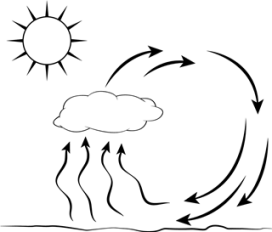
What is the original source of most of the energy on the surface of the Earth?
Energy that reaches Earth by radiation from the sun.
Energy that reaches the earth by convection from the sun.
Energy that reaches the earth by radiation from the core.
Energy that reaches the earth by conduction from the core.

