
 Worksheets
Unit 7 review-Molarity and Solubility
Total questions: 15
Worksheet time: 19mins
What is the molarity of a solution prepared by dissolving 14.2g of NaNO3 (molar mass = 85.0g/mol) in 350mL of solution?
Molarity= moles/liters
0.0405 M
40.57 M
0.477 M
0.0005 M
____ ions are associated with bases just as _____ ions are associated with acids.
Hydroxide, Hydroxide
Hydroxide, Hydronium
Hydronium, Hydronium
Hydronium, Hydroxide
How would a solution with a pH of 9.2 be classified?
Base
Neutral
Acid
The solution cannot be classified
The temperature of an ideal gas is raised from 135K to 270K, while the pressure remains constant. Which statement correctly identifies what happens to the volume?
Remains the same
Doubles in size
Shrinks to ½ the original volume
Increases by a factor of 10
For a fixed amount of gas at a constant temperature, how does the pressure change as volume increases?
Increases, then decreases
Remains the same
Decreases
Increases
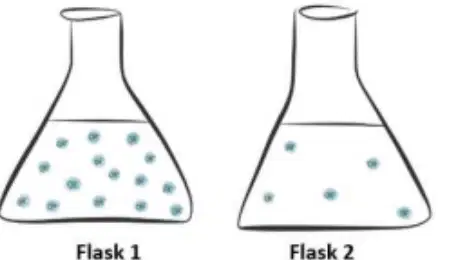
Which of the two flasks – Flask 1 or Flask 2 – has the higher molarity? Assume both flasks have the same amount of solvent.
Flask 1, because it has more moles of solute per liter of solvent than Flask 2.
Flask 2, because it has more moles of solute per liter of solvent than Flask 1
Flask 1, because it has fewer moles of solute per liter of solvent than Flask 2
Flask 2, because it has fewer moles of solute per liter of solvent than Flask 1
Which of the following best describes a weak base?
A base with a pH lower than 3.
A dilute strong base
A base with a very low concentration
A base that dissociates very slightly in a water solution
If a cube of sugar is crushed before being added to a cup of coffee, how is the solubility affected?
Crushing does not increase the temperature of the solution; therefore, solubility is not affected.
Crushing the sugar cube increases the surface area, therefore solubility is increased.
Crushing the sugar cube reduces the surface area, therefore solubility is increased
Crushing the sugar cube decreases the temperature of the solution, there solubility is increased.
A solute is added to water and a small amount of that solute remains undissolved. What kind of solution is this?
Saturated
Diluted
Supersaturated
Unsaturated
How many moles of KNO3 must be dissolved in water to make 1.5 L of a 2.0 M solution?
1.3 mol KNO3
.75 mol KNO3
1 mol KNO3
3 mol KNO3
Paulson eats too much hot sauce and his mouth is burning. What's his best option to make him feel better?
Water, because it's the universal base
Soda, because acids counteract acids
Milk, because bases counteract acids
There's no hope, he must suffer
CH3OH(g) → CO(g) + 2H2(g)
The reaction mixture contains 6.30 mol of CO(g) at equilibrium at 327°C. Calculate the number of moles of H2(g) in the tank.
12.6 mol H2
1 mol H2
2 mol H2
36 mol H2
What is the kinetic energy of H2O and CH4 in 2 different equations if the temperature stays the same?
H2O will have more kinetic energy because it is more polar
CH4 will have more kinetic energy because it has hydrogen bonding
They will have the same kinetic energy because the temperature is the same
Their kinetic energy cannot be measured is gaseous form
Generally speaking, how does decreasing the temperature impact the solubility of a solute in solution
As temperature decreases, the solubility of a solute decreases because the kinetic energy of the molecules decreases
As temperature decreases, the solubility of a solute decreases because the kinetic energy of the molecules increases
As temperature decreases, the solubility of a solute increases because the kinetic energy of the molecule decreases
As temperature decreases, the solubility of a solute increases because the kinetic energy of the molecule increases.
What is the molarity of 2.0 L of an aqueous solution that contains 0.5 mole of potassium iodide
1.0 M
4.0 M
0.25 M
1.5 M

