
 Worksheets
Earth and Space Science CAST NGSS
Total questions: 100
Worksheet time: 2hrs 34mins

Which of the following is NOT a rule to be considered a planet?
Has to be orbiting a star
Has to be spherical and large
Has to clear its orbit
Has to have multiple moons
The closest star to the Earth is (a) .

Which is true about the moon?
The Moon creates the same amount of light during both phases.
The Moon remains the same size during both phases.
The Moon moves closer to Earth during a full moon.
The Moon is covered by more clouds during a quarter moon.

The table describes two space objects. What is object 1?
Asteroid
Comet
Object Z in the solar system revolves around the Sun in an orbit between Venus and Jupiter. Another space object revolves in an orbit around Object Z. Object Z has a rocky surface and a round shape. Object Z is most likely which type of space object?
Planet
Moon
Comet
Asteroid

The star chart shows the positions of some constellations in summer and winter. Why are some constellations only visible during summer or winter?
Some constellations have stars that give off less light during different seasons.
Some constellations are blocked by the location of the Sun during different seasons.
The stars in some constellations move farther away from the Sun during different seasons.
The stars in some constellations move together in new patterns during different seasons.
The star chart shows the positions of some constellations in summer and winter. Why are some constellations only visible during summer or winter?
Some constellations have stars that give off less light during different seasons.
Some constellations are blocked by the location of the Sun during different seasons.
The stars in some constellations move farther away from the Sun during different seasons.
The stars in some constellations move together in new patterns during different seasons.
A student living in the Northern Hemisphere observes the Ursa Major constellation in the northeastern sky with a telescope in February. The student sees the same constellation in the northwestern sky in July.
Which causes the Ursa Major constellation to appear in different locations in the sky in February and July?
the rotation of Earth on its axis
the revolution of the stars in the constellation around the Sun
the revolution of Earth around the Sun
the distance between the stars in the constellation and Earth

A student uses a flashlight, globe, golf ball, and tongs in a dark room to model a lunar eclipse. The student tries two different models, as shown. Which statement correctly identifies and explains which model shows a lunar eclipse?
Model 1; Earth allows half the sunlight to reach the Moon.
Model 1; Earth allows most of the sunlight to reach the Moon.
Model 2; Earth blocks all the sunlight from reaching the Moon.
Model 2; Earth blocks a small amount of sunlight from reaching the Moon.

The diagram shows that the phase of the Moon on two different days in the same year is the same even though the position of the Moon in its orbit around Earth is different. Why can the same phase of the Moon occur at two different places in its orbit?
The position of Earth in its orbit around the Sun changes, causing the direction of sunlight
hitting the Moon’s surface to change.
The direction that Earth rotates on its axis changes, causing a different side of Earth to face the Moon each month.
The tilt of the Moon on its axis changes, causing the direction that light travels from the Moon to Earth to change.
The speed of the Moon orbiting around Earth changes, causing the position of the Moon to be different each month.


Which location would a 1st quarter moon be visible?
2
3
5
7
Sequence the Moon's WAXING phases in order, beginning with the New Moon phase. (a) (b) (c) (d) (e)
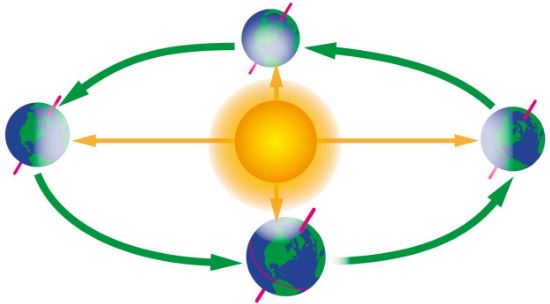
Why is it warmer in the summer?
Closer to the sun
More direct light from Earth's tilt
Stronger light from the sun
Earth spins slower
Order the life cycle of a high mass star
nebula
main sequence star
super giant
supernova
neutron star

This model demonstrates...
Revolution
Rotation
Seasons
Light Years

The the waves from least amount of energy to most.
Radio waves
Infrared
Visible Light
X-ray
Gamma Rays
Tectonic plates move quickly, so mountains take only a few years to form.
(MS-ESS2-3)
True
False

What part of the water cycle is shown at Number 1?
(MS-ESS2-6)
Evaporation
Condensation
Collection
Precipitation

What part of the water cycle is shown at Number 2?
(MS-ESS2-6)
Evaporation
Condensation
Collection
Precipitation

What part of the water cycle is shown at Number 3?
(MS-ESS2-6)
Evaporation
Condensation
Collection
Precipitation

What part of the water cycle is shown at Number 4?
(MS-ESS2-6)
Evaporation
Condensation
Collection
Precipitation
Oldest rock at the bottom, youngest at the top.
Relative Dating
a numeric age of rocks or fossils using radiometric dating
Absolute Dating
the study of rock strata.
Stratigraphy
The Law of Superposition states
Younger rocks layers are on top of older rock layers
Fossils are found in sedimentary rocks
Older rock layers are on top of younger rock layers
Absolute age dating

Use relative age dating to put the rock layers in correct order from oldest to youngest.
B, D, A, E, C
C, E, D, A, B
A, C, E, D, B
C, E, D, B, A

Which rock layer is oldest from Site 1?
G
B
A
E

Which of the fossils is the oldest?
Dinosaur
Bird
Shell
Ammonite

Quaternary
Holocene
Jurassic
Tertiary

The law of universal gravitation states that both mass and distance of objects affect the gravitational force between them. Gravitational force increases as the mass of the objects increase. Gravitational force decreases as distance between the objects increases. Why are these statements considered scientific law, and not scientific theory?
The statements tells what happens, and not why it happens.
The statements involve mass and distance measurements.
The statements explain the attractive force between two objects.
The statements predict what will happen under certain conditions.
Lilly was trying to explain to her friend the difference between a theory and a law in science. She used the theory of plate tectonics and the law of superposition as examples. Lilli explained the difference by using non-scientific language. Which statement could Lilly use to correctly describe the difference between a theory and a law in science?
A theory describes a natural event, while a law explains it.
A theory explains a natural event, while a law predicts it.
A theory explains a natural event, while a law describes it.
A theory predicts a natural event, while a law explains it.
In 1897, Joseph Thomson discovered that atoms contained electrons. He proposed a change in the atomic theory of that time, and the theory was modified because of his discovery. Since Thomson’s discovery, atomic theory has been further modified. What is the best explanation for why scientific theories are modified?
Theories more than ten years old are usually out of date.
Scientists want to prove that the work of other scientists is wrong.
New evidence that supports a change prompts scientists to modify earlier theories.
So much information is available today that it is harder to focus research and disprove theories.
Why are meteorites important to the study of the Earth's interior?
Meteorites are most likely debris ejected from the sun and moon.
Meteorites come from bodies in space that formed along with the planets and are thought to have similar compositions to Earth's layers.
Meteorites formed far outside the solar system at the same time Earth formed.
In the early 1900's, a hypothesis was introduced that proposed a single large landmass broke into smaller landmasses and formed and continents, which drifted in their present locations. What is the name of this hypothesis?
continental shift
continental drift
plate movement
plate tectonics
A subduction zone is a place where a more dense plate (oceanic) and a less dense plate (continental) collide and the more dense plate goes underneath the less dense plate. What would you call this boundary and what landform is likely to occur here?
divergent, trench
divergent, volcanoes
convergent, folded mountains
convergent, volcanoes
Which model of the solar system puts the Earth in the middle of everything?
Heliocentric
Astrological
Geocentric
Copernican
How many planets are in our SS?
7
12
9
8
What is the relationship between mass and gravitational pull?
Lower gravitational pull creates more mass.
Higher gravitational pull creates more mass.
Lower mass creates higher gravitational pull.
Higher mass creates higher gravitational pull.
What kinds of objects will experience a force when put in a magnetic field? Choose ALL that apply.
Any object with mass.
Any object that carries a positive or negative charge.
Any object that is made from a magnetic material.
Any object that is already in motion
Why should a strong magnet not be placed near a credit or debit card?
The cards use a magnetic strip that can be affected by the magnet.
The magnet will discolor the card.
The magnet can magnetize the card, causing it to become a magnet.
The cards will not be affected by the magnet.
How does a compass work?
Earth is a magnet that attracts all negatively charged objects, like the compass.
Both Earth and a compass are magnets, and the compass aligns with Earth's magnetic field.
The needle of the compass is a magnet which is a north pole pointing to Earth's South Pole.
The needle of the compass is a magnet, which is a south pole pointing to Earth's North Pole.
What kinds of objects will be affected by a gravitational field?
Only objects that are made from a a magnetic material will be affected.
Only objects that carry a positive or negative charge will be affected.
Any object with mass will be affected.
Only objects that are electrically neutral will be affected.
What is true about an electric field?
It is a field generated by any charged object.
It is a field generated by any object in motion.
It is a field generated by any object with a mass.
It is a field generated by any two objects touching each other.
A negative charge is attracted to ...
a neutral
a negative
a positive
What is the factor responsible for Earth’s gravity?
The sun.
The moon.
Earth’s mass.
Earth’s atmosphere.
What keeps all the planets in orbit around the sun in our solar system and is ALWAYS ATTRACTIVE?
Potential energy.
Electromagnetic energy.
Gravitational force.
Electromagnetic force.
When placed at equal distances apart, the greatest gravitational attraction will be between two...
bowling balls.
school buses.
skateboards.
refrigerators.
The gravitational force of the Sun is powerful enough to hold Earth in orbit even though Earth is an average of 150 million kilometers away. Which statement best describes why objects with much less mass than Earth are not pulled off the surface of Earth toward the Sun?
Objects on Earth are orbiting the Sun too quickly.
Objects on Earth have too little mass on which to pull.
Objects on Earth are influenced more by the gravity of Earth than by the gravity of the Sun.
Objects on Earth are held by the gravity of the Moon.
What is the relationship between mass and gravitational pull?
Lower gravitational pull creates more mass.
Higher gravitational pull creates more mass.
Lower mass creates higher gravitational pull.
Higher mass creates higher gravitational pull.

A
B
C
D
Reorder the following:
Reordenar lo siguiente:
Eukaryotes develop
Early atmosphere begins to cool
mitochondria and chloroplast become part of prokaryotes which leads to eukaryotic cells
Prokaryotes appear

The ecological role an organism performs in their specific environment is considered the organism's...
Habitat
Population
Biome
Niche
What is is the study of how and why plants and animals live where they do?
Evolution
Adaptive Radiation
Biogeography
Biogeology
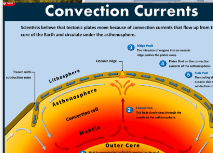
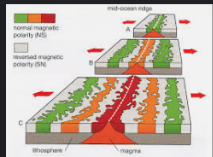
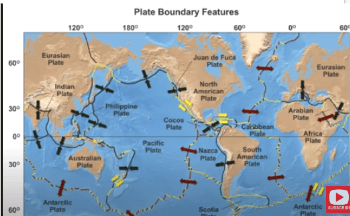
What is the driving force behind the movement of the plates?
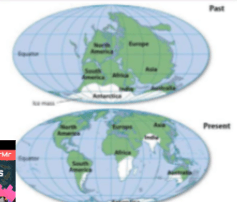
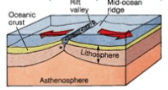
divergent
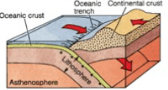
convergent
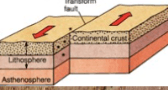
transform
The lithosphere includes the _____ and part of the _____.
core, crust
mantle, core
crust, core
crust, mantle
Which system is made up of all the living things on Earth
Biosphere
Hydrosphere
Atmosphere
Geosphere
Which system is made up of all of the rock and land formations on Earth?
Biosphere
Hydrosphere
Atmosphere
Geosphere
Which system is made up of all of the water on Earth?
Biosphere
Hydrosphere
Atmosphere
Geosphere
Which pie chart shows the relative proportions of Earth's water in each location?


The picture below shows the polar ice caps in the Arctic sea. What will happen to the ice caps if the Sun's energy gets stronger?
The ice will become much colder, causing
clouds to form less rainfall.
The ice will become much harder, causing
clouds to form more rainfall.
The ice will become water, then the water will
become vapor.
The ice will become vapor, then the vapor will
become water.
Huge waves of water that crash on shore after under water disturbances
Tsunami
A small storm formed over land that usually only last for a few minutes
Tornado
When Magma beneath the Earth's crust heat and pressure builds and it pushes out
Volcanoe
Huge Spinning storm that form over warm ocean water
Hurricane
Happens when part of the solid ground beneath the surface suddenly shifts
Earthquake
Earth's rocks change from one type to another in a cycle called __________
Earth's rocks process
The sedimentary rock cycle
The rock cycle
The igneous rock cycle
Order the materials from smallest to largest.
boulder, mountain, gravel, sand
mountain, boulder, gravel, sand
sand, gravel, boulder, mountain
Snow is an example of ___________.
evaporation
collection
precipitation
condensation
The way in which heat is trapped close to Earth's surface by gases.
Greenhouse Effect
Climate Change
Blanket Theory
Heat Sink Theory
Match the following Cause and Effect.
Geologic Processes (Volcanoes or Meteorite Impacts)
Gas and dust block sunlight and cause temperature to drop
Biologic Processes (Photosynthesis)
Cyanobacteria consume CO2 and add O2 to the atmosphere
Human Activity (Cars and Electricity)
Using fossil fuels adds CO2 to the atmosphere, causing temperature to increase.
CFC Use
Breaks down Ozone and allows harmful radiation to reach Earth
Why is our atmosphere important? (3)
The atmosphere protects Earth from meteor impacts.
The atmosphere protects Earth from harmful radiation and solar flares.
The atmosphere protects Earth from Volcano eruptions.
The atmosphere stabilizes our temperature.
The atmosphere causes temperature range to increase.

The graph shows us that
the earth temperature is always increasing
the earth's temperature has steadily increased since 1900
the earth's temperature has steadily rising since the 1960s
the earth's temperature decreased during the 19th and 20th centuries

The greenhouse effect is about
warming the atmosphere because of increased CO2 levels
warming the atmosphere because of decreased CO2 levels
cooing the atmosphere because of increased CO2 levels
cooling the atmosphere because of decreased CO2 levels
Rain, Sleet, and Snow are all examples of what?
Condensation
Precipitation
Runoff

Step one is an example of which form of heat transfer?
Conduction
Convection
Radiation
do we drink the same water that was on earth million years ago?
true
false
Atmosphere
The blanket of air that surrounds Earth
All the water that covers Earth
All the rocks and minerals that make up Earth

At higher altitudes, air pressure is...
Lower
Higher
The same
Increasing

What force creates air pressure on Earth?
Gravity
Magnetism
Electricity
Greenhouse Effect

_________________ is how the atmosphere behaves over relatively long periods of time.
Weather
Climate
Climate change
Latitude

Select all items that refer to weather forecasts.
Temperature
Humidity
Precipitation
Sunset
Wind
what determines weather?
Temperature
Air pressure
Wind
The amount of moisture in the air
Temperature
Tides
Sun
Moon
Heat
Snow
Wind
Rain
Cold
Air pressure
Wind
Rain water
Which of the following is a source of heat in Earth's interior? Select 3.
gravity pulling dense material to the center
seismic waves
radioactive decay
solar radiation
collisions of rock
Select TWO of the following discoveries that are evidence supporting the idea of continental drift? You need to find two that are evidence of continental drift.
the discovery of matching plant and animal fossils found on different continents
the discovery that most earthquakes are near plate boundaries
coal found in Antarctica
the discovery of the rock age increases as distance from mid-ocean ridges increases
the discovery of sea-floor rock patterns due to magnetic reversal
What two processes occur at mid-ocean ridges? Check two.
Material rises from the mantle to the crust.
Sediments from the crust sink into the mantle.
Crustal rock subducts into the mantle and melts
Thermal energy rises from the mantle to the crust.
Tsunami waves transfer energy from the crust to the mantle.

Nitrfying Bacteria

Plant

Nitrogen-fixing bacteria

atmosphere(air)

denitrfying bactera

A correct path that Nitrogen could take would be...
Air--> Animals--> Plants--> Bacteria
Air--> Bacteria--> Plants--> Animals
*Choose all that apply* What are benefits of photosynthesis?
It makes food that plants and animals can use for energy
It changes light energy from the sun into a form that can be used by living things
It changes carbon into a form that can be used by living things
__________ is the process of plants converting carbon from the air to make sugar.
Photosynthesis
Respiration
Decomposition
Fossilization
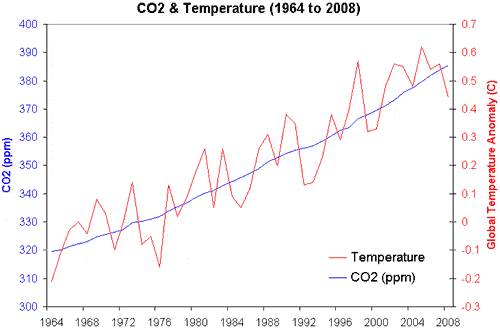
The graph below shows CO2 emissions and temperatures from 1909 to 1949. What conclusion is best supported by the graph?
There is no relationship between carbon dioxide concentrations and temperatures
As carbon dioxide concentrations increase, temperatures increase
As carbon dioxide concentrations increase, temperatures decrease
As carbon dioxide concentrations decrease, temperatures increase
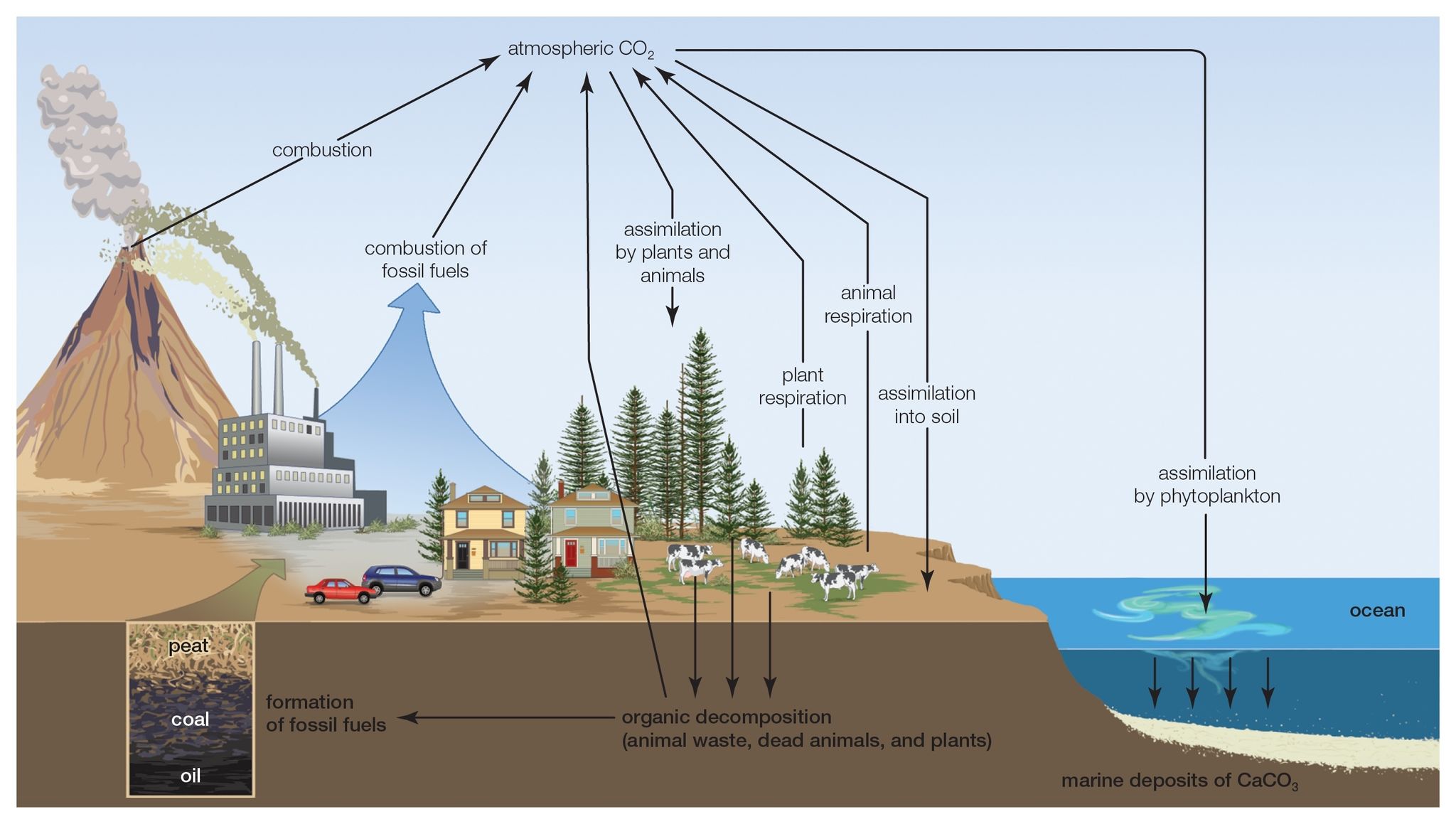
Label the steps of the carbon cycle in the correct location.
Combustion is another word for _____
Burning
Transportation
Respiration
Fossil fuels
occurs when the sun heats water up and it becomes vapor in the air.
Evaporation
the opposite of evaporation; it occurs when air cools and the vapor collects into liquid form.
Condensation
condensation falling onto land in the form of rain, sleet, hail, snow, and mist. Only 10% of water evaporated falls as precipitation.
Precipitation
the downward movement of water from the land surface into the soil or porous rock. Ground water begins as precipitation. Once water infiltrates the soil it can move vertically and horizontally through the soil.
Infiltration
is the water that exists for long periods below the Earth’s surface.
Groundwater storage

Evaporation
A
Condensation
B
Precipitation
C
Transpiration
D
Groundwater
E
The water cycle has no beginning or end.
True
False

