wayground logo

Free Printable Worksheets

NEW

Font size

S
M
L
XL
Worksheets

7F Separation Techniques Quiz

Total questions: 22

Worksheet time: 18mins

Name
Class
Date
1.

Name the separation technique

a)

Centrifuge

b)

Crystallisation

c)

Distillation

d)

Evaporation

2.

Name the separation technique

a)

Filtration

b)

Evaporation

c)

Distillation

d)

Separation

3.

True or false: Magnets can be used to separate iron filings from sand

a)

True

b)

False

4.

In a salt water solution ...

a)

Salt is the solute and water is the solvent

b)

Salt is the solvent and water is the solute

5.

True or false: Sieving can be used to separate a mixture with two solid components of different sizes

a)

True

b)

False

6.

True or false: Decanting is a technique that can be used to separate a salt water solution

a)

True

b)

False

7.

solute + solvent =

a)

solution

b)

equation

8.
What is a solute?
a)
The substance that does the dissolving in a solution.
b)
The substance that is dissolved into the solution.
c)
The mixing of different substances.
d)
The process in which neutral molecules lose or gain electrons
9.

Which separation technique is used to obtain salt from seawater?

a)

Simple distillation

b)

Filtration

c)

Chromatography

d)

Evaporation

10.

During filtration, the solid that is trapped in the filter paper is called ..A.. and the liquid that has passed through the filter paper is called ..B..

a)

A: residue B: filtrate

b)

A: residue B: filterate

c)

A: filtrate B: residue

d)

A: filterate B: residue

11.
Which one of the following is a disadvantage of evaporation?
a)
It always requires heat
b)
It cannot be used for insoluble solids
c)
All of the solute is recovered
d)
The solvent (liquid part) is not recovered
12.

No matter what you do, sand will not dissolve in water, because sand is _________.

a)

dissolved

b)

soluble

c)

insoluble

d)

aqueous

13.
If you shake up the sand and water, the sand spreads through the water forming a cloudy ______.
a)
substance
b)
suspension
c)
sediment
d)
solution
14.

Charcoal powder is insoluble in water. When water is filtered, the charcoal powder becomes the _______.

a)

solute

b)

residue

c)

filtrate

d)

solvent

15.

A solution that contains the maximum amount of solute that is able to dissolve is best described as 

a)

unsaturated

b)

saturated

c)

dilute

d)

weak

16.
Filtration can be used to separate...
a)
an insoluble solid from a solution
b)
a soluble solid from a solution
c)
a dissolved solid from a solution
17.

solute + solvent =

a)

solution

b)

equation

18.
What is a solute?
a)
The substance that does the dissolving in a solution.
b)
The substance that is dissolved into the solution.
c)
The mixing of different substances.
d)
The process in which neutral molecules lose or gain electrons
19.
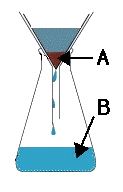
The diagram shows the apparatus for separating soil and water. What are the labelled parts?
a)
A = distillate, B = filtrate
b)
A = filtrate, B = residue
c)
A = residue, B = filtrate
d)
A = residue, B = distillate
20.

True or false: Sieving can be used to separate a mixture with two solid components of different sizes

a)

True

b)

False

21.
What is the boiling point of water?
a)
0oC
b)
100oC
c)
80oC
d)
95oC
22.
Which one of the following is NOT an example of a separation technique?
a)
boiling an egg
b)
fishing net
c)
surgical mask
d)
 tea strainer