wayground logo

Free Printable Worksheets

Font size

S
M
L
XL
Worksheets

VUS.2-5 Review

Total questions: 44

Worksheet time: 47mins

Name
Class
Date
1.
Which date on the this timeline represents the beginning of a permanent British presence in North America
a)
1565
b)
1587
c)
1607
d)
1620
2.
Which Colony was established as a business venture?
a)
Connecticut
b)
Massachusetts
c)
Georgia
d)
Virginia
3.
The initial French exploration of North America Resulted in
a)
economic opportunities in Florida
b)
competition with Spanish settlers
c)
plantations using slave labor
d)
cooperation with native groups
4.
The Colony type in the map colored yellow represents:
a)
Southern
b)
Mid - Atlantic
c)
New England
d)
Floridian
5.
The Colony type in the map colored turquoise represents:
a)
Southern
b)
Mid - Atlantic
c)
New England
d)
Floridian
6.
The Colony type in the map colored pink represents:
a)
Southern
b)
Mid - Atlantic
c)
New England
d)
Floridian
7.
The government of the early New England Colonies was a form of direct democracy administered through -
a)
formal legislative bodies
b)
town meetings
c)
decrees from the King 
d)
powerful warlords
8.
A type of labor that existed in the New World where someone pledged a certain number of years of service in exchange for passage was known as - 
a)
slavery
b)
indentured servitude
c)
contract work
d)
apprentice
9.
The first elected assembly in the New World was ____________ now known as the General Assembly of Virginia. 
a)
Virginia Assembly of Elders
b)
Virginia High Council
c)
Virginia Squires
d)
Virginia House of Burgesses 
10.
The document that provided a framework for the first New England Colony was the -
a)
Declaration of Independence  
b)
Two Treatise on Government
c)
Albany Plan of Union
d)
Mayflower Compact
11.
The primary reason for the establishment of the New England Colonies was...
a)
Academic
b)
Economic
c)
Religious
d)
Scientific
12.
The primary reason for the establishment of the Southern Colonies was...
a)
Academic
b)
Economic
c)
Religious
d)
Scientific
13.
These individuals were English nobility who received large land grants in eastern Virginia from the King of England. They were called
a)
Landowners
b)
Nobility
c)
Knights of Arms
d)
Cavaliers
14.
What religious group settled primarily in Pennsylvania?
a)
Puritans
b)
Quakers
c)
Catholics
d)
Presbyterians
15.
Which movement led to the rapid growth of evangelical religions in Europe and the colonies during the mid-1700s?
a)
The Great Awakening
b)
Religious Zealots
c)
The Vatican mandate
d)
Martin Luther reforms
16.
Conflict between American Indians and European settlers most often resulted from the different ways each culture viewed
a)
religious practices
b)
political systems
c)
family relationships
d)
land ownership
17.
Which colonial area was settled by Puritans?
a)
New England
b)
Middle Atlantic
c)
The South
d)
The Tennessee Valley 
18.
Which of the following was the source for a colonial New England covenant community?
a)
The Mayflower Compact
b)
The Magna Carta
c)
The Bill of Rights
d)
The Declaration of Independence
19.
This passage brought slaves to the New World
a)
Northern Passage
b)
Middle Passage
c)
Southern Passage
d)
Eastern Passage
20.
Which state was founded by dissenters fleeing persecution by Puritans in Massachusetts?
a)
Vermont
b)
Rhode Island
c)
Ohio
d)
Maine
21.
One result of the first Great Awakening was
a)
the revival of the Salem witch hunts
b)
a move to limit religious freedom
c)
the founding of free Bible colleges
d)
a renewed interest in religion
22.
English nobility who received large land grants in Eastern Virginia from the King of England
a)
cavalier
b)
slave
c)
indentured servant
d)
artisan
23.
a worker in a skilled trade, especially one that involves making things by hand
a)
cavalier
b)
slave
c)
indentured servant
d)
artisan
24.

What best fits the "?"

a)

French and Indian War

b)

Revolutionary War

c)

Spanish-American War

d)

Great Awakening

25.

The Proclamation of 1763 stated that -

a)

the colonists were not allowed west of the Appalachian Mountains.

b)

the French were not allowed east of the Mississippi River.

c)

American Indians were not allowed west of the Appalachian Mountains.

d)

The Spanish were not allowed North of Florida.

26.

During the Revolutionary War Era, this cartoon by Benjamin Franklin attempted to -

a)

encourage colonists to put aside their differences.

b)

recruit colonists for the royal navy.

c)

persuade colonists to support the loyalists.

d)

convince colonists to maintain state sovereignty.

27.

The Sugar Act and Stamp Act were early examples of how the -

a)

British taxed the colonists to pay off their French and Indian War debt.

b)

colonists eagerly made sacrifices to pay their Revolutionary War debt.

c)

British attempted to aid the failing colonial economies.

d)

colonies taxed merchants for the goods they sold.

28.

During the American Revolution, a Loyalist would have agreed with which of the following political statements?

a)

The colonists should pay for the British troops protecting the colonies.

b)

British taxes on the colonists are unfair.

c)

Colonists should have the ability to govern themselves.

d)

Rebelling is the only way to achieve freedom for the colonists.

29.

Thomas Paine's publication of Common Sense influenced many colonists to support -

a)

the idea of separation from Britain.

b)

the concept of capitalist economies.

c)

the formation of loyalist groups.

d)

purchasing Louisiana.

30.

John Locke's ideas influenced the Declaration of Independence because he influenced the belief of the colonists in -

a)

self-government and natural rights.

b)

capitalism and free enterprise.

c)

a strong federal government and the rule of law.

d)

a monarchy and democracy.

31.

Which famous colonist negotiated the treaty of alliance with France during the American Revolution?

a)

Benjamin Franklin

b)

George Washington

c)

John Adams

d)

Thomas Jefferson

32.

One major element of George Washington's military strategy during the Revolutionary War was avoiding -

a)

direct confrontations with the British.

b)

night attacks on the British.

c)

important cities.

d)

naval battles.

33.
What was the name of the FIRST government of an independent United States after 1776?
a)
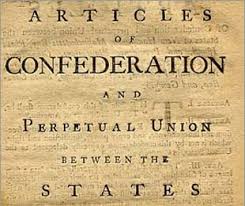
Articles of Confederation
b)
Mayflower Compact
c)
2nd Continental Congress
d)
House of Burgesses
34.

Who wrote the Virginia Declaration of Rights?

a)

George Mason

b)

George Washington

c)

James Madison

d)

Thomas Jefferson

35.

What completes the graphic?

a)

Bill of Rights

b)

Declaration of Independence

c)

Mayflower Compact

d)

Constitution

36.
What was the role of George Washington at the Constitutional Convention?
a)
Chairman of the Convention
b)
Father of the Constitution
c)
Argued for a new government
d)
Argued to keep the Articles of Confederation
37.
How many branches of government did the new constitution create?
a)
3
b)
1
c)
2
d)
4
38.
How did the framers solve the problem of how to count slaves for the House of Representatives?
a)
3/5 Compromise
b)
1/2 Compromise
c)
2/3 Compromise
d)
1/4 Compromise
39.
Who were the Federalists from Virginia?
a)
George Washington & James Madison
b)
Patrick Henry & George Mason
c)
John Adams & Sam Adams
d)
Benjamin Franklin & Paul Revere
40.
Who were the Anti-Federalists from Virginia?
a)
George Washington & James Madison
b)
Patrick Henry & George Mason
c)
John Adams & Sam Adams
d)
Benjamin Franklin & Paul Revere
41.
Most Anti-Federalists voted "yes" to the constitution after Federalists agreed to add what to the constitution?
a)
a Bill of Rights
b)
another branch of government
c)
more state powers
d)
a strong president
42.
The Articles of Confederation was unsuccessful as a government system because it established
a)
a common currency.
b)
a balance of power between national and state governments.
c)
a weak national government.
d)
state representation in the national legislature by size of population.
43.
The Supreme Court case of Marbury v. Madison is significant because it
a)
prohibited states from taxing the federal government.
b)
permitted annexation of the Louisiana Territory.
c)
authorized the Monroe Doctrine.
d)
established the power of the courts to declare laws unconstitutional.
44.
Which of the following is an example of a weakness in the Articles of Confederation?
a)
Congress couldn't collect taxes
b)
Weak national government
c)
Provided no common currency/money for all 13 states
d)
All of the  above