
 Worksheets
Short test
Total questions: 24
Worksheet time: 12mins
Name
Class
Date
1.
1) After applying an arm sling on a casualty, you should:
a)
Perform capillary refill test
b)
Nothing
c)
Walk away
d)
Check their heartbeat
2.
2) Bleeding from a vein can be described as:
a)
dark red and spurting
b)
dark red and flowing
c)
bright red and spurting
d)
bright red and flowing
3.
3) Hypovolemic shock is a disorder of _______ system.
a)
Digestive
b)
Nervous
c)
Respiratory
d)
Circulatory
4.
4) Which transportation rules are false:
a)
Don't explain your action
b)
Ensure casualty safety
c)
Never move alone if help available
d)
Protect yourself
5.
5) What happens to the pressure inside the chest when the diaphragm contracts?
a)
It remains the same
b)
It decreases
c)
It increases
d)
It is always equal to the atmospheric pressure
6.
6) What is the most common cause of airway obstruction in a 27-year old patient who fell unconscious during a sporting game?
a)
Food found in the mouth
b)
Vomit in the mouth
c)
Dentures
d)
Tongue
7.
7) Bandages are used to:
a)
Hold dressing in place
b)
Soak up blood directly from a wound
c)
Ease pain from a wound
d)
Prevent infection
8.
8) A superficial burn:
a)
Is the most serious of burns
b)
Involves only the top layer of skin
c)
Is red and blistered
d)
Destroys all layer of skin
9.
9) Poison can enter body through:
I. Eating/drinking
II. Inhaling
III. Injection
IV. Absorption through skin
a)
I, II, III
b)
II, III, IV
c)
I, II, III and IV
d)
I, III
10.
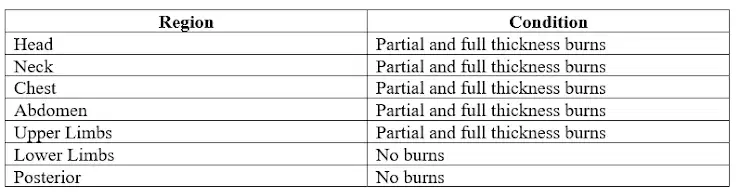
10) A casualty is unconscious and has extensive burns. Your assessments reveal the following:
a)
27
b)
45
c)
36
d)
54
11.
11) Which of the following is an alternative method to the Rule of Nines for approximating the size of affected body surface area?
a)
Rule of feet
b)
Rule of face
c)
Rule of thumbs
d)
Rule of palms
12.
12) Which of the principles of lifting(transportation) are incorrect?
a)
Safe grip
b)
Arms far to body
c)
Back straight
d)
Object close to body
13.
13) What is the average heartbeat rate for an adult per minute?
a)
60-80 beats
b)
12-16 beats
c)
100-120 beats
d)
40-60 beats
14.
14) Bleeding may NOT be stop by:
a)
Direct pressure
b)
Cold
c)
Elevation
d)
Indirect pressure
15.
15) Scalding is usually caused by:
a)
Fire
b)
Hot air
c)
Hot water
d)
Hot metal
16.
16) The following are the sign of hypovolemic shock EXCEPT:
a)
Rapid pulse
b)
Warm skin
c)
Clammy skin
d)
Weak pulse
17.
17) Signs of internal bleeding include:
a)
Reduced pulse rate and dry skin
b)
Reduced pulse rate and sweaty skin
c)
Increased pulse rate and clammy skin
d)
Increased pulse rate and warm skin
18.
18) The following are the bones of lower limbs EXCEPT:
a)
Femur
b)
Tibia
c)
Humerus
d)
Fibula
19.
19) Which of the following should NOT be performed when aiding a patient who has swallowed corrosive poison?
a)
Give water to patient
b)
Give milk to patient
c)
Induce the patient to vomit
d)
Find out what poison has been ingested by the patient
20.
20) What is the average adult breathing while resting?
a)
8-10 times per minute
b)
12-18 times per minute
c)
60-80 times per minute
d)
20-28 times per minute
21.
21) Hyperglycemia are caused by:
a)
Not eaten enough
b)
Overexertion
c)
Not taken their insulin
d)
Hot weather
22.
22) DRSABC stand for:
(a)
23.
23) Name the blood vessel which flows deoxygenated blood from the right ventricle.
a)
Pulmonary viens
b)
Aorta
c)
Pulmonary artery
d)
Inferior vena cava
24.
24) The following are the sign and symptoms of choking EXCEPT:
a)
Difficulties and noisy breathing
b)
Shouting
c)
Skin colour become grey-blue
d)
Grasping neck
100 %

