wayground logo

Free Printable Worksheets

Font size

S
M
L
XL
Worksheets

Physics 2nd semester final exam review

Total questions: 88

Worksheet time: 2hrs 46mins

Name
Class
Date
1.

During a collision. an object experiences an impulse. The impulse causes and is equal to the _____ of the object

a)

energy change

b)

kinetic energy change

c)

force

d)

momentum

e)

momentum change

2.

Which one of the following units represents the standard metric units of momentum

a)

Newtons * meter / second

b)

Kilograms * meter / second2

c)

meter / second

d)

Kilograms * meter / second

3.

When a cannon fires a cannon ball, it recoils backwards. This occurs because of...

a)

Energy in the system is conserved

b)

Energy in the system is increased

c)

Momentum in the system is conserved

d)

Energy in the system is not conserved

4.

A freight car of mass 20,000kg moves along a track at 15 m/s. What is the momentum of the car?

a)

30,000 kg*m/s

b)

3,000 kg*m/s

c)

300,000 kg*m/s

d)

3,000,000 kg*m/s

5.
The total momentum before a collision is _________ the total momentum after a collision.
a)
equal to 
b)
less than 
c)
more than
d)
It depends on the type of collision
6.

During a collision. an object experiences an impulse. How can this impulse be calculated?

a)

Multiplying force by time

b)

Multiplying mass by velocity

c)

Dividing velocity by time

d)

Multiplying mass by acceleration

7.
If 2 objects collide and stick together, what will happen to their velocities?
a)
velocities will increase
b)
velocities will decrease
c)
velocities will stay the same
d)
none of the above
8.

A 2kg object moving at 5 m/s encounters a 30 N resistive force over a duration of 0.10 seconds. The impulse experienced by this object is _____

a)

0.30 N*s

b)

2 N*s

c)

2.5 N*s

d)

3 N*s

e)

7 N*s

9.

An egg landing on a soft surface will remain intact. The surface increases the _____ and decreases the _____ during the impact

a)

impulse, time

b)

impulse, force

c)

force, time

d)

time, force

10.

Which one of these objects has the greater amount of momentum?

a)

A turtle that slowly crosses a road

b)

A parked car

c)

A stop sign

11.

A 5kg ball has a momentum of 30 kg*m/s. What is the speed of the ball

a)

150 m/s

b)

35 m/s

c)

6 m/s

d)

5 m/s

12.
An object with a mass of 2000 kg at rest has what momentum?
a)
2000 kg m/sec
b)
0 kg m/sec
c)
2000 kg
d)
2000 m/sec
13.

Padded dashboards in cars are safer in accidents than non padded ones because the passenger hitting the dash has...

a)

a) Increased time of impact

b)

b) decreased impulse

c)

c) decreased impact force

d)

d) a and b

e)

e) a and c

14.

Total momentum is conserved in what type of collisions?

a)

elastic

b)

inelastic

c)

both of them

15.

What is the equation for momementum?

a)

p=m×vp=m\times v

b)

p=m×ap=m\times a

c)

p=f÷ap=f\div a

d)

m=p×vm=p\times v

16.

An object that has momentum can be described as _________

a)

a) changing its velocity

b)

b) moving fast

c)

c) resisting changes in its state of motion

d)

d) having its mass in motion

e)

e) encountering a net force

17.

TRUE or FALSE. Potential energy is stored energy. It is relative to its position and location.

a)

True

b)

False: Potential energy is energy in motion.

18.
On a roller coaster, where is maximum potential energy?
a)
At the bottom of a big hill
b)
When going around a corner
c)
When going upside down
d)
At the top of a big hill
19.

SI unit for Power and its relationship with time

a)

Watts ; inversely proportional

b)

Watts ; directly proportional

c)

Joules ; inversely proportional

d)

Joules ; directly proportional

20.

Which of these is true at the halfway point for a falling object?

a)

PE > KE

b)

PE < KE

c)

PE = KE

d)

none of these

21.

A 300 N force moves an object 2m. How much work is done?

a)

300 J

b)

150 J

c)

600 J

d)

6000 J

22.

Which option is the correct unit of measurement for energy?

a)

Joule (J)

b)

Kilogram (kg)

c)

Newton (N)

d)

Jewel (je)

23.

TRUE or FALSE. Potential energy is stored energy. It is relative to its position and location.

a)

True

b)

False: Potential energy is energy in motion.

24.

Pick the correct formula to calculate for Potential Energy.

a)

PE = 1/2mv2

b)

PE = mgh

c)

m = PE/gh

d)

h = PE/mg

25.

Pick the correct formula to solve for Kinetic Energy.

a)

KE = 1/2mv2

b)

KE = mgh

c)

KE = d/t

d)

v2 = 2KE/m

26.

According to which law of energy, energy can't be created or destroyed?

a)

First law of motion

b)

The law of tacos

c)

Law of Energy

d)

Law of conservation of energy

27.

Edward pushes on a large rock that does not move. The work done on the rock is-

a)

Positive Work

b)

Negative Work

c)

No Work

28.
In the formula 
W = F * d
what is distance measured in?
a)
Newtons
b)
Feet
c)
Meters
d)
Whatever you want
29.
The faster an object moves, the ________ kinetic energy it has. 
a)
more
b)
less
c)
none of the above
d)
all of the above 
30.
Sound can't travel through :
a)
air
b)
water
c)
iron
d)
a vacuum
31.

Type of wave were particles move perpendicular to the wave's motion

a)

longitudinal

b)

surface

c)

transverse

d)

none of these

32.

Type of wave that does not require a medium (particles) to travel through?

a)

longitudinal

b)

surface

c)

transverse

d)

electromagnetic

33.

Type of wave that does not require a medium (particles) to travel through?

a)

longitudinal

b)

surface

c)

transverse

d)

electromagnetic

34.
Electromagnetic waves are:
a)
transverse waves
b)
longitudinal waves
c)
compressional waves
d)
combination waves
35.

Which wave travels fastet?

a)

sound

b)

water

c)

light

36.
Which two points on the wave represent the crest?
a)
A and E
b)
A and C
c)
B and D
d)
D and F
37.

A repelling force occurs between two charged objects when the charges are of

a)

unequal magnitude

b)

equal magnitude

c)

like signs

d)

unlike signs

38.

Light is consider _______________ ( select all that apply)

a)

Particle

b)

Wave

c)

Medium

d)

Phase Change

39.

What is the material that waves travel through?

a)

Medium

b)

Atmosphere

c)

Space

d)

Vibranium

40.

A wave bends around a corner by

a)

Refraction

b)

Diffraction

c)

Reflection

d)

Absorption

41.
What do we call the bottom of a transverse wave?
a)
crest
b)
trough
c)
wavelength
d)
amplitude
42.
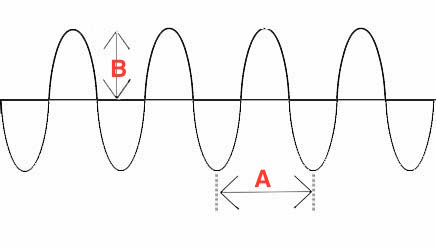
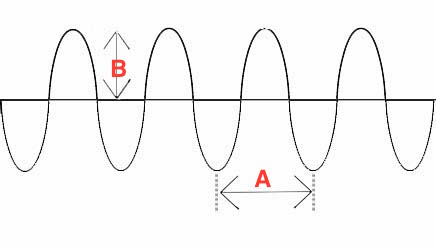
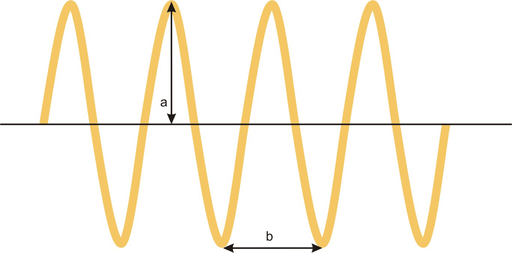
What property of this wave is represented by the letter "A"
a)
amplitude
b)
crest
c)
trough
d)
wavelength
43.
What property of the wave is represented by the letter "B"?
a)
amplitude
b)
crest
c)
trough
d)
wavelength
44.
What do waves carry from place to place?
a)
Energy, but not matter or particles
b)
Energy and matter or particles
c)
Matter or particles but not energy
d)
Neither energy nor matter or particles
45.
Which wave is pictured?
a)
Transverse
b)
Longitudinal
c)
Both
d)
Neither
46.
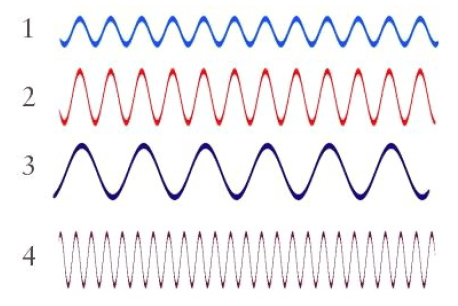
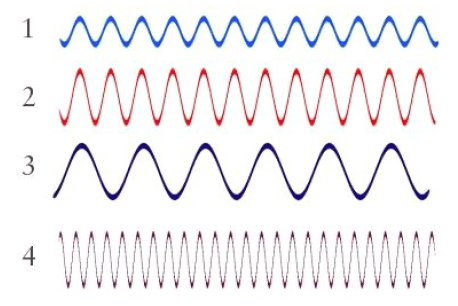
Which wave in the diagram has the greatest frequency?
a)
1
b)
2
c)
3
d)
4
47.
What kind of wave is pictured below?
a)
compressional wave
b)
transverse wave
c)
sound wave
d)
mechanical wave
48.
How would a person measure the wavelength on this sound wave?
a)
dense to less dense
b)
trough to crest
c)
compression to compression
d)
beginning of illustration to the end
49.

Which wave in the diagram has the greatest wavelength?

a)

1

b)

2

c)

3

d)

4

50.
The units for frequency are measured in _____________.
a)
hertz
b)
seconds
c)
m/s
d)
grams
51.

Sandra notices five wave crests pass by her every 10 seconds. What is the frequency of this wave?

a)

10 Hertz

b)

2 Hertz

c)

0.5 Hertz

d)

5 Hertz

52.
When wavelength increases, what happens to the frequency?
a)
it increases
b)
it decreases
c)
it stays the same
53.
How many waves are in this wave chain?
a)
6
b)
3
c)
4
d)
5
54.
 A wave has frequency of 50 Hz and a wavelength of 10 m. What is the speed of the wave?
a)
500 m/s
b)
50 m/s
c)
5 m/s
d)
0.5 m/s
55.
A wave has wavelength of 10 m and a speed of 340 m/s. What is the frequency of the wave?
a)
34 m/s
b)
3400 Hz
c)
3400 m/s
d)
34 Hz
56.
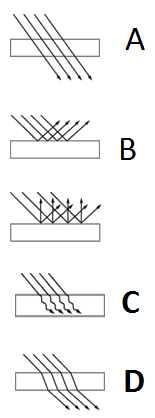
Which of the following represents refraction?
a)
A
b)
B
c)
C
d)
D
57.
Which of the figures represents reflection?
a)
A
b)
B
c)
C
d)
D
58.
This image is representing what wave interaction?
a)
Refraction
b)
Diffraction
c)
Reflection
d)
Interference
59.
Which wave in the diagram below appears to have the higher amplitude?
a)
The top picture
b)
The bottom picture
c)
They both have the same amplitude
d)
The waves only show frequency
60.
Constructive interference will cause the wave to 
a)
Increase its displacement
b)
Decrease its displacement 
c)
Make its displacement stay the same
61.

Two like charges

a)

don't interact

b)

repel

c)

attract

d)

add up to 2

62.
Where do electrons go when you rub a balloon on your hair?
a)
Onto the balloon
b)
Into your hair
c)
Nowhere
63.
How many Volts would it take to push 1 Amp through a resistance of 1 Ohm
a)
10 volts
b)
1 volt
c)
48 volts
d)
5 volts
64.
This is an example of a ______ circuit
a)
Series
b)
Parallel
c)
Open
d)
Dihexihedral
65.
What method of charging adds electrons to a balloon when you rub it with a piece of rabbit's fur?
a)
conduction
b)
induction
c)
friction
d)
resonance
66.
This is an example of a _______ circuit
a)
open
b)
series
c)
parallel
d)
square
67.

If both resistors R1 and R2 are identical and have a resistance of 4 Ω, and the battery provides 12 V, then the total current coming from the battery is

a)

6 A

b)

1.5 A

c)

24 A

d)

3 A

68.

If the voltage across the battery was 10 V, how much voltage does each bulb get?

a)

10 V

b)

5 V

c)

20 V

d)

0 V

69.

Which circuit has the smallest equivalent resistance? All resistors have a resistance of 4 ohms.

a)

A

b)

B

c)

C

70.

What is the total current in this circuit?

a)

0.32 A

b)

456 A

c)

0.6 A

d)

1.09 A

e)

1.71 A

71.
The equivalent resistance in this circuit is 
a)
100 ohms
b)
450 ohms
c)
400 ohms
d)
30 ohms
72.
The current through the battery of this circuit is
a)
0.02 amps
b)
0.09 amps
c)
50 amps
d)
9 amps
73.

The power consumed by a 10 ohm resistor connected to a 2 v power source is

a)

0.02 W

b)

0.04 W

c)

100 W

d)

9 W

74.
In a parallel circuit if one of the light bulbs burns out the rest _________.
a)
stop the flow of electricity
b)
 can still light up
c)
 will go out
d)
of the light bulbs burn out also
75.

Current (I) is measured in

a)

Amperes

b)

Voltage

c)

Ohms

d)

Gigawatts

76.
What is resistance measured in?
a)
Ω (Ohms)
b)
V (Volts)
c)
A (Amps)
d)
W (Watts)
77.
If the Voltage stays the same and Resistance is increased, Current will 
a)
Increase
b)
Decrease
c)
Stay the same
d)
X
78.
In a parallel circuit which of the following is different for each resistor?
a)
Voltage
b)
Current
c)
Ohms Law
d)
Charge
79.

How many lightbulbs will work if there is a break in the circuit at POINT F?

a)

1

b)

2

c)

3

d)

NONE

80.
An atom loses an electron.  What type of charge does it have now?
a)
positive
b)
negative
81.
When a glass rod is rubbed with silk and the glass rod becomes positively charged, what happens to the electrons?
a)
they are removed from the rod
b)
they are added to the rod
82.

A charged balloon is brought near an electroscope but DOES NOT touch the electroscope, and then grounded. This is an example of charging by

a)

Conduction

b)

Convection

c)

Friction

d)

Induction

83.
The force that pushes the electricity through a circuit is called...
a)
resistance
b)
voltage
c)
current
d)
switch
84.
What slows down the flow of electricity in a circuit?
a)
resistance
b)
voltage
c)
current
d)
source of electric current
85.

If I add more light bulbs to a series circuit what happens?

a)

The current speeds up and the lights get brighter

b)

The current slows down and the lights dim lower

c)

The current speeds up and the lights dim lower

d)

The current slows down and the lights get brighter

86.
The picture shows an electrical circuit. This circuit is a series circuit because: 
a)
It has 3 light bulbs.
b)
The same current flows through all three light bulbs.
c)
It uses a single battery.
d)
The electrical current is divided between the three light bulbs.
87.
What is current measured in?
a)
Ω (Ohms)
b)
V (Volts)
c)
A (Amps)
d)
W (Watts)
88.
What voltage is needed to cause a 2A current flow through a 10Ω resistor?
a)
5V
b)
0.2V
c)
20V
d)
200V