
 Worksheets
Day #2: Review
Total questions: 21
Worksheet time: 2hrs 15mins
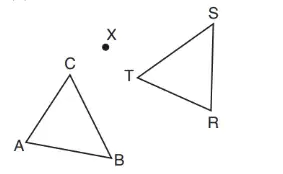
After a counterclockwise rotation about point X, scalene triangle ABC maps onto
∆RST, as shown in the diagram below. Which statement must be true?
∠A≅∠R
∠A≅∠S
CB≅TR
CA≅TS
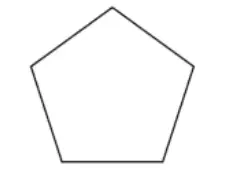
The regular polygon below is rotated about its center. Which angle of rotation will carry the figure onto itself?
60°
108°
216°
540°
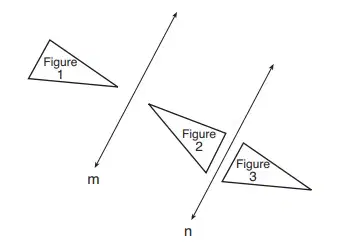
In the diagram below, line m is parallel to line n. Figure 2 is the image of Figure 1 after a reflection over line m. Figure 3 is the image of Figure 2 after a reflection over line n. Which single transformation would carry Figure 1 onto Figure 3?
a dilation
a rotation
a reflection
a translation
Triangle A'B'C' is the image of triangle ABC after a translation of 2 units to the right and 3 units up. Is
∆ABC congruent to ∆A'B'C'? Explain why.
Given square RSTV, where RS = 9 cm. If square RSTV is dilated by a scale factor of 3 about a given center, what is the perimeter, in centimeters, of the image of RSTV after the dilation?
12
27
36
108
Line MN is dilated by a scale factor of 2 centered at the point
(0,6). If MN is represented by y=-3x+6 , which equation can represent M'N', the image of MN?
y=-3x+12
y=-3x+6
y=-6x+12
y=-6x+6
Points
D(1,2), B(1,4), and C( 3,4) are graphed on the set of axes below. State the coordinates of D', the image of ∆DBC, after a dilation of scale factor 2.
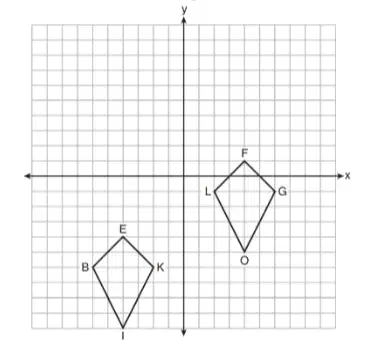
Quadrilaterals BIKE and GOLF are graphed on the set of axes below. Describe a sequence of transformations that maps quadrilateral BIKE onto quadrilateral GOLF.
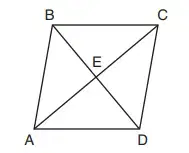
The diagram below shows parallelogram ABCD with diagonals.
AC and BD intersecting at E. What additional information is sufficient to prove that parallelogram ABCD is also a rhombus?
BD bisects AC
AB is parallel to CD
AC is congruent to BD
AC is perpendicular to BD

Given: Parallelogram ABCD,
BFAFD, and DEBEC
Prove: BEDF is a rectangle

Skye says that the two triangles below are congruent. Margaret says that the two triangles are similar. Are Skye and Margaret both correct? Explain why.

In the diagram below,
AF, and DB intersect at C, and AD and FBE are drawn such that m ∠D=65°, m ∠CBE=115°, DC=7.2, AC=9.6, and CF=21.6. What is the length of CB?
3.2
4.8
16.2
19.2
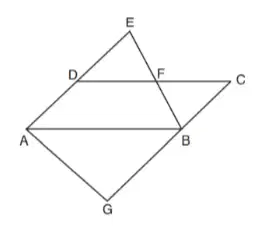
In the diagram below,
AB is parallel to DFC, EDA is parallel to CBG , and EFB and AG are drawn. Which statement is always true?
∆DEF≅∆CBF
∆BAG≅∆BAE
∆BAG ~ ∆AEB
∆DEF ~ ∆AEB
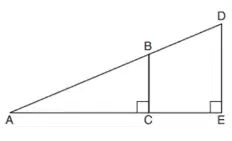
In the diagram below of right triangle AED,
BCDE. Which statement is always true?
AC/BC=DE/AE
AB/AD=BC/DE
AC/CE=BC/DE
DE/BC=DB/AB

In the diagram below of
∆PQR, ST is drawn parallel to PR, PS = 2, SQ = 5, and TR = 5. What is the length of QR?
7
2
12 1/2
17 1/2
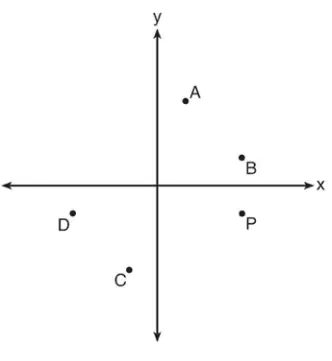
Which point shown in the graph below is the image of point P after a counterclockwise rotation of 90° about the origin?
A
B
C
D
What is the image of the point (−5,2) under the translation T (3, −4)?
(−9,5)
(−8,6)
(−2,−2)
(−15,−8)

Triangle A'B'C' is the image of ABC after a dilation centered at the origin. The coordinates of the vertices of ABC are A (−2,1), B (2,4), and C (2, −3). If the coordinates of A' are (−4,2), the coordinates of B' are
(8,4)
(4,8)
(4,−6)
(1,2)
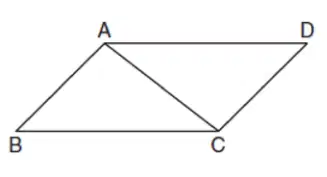
Given: Parallelogram ABCD with diagonal AC drawn. Prove: Triangle ABC ≅ Triangle CDA
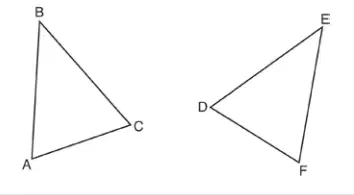
Which statement is sufficient evidence that DEF is congruent to ABC?
AB = DE and BC = EF
∠D ≅ ∠A, ∠B ≅ ∠E, ∠C ≅ ∠F
There is a sequence of rigid motions that maps AB onto DE, BC onto EF, and AC onto DF
There is a sequence of rigid motions that maps point A onto point D, AB onto DE, and ∠B onto ∠E.
In right triangles ABC and RST, hypotenuse AB = 4 and hypotenuse RS = 16. If ABC ∼ RST, then 1:16 is the ratio of the corresponding
legs
areas
volumes
perimeters

