
 Worksheets
Practice for Final Exam 2026
Total questions: 100
Worksheet time: 50mins
Name
Class
Date
1.
Why did the Pilgrims come to North America?
a)
Gold and adventure
b)
better farmland
c)
to discover a Northwest Passage
d)
Religious freedom
2.
According to the Navigation Acts, what was the only country in which the colonists could sell some of their goods, including tobacco, cotton, and indigo?
a)
England
b)
Other Colonies
c)
France
d)
Spain
3.
The possibility of a person to move from one social class to another is called
a)
Social Mobility
b)
Democracy
c)
Free Enterprise
d)
Elitism
4.
In the Declaration of Independence, Jefferson wrote that government should be based on the
a)
consent of the governed
b)
will of the strongest
c)
decisions of landowners
d)
vote of all adults
5.
Colonists who supported Great Britain were called
a)
Royalists
b)
Constitutionalists
c)
Federalists
d)
Loyalists
6.
On the Olive Branch Petition, the colonists said they were
a)
joining sides with the Native Americans
b)
forming a new nation
c)
going to war
d)
Still loyal to the king
7.
What was the main purpose of the Bill of Rights?
a)
It declared war against King George III and England
b)
The Bill of Rights prohibited slavery
c)
It establishes the executive branch of the government
d)
It spells out the rights of individual citizens
8.
Which political party wanted a weak federal government with strong states’ rights?
a)
Federalists
b)
Republicans
c)
Democratic-Republicans
d)
Democrats
9.
Which political party wanted a strong federal government with lots of power?
a)
Federalists
b)
Republicans
c)
Democratic-Republicans
d)
Democrats
10.
Sedition means to act out against the
a)
Constitution
b)
Government
c)
Supreme Court
d)
Church
11.
What word means to cancel?
a)
unconstitutional
b)
nullify
c)
tribute
d)
deport
12.
What word means to kidnap?
a)
impress
b)
nullify
c)
tribute
d)
deport
13.
While in office, Jefferson
a)
Expanded the military
b)
Cut federal spending
c)
Discouraged agriculture
d)
Raised taxes
14.
Developer of the "American System"
a)
John Q Adams
b)
Andrew Jackson
c)
Henry Clay
d)
James Monroe
e)
John C Calhoun
15.
Our first ten amendments are known as:
a)
The Treaty of Paris
b)
The Constitution
c)
The Declaration of Independence
d)
The Bill of Rights
16.
People who buy land in the hope that they can sell it at a higher price are called
a)
Brokers
b)
Speculators
c)
Landlords
d)
Realtors
17.
Which of these best explains the American colonization of the West?
a)
Demand for buffalo skins by Europeans
b)
A lack of consistent food supply in the East
c)
Demand for land and a new life for early settlers
d)
Settlers desire to see the Pacific Ocean
18.
In the 1800s, women could not
a)
vote
b)
publish books
c)
hold jobs
d)
meet publicly
19.
Families on small Southern farms were called
a)
gentry
b)
yeomanry
c)
the elite
d)
peasants
20.
Many northerners openly assisted fugitive slaves, ignoring
a)
Slave Codes
b)
Harriet Tubman
c)
The Fugitive Slave Act
d)
The Missouri Compromise
21.
Confederate President
a)
PGT Beauregard
b)
South
c)
North
d)
Winfield Scott
e)
Jefferson Davis
22.
54th Massachusetts Volunteers
a)
George McClellan
b)
Union Army
c)
Confederate Army
d)
George Meade
e)
African American Union army regiment
23.
The Emancipation Proclamation made the war a struggle over
a)
Borders
b)
Slavery
c)
Expansion
d)
Tariffs
24.
The Civil War began when the Confederates captured a fort in
a)
Kentucky
b)
South Carolina
c)
Virginia
d)
North Carolina
25.
Grant's forces cut off the supply lines to Vicksburg in a strategy called
a)
a retreat
b)
a tactic
c)
a siege
d)
an advance
26.
During the beginning of the war, the South had a better
a)
Navy
b)
Army
c)
Railroad
d)
Banking system
27.
The states that lay between the Union and Confederacy were called
a)
Liner states
b)
buffer states
c)
Middle states
d)
Border States
28.
Before the Civil War, most controversies centered around slavery in
a)
Textile Mills
b)
The Deep South
c)
Canada
d)
The new territories
29.
The Republican Party was formed to oppose the
a)
Extension of slavery into western territories
b)
Statehood for Kansas
c)
Freeport Doctrine
d)
Election of Abraham Lincoln
30.
The first state to secede was
a)
Alabama
b)
South Carolina
c)
Maryland
d)
Kentucky
31.
California's population rose between 1848 and 1849 because of
a)
High immigration from Mexico
b)
The discovery of oil
c)
A war in China
d)
The Gold Rush
32.
The Missouri Compromise only applied to those states carved out of the
a)
Indiana Territory
b)
Ohio Territory
c)
Land settlement with Mexico
d)
Louisiana Territory
33.
In most Southern states, teaching an African American to read was
a)
outlawed
b)
the responsibility of the Church
c)
required by law
d)
the responsibility of slaveholders
34.
wrote Twelve Years a Slave
a)
Benjamin Montgomery
b)
Poor Whites
c)
Solomon Northup
d)
Denmark Vesey
e)
Free African Americans
35.
In 1860 the chief export of the US was
a)
citrus fruits
b)
cotton
c)
tobacco
d)
rice
36.
Between 1830 and 1860, most immigrants to the United States came from
a)
Africa
b)
Asia
c)
Australia
d)
Europe
37.
The exclusive right to use, make, or sell an invention is given through a
a)
copyright
b)
license
c)
royalty
d)
patent
38.
Many African American women did not fight for women's rights because they gave their attention to
a)
religion
b)
the temperance movement
c)
abolition
d)
prohibition
39.
Famous conductor on the Underground Railroad.
a)
Elijah Lovejoy
b)
Wendell Phillips
c)
Harriet Tubman
d)
Frederick Douglass
e)
William Lloyd Garrison
40.
The religious group that opposed slavery was the
a)
Catholics
b)
Methodists
c)
Baptists
d)
Quakers
41.
Support for public schools was strengthened because of the large number of
a)
gangs among children
b)
illiterate federal workers
c)
immigrants to the United States
d)
teachers moving to the United States
42.
The Oregon Country included present-day
a)
Texas
b)
California
c)
North Dakota
d)
Idaho
43.
The Mexican War resulted in
a)
The US increasing its land holdings in North America
b)
Texas breaking away from the US
c)
Southern California being controlled by Mexico
d)
Mexico increasing its land holdings in North America
44.
During the Gold Rush, many Asians moved to California from
a)
China
b)
Vietnam
c)
Japan
d)
India
45.
Northern States were concerned by the Mexican Cession because
a)
They were concerned about the language barrier, since people in the newly acquired lands did not speak English
b)
They feared the new states would be slave states
c)
They were upset that the new states would be against slavery
d)
They thought the US was becoming too big to govern itself
46.
A gold seeker in California
a)
Forty-niner
b)
Mifflin Gibbs
c)
John Sutter
d)
Joseph Smith
e)
Brigham Young
47.
What is the “states’ rights” theory?
a)
It was the solution to the problems between the North and South
b)
A theory supported by President Jackson
c)
The theory that the federal government should have more power over the states
d)
The theory that the states should have the right to overrule a federal law
48.
What state passed the Nullification Act?
a)
South Carolina
b)
Georgia
c)
Maryland
d)
New York
49.
The first President to die in office
a)
William Henry Harrison
b)
Henry Clay
c)
Andrew Jackson
d)
John Tyler
50.
The forced movement of the Cherokee is referred to as the
a)
Sorrowful Journey
b)
Last Campaign
c)
Path of Death
d)
Trail of Tears
51.
Jackson’s practice of rewarding political supporters with government jobs became known as
a)
Jacksonian democracy
b)
Mudslinging
c)
A corrupt bargain
d)
The spoils system
52.
Which amendment protects Americans from unreasonable searches and seizures?
a)
Second
b)
Third
c)
Fourth
d)
First
53.
How does an amendment go into effect? (The FINAL step)
a)
2/3 vote of Congress
b)
2/3 of states must ratify
c)
The President must veto it
d)
3/4 of states must ratify
54.
Which amendment guarantees the right to bear arms?
a)
Third
b)
Fourth
c)
Second
d)
First
55.
Any change in the Constitution is called a(n)
a)
ratification
b)
amendment
c)
nullification
d)
preamble
56.
Which job is the legislative branch of the US government responsible for?
a)
making laws
b)
interpreting laws
c)
enforcing laws
d)
carrying out laws
57.
Runaway slaves sometimes hid in
a)
Florida
b)
Atlanta
c)
Washington, D.C.
d)
New Orleans
58.
Factories began to pop up all over the New England area in the early and mid 1800s. What is one reason that there were so many more factories in New England than in the South?
a)
Slavery was illegal in the North, so the northerners had to find a way to earn money that did not involve slavery
b)
There were more rivers in the Appalachian Mountains, which the factories needed for power.
c)
The South had so many big cities, that there was no room for factories. Therefore, they had to be built in the North.
d)
Thomas Jefferson passed laws so that factories could only be built in the North.
59.
In the early-to-mid 1800s, there were three distinct sections in our country. What were the three sections?
a)
North, South, and West
b)
Up, down, and all around
c)
New England, Middle, and Southern colonies
d)
New York, D.C., and Boston
60.
In 1819, Missouri applied to become a state. Besides the issue of slavery, what was an area of concern in Missouri’s application for statehood?
a)
Native Americans still lived in Missouri and did not want to move away from their homelands
b)
Northerners did not want to lose power or representation in Congress
c)
How to divide the gold that was found on Missouri soil
d)
Use of the Missouri River, which led to the Mississippi River
61.
Interchangeable parts are
a)
Not possible
b)
Found in nature
c)
Very different
d)
The same
62.
The Industrial Revolution began in
a)
The United States
b)
France
c)
Germany
d)
Great Britain
63.
A rapid rise in the price of goods is called
a)
Stagflation
b)
Inflation
c)
Recession
d)
Depression
64.
The case Marbury vs. Madison was a landmark Supreme Court decision because it
a)
resulted in an increase in the number of Supreme Court Justices
b)
reinforced the power of the president as commander in chief
c)
established the power of the Supreme Court to declare a law unconstitutional
d)
increased the power of the Federalists in the legislative branch
65.
With the Louisiana Purchase, the size of the United States
a)
Grew by 10%
b)
Doubled
c)
Grew by 30%
d)
Tripled
66.
How did Lewis and Clark help the expanding country?
a)
They set up trails that the pioneers would later follow
b)
They helped remove the Spanish from what is now California
c)
they explored the West and brought back reports of the land and animals
d)
they helped set up large plantations in the west
67.
A government policy of letting people do as they choose is called
a)
Stare decisis
b)
Detente
c)
Laissez-faire
d)
Eminent Domain
68.
On June 18, 1812, President Madison asked Congress to declare war on
a)
Tripoli
b)
France
c)
Great Britain
d)
Native Americans
69.
Treaty that ended the War of 1812
a)
Battle of New Orleans
b)
Henry Clay
c)
Treaty of Ghent
d)
Lake Erie
e)
William Hull
70.
Which conflict led to the formation of the first political parties?
a)
The expansion of slavery
b)
Whether to fight the War of 1812 against the British
c)
The ratification of the Constitution
d)
Removal of Indian tribes to lands in the West
71.
How did creating a Senate give small states an equal voice in government?
a)
Larger states would send more members because more people lived there
b)
The Bill of Rights gave everyone an equal voice in the U.S. government
c)
Small states would send the same number of members as large states
d)
The three branches of government would all have the same amount of power
72.
What is one problem that surrounded the Articles of Confederation?
a)
The legislature could not declare war on other nations
b)
The legislature could not collect taxes directly from states
c)
The legislature could not negotiate treaties with other nations
d)
The legislature could not maintain an army or navy
73.
Both the federal and state governments have the power to
a)
make treaties
b)
create money
c)
tax
d)
declare war
74.
By which process can the United States Constitution be changed?
a)
Amendment
b)
Resolution
c)
Legislative hearing
d)
Veto
75.
The United States' first national constitution was called the
a)
American Rules
b)
Canon Law
c)
Bill of Rights
d)
Articles of Confederation
76.
The Three-Fifths Compromise concerned
a)
Tariffs
b)
Federal land grants
c)
Counting enslaved persons
d)
The appointment of judges
77.
The first 10 amendments to the Constitution are known as
a)
The Federalist
b)
The Citizenship Handbook
c)
The Bill of Rights
d)
The Added Amendments
78.
A government in which representatives are elected to govern on behalf of the people is called
a)
a confederation
b)
an alliance
c)
a republic
d)
a monarchy
79.
"I only regret that I have but one life to lose for my country" was said by
a)
Thomas Jefferson
b)
Thaddeus Kosciuszko
c)
Nathan Hale
d)
Benedict Arnold
80.
Preventing the movement of goods into ports
a)
Saratoga
b)
Valley Forge
c)
Blockade
d)
Long Island
e)
George Rogers Clark
81.
Wrote the Declaration of Independence
a)
Ethan Allen
b)
King George III
c)
Thomas Jefferson
d)
Richard Henry Lee
e)
Thomas Paine
82.
Through the Treaty of Paris, Great Britain agreed to
a)
give the United States money
b)
apologize for fighting
c)
give part of Canada to the United States
d)
remove its troops from American soil
83.
How did the Committees of Correspondence aid the Patriots’ efforts before the Revolutionary War?
a)
They organized opposition to slavery in hopes of gaining blacks’ support for independence
b)
They helped make sure citizens were informed about what was happening in far-off colonies
c)
They organized resistance to the British, especially in Massachusetts
d)
They printed the names of Loyalists in newspapers
84.
A colonial leader who warned that Parliament was a threat to American rights and liberties was
a)
Lord North
b)
Samuel Adams
c)
John Adams
d)
George Washington
85.
What Enlightenment idea influenced the Continental Congress to declare independence from Britain?
a)
Government powers should be spelled out in the law
b)
Government should protect the right of corporations to own property
c)
Government organization should be divided into three parts
d)
Government should be seen as a contract between the people and their rulers
86.
The First Continental Congress was held in
a)
Philadelphia
b)
New Orleans
c)
Boston
d)
New York
87.
Which is the name of the group that dumped tea in Boston Harbor to protest taxes?
a)
Knights of Columbus
b)
the Four Horsemen
c)
Boy Scouts of America
d)
Sons of Liberty
88.
Unlike the British, the French offered Native Americans
a)
Christianity
b)
Alcohol
c)
Horses
d)
Respect
89.
Triangular Trade routes ran from the West Indies, to New England, and to
a)
West Africa
b)
India
c)
Portugal
d)
Spain
90.
Most slaves used in the colonies were taken from Western Africa. Why were African slaves not taken from other parts of Africa like the East or the South?
a)
The African people did not like the Western African tribes and allowed them to be kidnapped into slavery while they protected the tribes in the other areas
b)
The Western part of Africa was closest to the Triangular Trade Route and was the easiest place to capture slaves to work in the colonies
c)
Africans from the West were able to speak English so they could communicate with the English much easier than people from other parts of Africa
d)
People from West Africa were stronger and could do more work than Africans from other parts of Africa
91.
Town meetings were an early form of
a)
Entertainment
b)
Revolution
c)
Protest
d)
Democracy
92.
Slave codes were adopted in the 1700’s and were designed to…
a)
Provide slave owners with guidelines as to how slaves should be treated
b)
Provide slaves with guidelines as to how they should behave
c)
Deny slaves of most rights such as the right to hold meetings
d)
Show slaves how to behave so that they could gain their freedom
93.
The route between Africa and America, used by slave traders was called the
a)
Path of Crime
b)
Middle Passage
c)
Slave Course
d)
Underground Railroad
94.
An area with mostly farms
a)
New England
b)
urban
c)
West Africa
d)
rural
95.
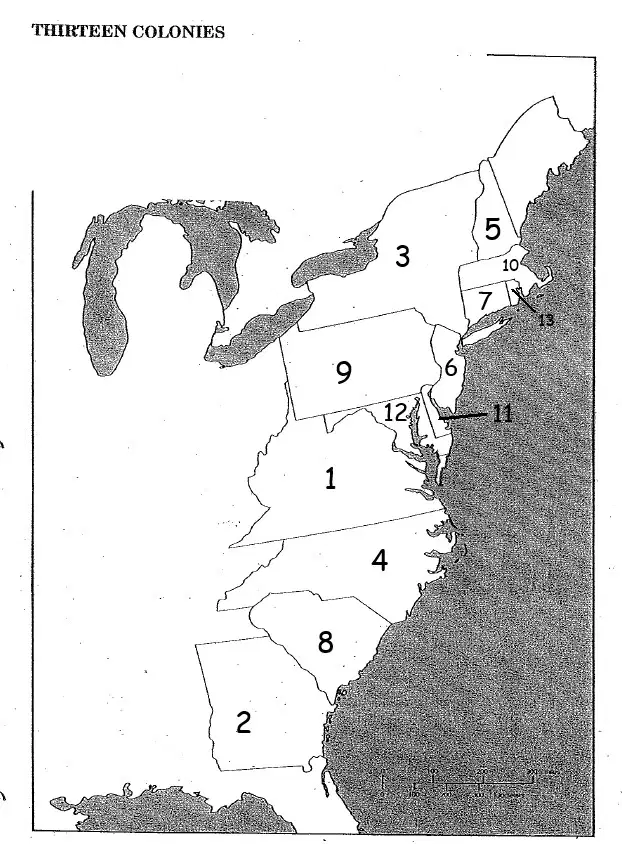
Which colony corresponds with number 1 on the map?
a)
Virginia
b)
Georgia
c)
South Carolina
d)
North Carolina
e)
Maryland
96.
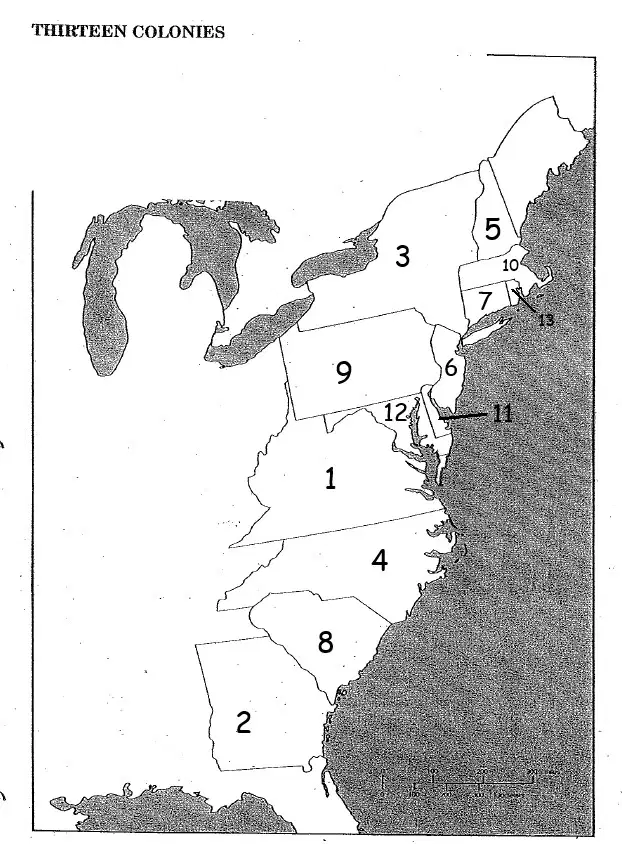
Which colony corresponds with number 2 on the map?
a)
Georgia
b)
South Carolina
c)
North Carolina
d)
Virginia
e)
Maryland
97.
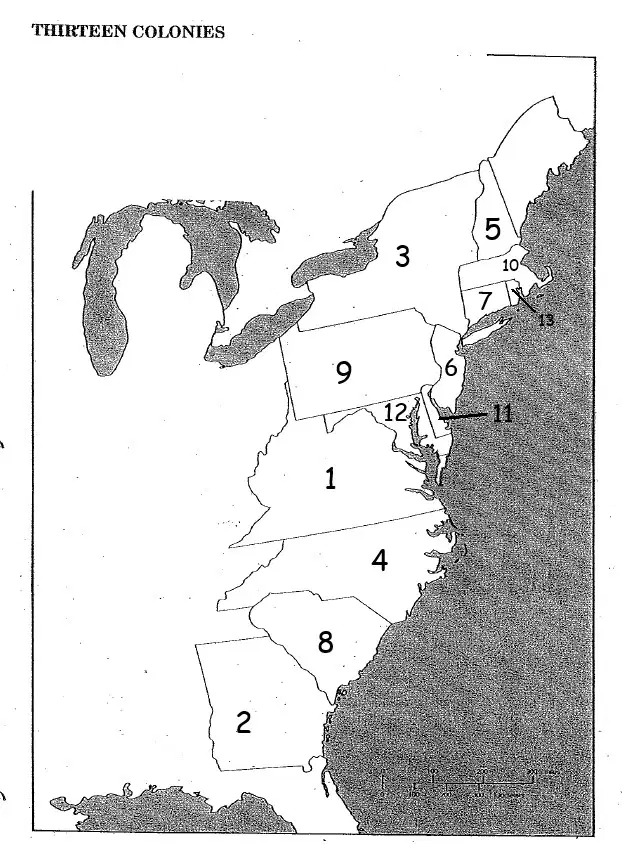
Which colony corresponds with number 4 on the map?
a)
North Carolina
b)
Georgia
c)
South Carolina
d)
Virginia
e)
Maryland
98.
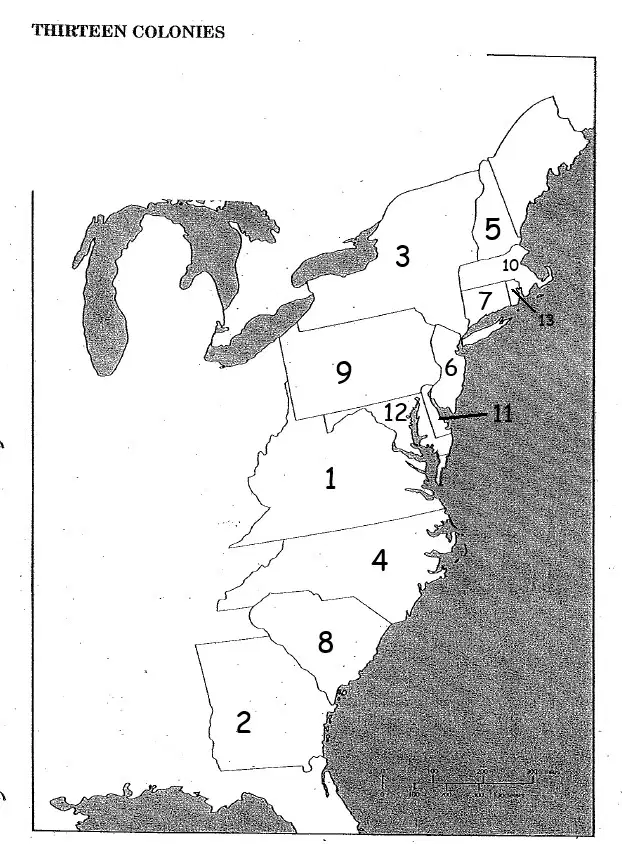
Which colony corresponds with number 9 on the map?
a)
Pennsylvania
b)
Georgia
c)
South Carolina
d)
North Carolina
e)
Virginia
99.

Which colony corresponds with number 11 on the map?
a)
Delaware
b)
Georgia
c)
South Carolina
d)
North Carolina
e)
Virginia
100.
What was an effect of the Jamestown settlers choosing a swampy area to settle on?
a)
The settler’s houses kept sinking into the swamp
b)
The settlers caught diseases from the mosquitoes
c)
The settlers could not farm the land
d)
The settlers of Jamestown did not settle on swampy land, the Pilgrims did
100 %

