
 Worksheets
Biology - S2 EOCA Review
Total questions: 20
Worksheet time: 10mins
1. Which of the following correctly puts the levels of classification of life into the correct order from biggest to smallest?
Biome, ecosystem, population
Population, ecosystem, biome
Ecosystem, biome, population
Ecosystem, population, biome
Even though two species live in the same area, one lives in a tree, and the other lives underground. They won’t mate because they have
Mechanical isolation
Behavioral isolation
Habitat (geographic) isolation
Allopatric isolation
Bats and birds look very similar, but they are NOT closely related. They evolved to look similar through
Sexual selection
Disruptive evolution
Convergent evolution
Divergent evolution
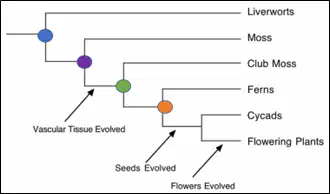
Which dot in the image above represents the most recent common ancestor between club moss and cycads?
Blue dot
Purple dot
Green dot
Orange dot
The legs of humans, elephants, and alligators all look different on the outside, but they have the same structure inside. This suggests that
They all evolved from the same common ancestor
They all reproduce similarly
They all live in similar areas
They can all run quickly
If 2 lizards live in the same area, grow at the same rate, look similar, but one is active at day and the other is active at night, they are most likely
In the same species
In the same genus
In a different domain
In a different phylum
Lizards, turtles, and pigs all share the same embryo shape. This means that
They all grow into similar shaped adults
They likely have a distant common ancestor
Pigs only underwent natural selection
They all evolved to look similar over time
If an organism is a heterotroph that can reproduce sexually and can move, it is probably a
Fungus
Green plant
Bacteria
Animal
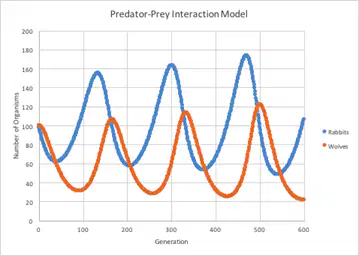
According to the image, what is happening to the populations of rabbits and wolves?
The populations are not related to each other
Both populations go up and down at the same time
The rabbit population changes after the wolf population
The wolf population changes after the rabbit population
In Yellowstone National Park, deer eat grass and then wolves eat the deer. To protect the deer, almost all of the wolves are killed off. What will most likely happen to the deer population in the future now that all of its predators are gone?
It will stabilize
It will continue to increase forever because there aren't predators
It will increase when goats move into the area
It will decrease because they will run out of food
Natural selection cannot occur without:
Competition for unlimited resources
Gradual warming of earth
Genetic variation in species
Asexual reproduction in species
When birds landed on the Galapagos Islands, they were all the same, but when separated on the islands with differing habitats, the birds changed. Why did the beaks of the birds on islands with nuts differ from the beaks of the birds on islands with insects?
The birds migrated to the island with the right food supply for their beaks
The food supply on the islands changed to match the birds' beaks
The predators eliminated the birds with the "wrong" beaks
The birds with the best beaks for the food supply had more offspring
A population is 50% green bugs and 50% red bugs. A tornado killed all the green bugs in an area, but the red bugs survived randomly. The surviving population of bugs is 100% red. Which of these processes is described in this example?
Genetic drift
Natural selection
Mass extinction
Geographic isolation
On a small, isolated island, a hurricane destroyed all the trees that produced a large, hard-shelled nut. Which bird population would most likely decrease?
Birds with long, probing beaks
Birds with thick, strong beaks
Birds with thin, short beaks
Birds with large, pouch beaks
What is one disadvantage of asexual reproduction?
It takes too much time and energy
There is decreased genetic diversity within the population
The offspring grows faster than one that is produced sexually
The offspring receives its DNA from two parents
Which process has most likely occurred when new traits appear in a species?
Selective breeding
Genetic mutation
Crossbreeding
Cloning
Nitrogen is very important for plants to grow. Most fertilizer contains nitrogen, and when it is added, plants grow better. Which best describes the role of the nitrogen in the ecosystem?
A trophic level
A limiting factor
A territorial boundary
A food-chain component
Can Earth's human population increase indefinitely?
Yes, even though resources are finite
Yes, because resources are infinite
No, even though resources are infinite
No, because resources are finite
What will most likely happen to a stable ecosystem when a population of animals exceeds the ecosystem's carrying capacity?
The ecosystem will improve
The ecosystem will degrade
The ecosystem will change type
The ecosystem will remain unchanged
The greatest amount of diversity can be found among which type of organism?
Plants
Animals
Bacteria
Fungi

