
 Worksheets
ENT Combined Quiz
Total questions: 119
Worksheet time: 1hrs 29mins
Name
Class
Date
1.
Which are the principle of structured engineering? (More than 1 answer)
a)
Hierachy
b)
Modularity
c)
Resiliency
d)
Flexibility
2.
Which principle of Structured Engineering breaks a complex problem of network design into smaller and more manageable areas?
a)
Hierachy
b)
Modularity
c)
Resiliency
d)
Flexibility
3.
Which principle of Structured Engineering separates functions that exist on a network into modules?
a)
Hierachy
b)
Modularity
c)
Resiliency
d)
Flexibility
4.
Which principle of Structured Engineering reflects that network must remain available under both normal and abnormal conditions?
a)
Hierachy
b)
Modularity
c)
Resiliency
d)
Flexibility
5.
Which principle of Structured Engineering reflects the ability to modify portions of the network, add new services, or increase capacity without going through a major fork-lift upgrade?
a)
Hierachy
b)
Modularity
c)
Resiliency
d)
Flexibility
6.
Which is NOT one of the 3 layers of Hierachical Network Design?
a)
Access Layer
b)
Distribution Layer
c)
Routing Layer
d)
Core Layer
7.
Which layer of the Hierachical Network Design provides workgroup or user access to the network?
a)
Access Layer
b)
Distribution Layer
c)
Routing Layer
d)
Core Layer
8.
Which layer of the Hierachical Network Design aggregates LAN or WAN links and provides policy-based connectivity?
a)
Access Layer
b)
Distribution Layer
c)
Routing Layer
d)
Core Layer
9.
Which layer of the Hierachical Network Design provides high-speed switching and routes packet through firewall to the internet?
a)
Access Layer
b)
Distribution Layer
c)
Routing Layer
d)
Core Layer
10.
Two-Tier Collapsed Core Design is when distribution layer and core layer functions are implemented by a single device?
a)
YES
b)
NO
11.
Which of the following is/are TRUE about Point-to-point? (More than 1 answer)
a)
Connects LANs to service provider WANs
b)
Point-to-point links can connect two geographically distant sites
c)
Also referred to as serial connection or leased-line connection
d)
Bits are transmitted sequentially over a single channel
12.
What is NOT correct about Demarcation Point?
a)
Marks the point where customer network meets or interfaces with a network that is owned by another organization
b)
Point in the network where the responsibility of the service provider ends
c)
It does not involve Customer Premises Equipment
13.
What of the following is/are TRUE about DTE and DCE? (More than 1 answer)
a)
DTE is generally a router
b)
DCE is commonly a modem that converts user data into a form acceptable to the WAN service provider link
c)
DTE could be computer or printer that connects to the service provider network
14.
Which of the following are WAN Encapsulation Protocol?
a)
HDLC
b)
PPP
c)
PAP
d)
CHAP
15.
Which of the following are WAN Authentication Protocol?
a)
HDLC
b)
PPP
c)
PAP
d)
CHAP
16.
Which is the default encapsulation method?
a)
HDLC
b)
PPP
c)
PAP
d)
CHAP
17.
Which are the PPP Configuration Options? (More than 1 answer)
a)
Authentication
b)
Authorisation
c)
Compression
d)
Multilink
18.
For CHAP authentication, both the password must be the same?
a)
YES
b)
NO
19.
Which of the following sends its username and password to destination router?
a)
HDLC
b)
PPP
c)
PAP
d)
CHAP
20.
Which of the following sends its username and hash value (based on the same password) to the destination router?
a)
HDLC
b)
PPP
c)
PAP
d)
CHAP
21.
Which of the following is a switching method where a dedicated path is already established first between sender and receiver.
a)
Circuit Switching
b)
Packet Switching
c)
MPLS
d)
VSAT
22.
Which of the following is a method where no fixed path will be taken by packets to travel from sender to receiver
a)
Circuit Switching
b)
Packet Switching
c)
MPLS
d)
VSAT
23.
What are the advantages of Leased Lines? (More than 1 answer)
a)
Simplicity
b)
Quality
c)
Availability
d)
Cost
24.
What are the advantages of Dialup? (More than 1 answer)
a)
Simplicity
b)
Availability
c)
Low implementation cost
d)
Low data rate
25.
Which of the following is a WAN technology that route data from 1 router to another based on short path labels rather than IP network addresses?
a)
Circuit Switching
b)
Packet Switching
c)
MPLS
26.
Which of the folllowing creates a private WAN using satellite communications?
a)
VSAT
b)
MPLS
c)
VPN
27.
Which of the following about ACL is incorrect?
a)
If filtering inbound traffic, packets will be checked when reach router interface
b)
If filtering outbound traffic, packets will be checked before leaving router interface
c)
ACL is configured to filter inbound or outbound traffic
d)
An ACL is a sequential list of permit or deny statements
e)
None of them is incorrect
28.
Standard ACLs – filters packets based on Source IP address only?
a)
YES
b)
NO
29.
Extended ACLs – filters packets based on Source & Destination IP addresses, Protocol, Port no?
a)
YES
b)
NO
30.
Which of the following is/are Standard ACL command? (More than 1 answer)
a)
access-list 1 remark ACL for Server Farm
b)
access-list 1 deny 192.168.11.1 0.0.0.0
c)
access-list 1 permit 192.168.10.0 0.0.0.255
d)
Access-list 100 deny tcp 192.168.11.0 0.0.0.255 192.168.30.0 0.0.0.255 eq 21
31.
What is the outcome of executing the following commands?
access-list 3 deny 192.168.10.0 0.0.0.255
access-list 3 permit host 192.168.10.10
a)
192.168.10.10 will be permitted to pass through the router
b)
192.168.10.10 will not be permitted to pass through the router
c)
Error will appear
32.
Extended ACLs can filter on which of the following? (More than 1 answer)
a)
Source Address
b)
Destination Address
c)
Protocol
d)
Port no.
33.
What of the following is/are correct about the following command? (More than 1 answer)
access-list 114 permit tcp 192.168.20.0 0.0.0.255 any eq 21
a)
This is an Extended ACL
b)
192.168.20.10 is permitted to pass through the router
c)
FTP is not permitted
d)
192.168.20.11 is permitted to pass through the router to any destination
34.
Routers are responsible for routing traffic between networks?
a)
YES
b)
NO
35.
Which components does a Router has?
a)
CPU
b)
Memory and Storage
c)
Operating System
d)
Power Supply
36.
Which of the following are TRUE about router memory? (Choose 3)
a)
NVRAM stores Startup configuration file
b)
Flash stores Operating System
c)
ROM stores bootup instructions
d)
ROM stores ARP tables
37.
Volatile memory loses all its contents when powered down or restarted?
a)
YES
b)
NO
38.
Which of the following are performed by the router during the bootup process?
a)
Perform Power-on-self-test
b)
Load the bootstrap program
c)
Load IOS and Startup configuration file into RAM
d)
Broadcast message to all hosts on its interface
39.
How does a PC forward a packet?
a)
If the packet is destined to a host within the same network, the packet is forwarded directly to destination
b)
If the packet is destined for host on a different network, the packet is forwarded to the default gateway
c)
The packet is always sent to the default gateway regardless of the destination
40.
Which IOS command sets the IP address and default gateway?
a)
ip address 192.168.10.2
ip default gateway 192.168.10.1
b)
ip address 192.168.10.2 192.168.10.1
c)
ip address 192.168.10.1 192.168.10.2
d)
ip gateway 192.168.10.1 192.168.10.2
41.
Which IOS command sets the password ILOVEITE for privilege execution mode?
a)
enable secret ILOVEITE
b)
password ILOVEITE
c)
service password-encryption
d)
enable secretpass ILOVEITE
42.
Which one of the following components in a router stores the startup configuration file?
a)
FLASH
b)
NVRAM
c)
RAM
d)
ROM
43.

Refer to the attached figure. The prompt appears when a console cable was connected to a router to perform configuration. Explain why setting a console password is important.
a)
Protect against power outage
b)
Prevent remote network connections
c)
Protect unauthorised access to device
d)
Limit device access over Telnet or SSH connection
44.
Which of the following describe the command "copy run start" in a Cisco router?
a)
Copy the current configuration file to RAM
b)
Copy the current configuration file to ROM
c)
Copy the current configuration file to Flash
d)
Copy the current configuration file to NVRAM
45.
An IT specialist receives a call that one of the links from Router HQ is down. He wants to quicky verify the interface connectivity including obtaining the IP address. Which command should be execute?
a)
show run
b)
show ip int br
c)
show ip route
d)
show ip status
46.
Which of the following command disables DNS lookup in a Cisco router?
a)
no ip domain-lookup
b)
disable dns
c)
remove ip dns
d)
no ip domain look up
47.
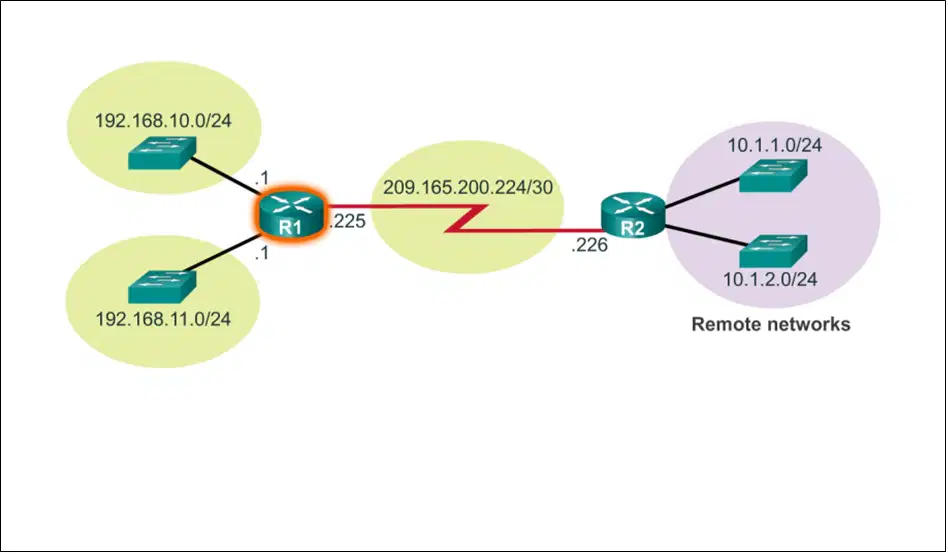
Refer to the attached figure. How many directly connected networks are there at R1?
a)
1
b)
2
c)
3
d)
4
48.
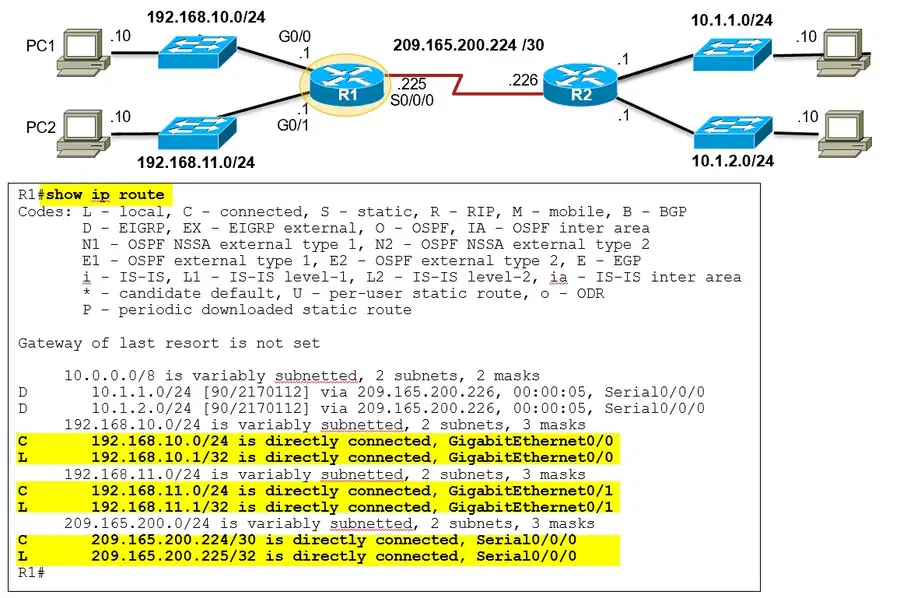
Refer to the attached figure. What is the IP address assigned to R1 G0/0?
a)
192.168.10.0
b)
192.168.10.1
c)
192.168.11.0
d)
192.168.11.1
49.
What is next-hop address?
a)
IP address of the intermediate device used to reach a specific remote destination
b)
IP address of the last device used to reach a specific remote destination
c)
IP address of the exiting interface of the router
d)
Network address of the exiting interface of the router
50.
What is the first bootup process in a Cisco Router?
a)
POST
b)
Load Bootloader
c)
Load from Running Config
d)
Load from Startup Config
51.
What is the last bootup process in a Cisco Router?
a)
POST
b)
Load Bootloader
c)
Load from Running Config
d)
Load from Startup Config
52.
Where is IOS image being executed in Cisco Router?
a)
ROM
b)
Flash
c)
RAM
d)
NVRAM
53.
Where is IOS image being stored in Cisco Router?
a)
ROM
b)
Flash
c)
RAM
d)
NVRAM
54.
Which of the following is NOT found in Cisco router's RAM?
a)
Running Configuration
b)
ARP Table
c)
IOS Image
d)
Routing Table
55.
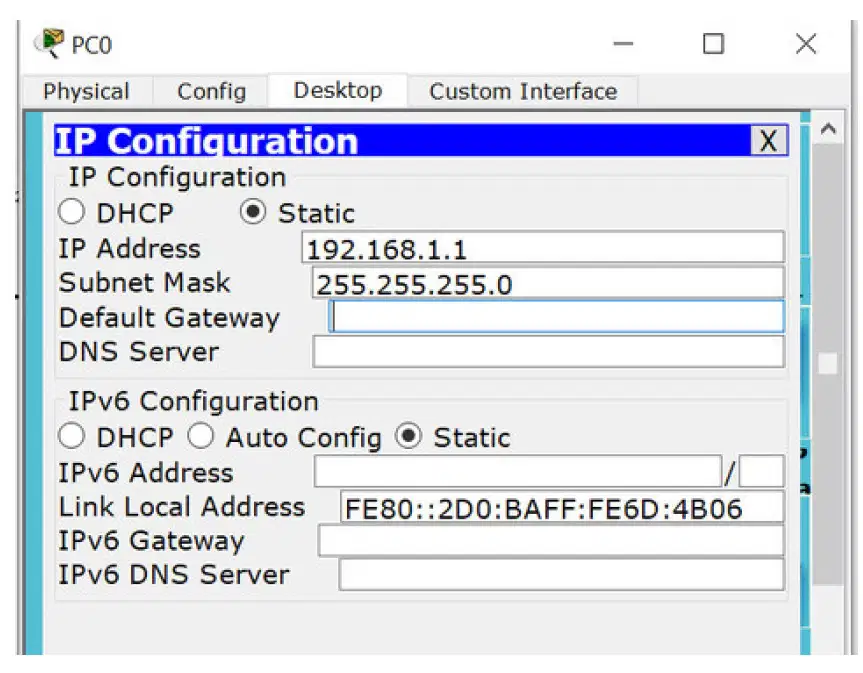
Refer to the attached figure. Can PC0 ping to a remote network e.g. 192.168.2.1?
a)
YES
b)
NO
56.
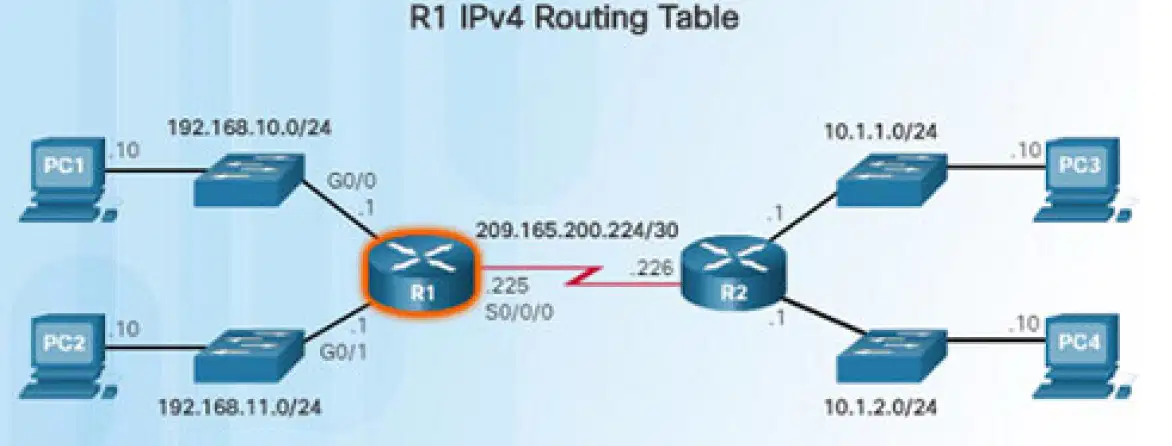
Refer to the attached figure. What is the number of remote network for R2?
a)
1
b)
2
c)
3
d)
4
57.
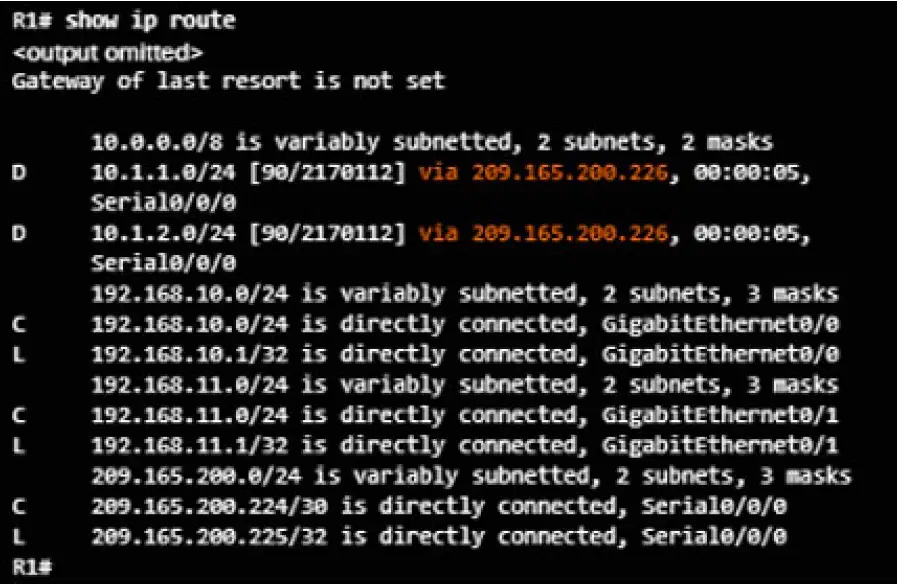
Refer to the attached figure. Based on the result of "show ip route" command in R1. Determine the no of directly connected network.
a)
2
b)
3
c)
5
d)
8
58.
The purpose of dynamic routing protocols includes which of the following? (More than 1 answer)
a)
Discovery of remote networks
b)
Maintaining up-to-date routing information
c)
Choosing the best path to destination networks
d)
Ability to find a new best path if the current path is no longer available
59.
Which is NOT an operation of dynamic routing protocol?
a)
Router sends and receives routing messages on its interfaces
b)
Router shares routing messages and information with other routers regardless of the routing protocol
c)
Routers exchange routing information to learn about remote networks
d)
When router detects a topology change, the routing protocol can advertise this change to other routers
60.
Which protocols are under the Interior Gateway Protocols (IGPs)? (More than 1 answer)
a)
RIP
b)
EIGRP
c)
OSPF
d)
IS-IS
e)
BGP
61.
Which protocols determine best path based on distance? (More than 1 answer)
a)
RIPv1
b)
RIPv2
c)
IGRP
d)
EIGRP
e)
BGP
62.
Which protocols forward updates to the other routers when state of link changes? (More than 1 answer)
a)
OSPF
b)
IS-IS
c)
IGRP
d)
RIPv2
63.
Distance vector routing protocol will only know which router to send to?
a)
YES
b)
NO
64.
Link-state routing protocol will know which remote network is connected to which interface of the remote router?
a)
YES
b)
NO
65.
Link-state router uses the link-state information to create a topology map and to select the best path to all destination networks in the topology
a)
YES
b)
NO
66.
Routing protocols determine the best path based on the route with the highest metric (cost)
a)
YES
b)
NO
67.
What of the following are correct about Distance Vector Routing Protocols? (More than 1 answer)
a)
Share updates between neighbors
b)
Not aware of the network topology
c)
Only know remote network addresses of its neighbors
d)
Updates consume bandwidth and network device CPU resources
68.
Which are the advantages of Link-State Routing Protocols? (More than 1 answer)
a)
Each router builds its own topology map of the network to determine the shortest path.
b)
Immediate flooding of LSPs achieves faster convergence
c)
LSPs are sent only when there is change to topology and only information of changes are sent
d)
Bandwidth can be adversely affected by link-state packet flooding
69.
Which of the following in NOT a main component in a typical dynamic routing protocol?
a)
Data Structure
b)
Routing Protocol Message
c)
Algorithm
d)
Startup Configuration
70.

Refer to the figure. Based on Dijkstra's Shortest Path First Algorithm, what is the cost from R2 to R3?
a)
27
b)
52
c)
32
d)
25
71.

Refer to the figure. Based on Dijkstra's Shortest Path First Algorithm, which is the shortest path from R2 to R3?
a)
R2 > R1 > R3
b)
R2 > R5 > R4 > R3
c)
R2 > R5 > R4 > R1 > R3
72.
OSPF is a routing protocol that is used to advertise directly connected networks to the other routers in the topology?
a)
YES
b)
NO
73.
OSPF is based on distance - no. of hops from one point to another?
a)
YES
b)
NO
74.
Which of the following is/are correct? (Multiple answers)
a)
OSPFv2 is meant for IPv4
b)
OSPFv2 is for IPv6
c)
OSPF is an Interior Gateway Protocol
d)
OSPF is based on no. of hops
75.
Which is/are the databases of OSPF? (Multiple answers)
a)
Adjacency DB
b)
Link-State DB
c)
Forwarding DB
76.
Which protocols forward updates to the other routers when state of link changes? (More than 1 answer)
a)
OSPF
b)
IS-IS
c)
IGRP
d)
RIPv2
77.
OSPF area is a group of routers that share the same link-state information?
a)
YES
b)
NO
78.
OSPF area is an area where all other areas connect to it?
a)
YES
b)
NO
79.
Which of the command enables OSPF?
a)
router ospf 1
b)
router-id 1.1.1.1
c)
clear ip ospf process
d)
network ospf 1
80.
Which of the following command advertise the network address 172.16.1.0/24?
a)
network 172.16.1.0/24
b)
network 172.16.1.0 255.255.255.0
c)
network 172.16.1.0 255.255.255.0 area 0
d)
network 172.16.1.0 0.0.0.255 area 0
81.
What is the Wildcard mask for /30?
a)
255.255.255.252
b)
0.0.0.255
c)
0.0.0.3
d)
255.255.255.255
82.
router-id 11.1.1.1 - this command assigns a routable IP address to the router?
a)
YES
b)
NO
83.
Which command is used to verify OSPF neighbors?
a)
show ip ospf neighbor
b)
show interface serial 0/1/1
c)
show ip ospf
d)
show protocols
84.
What is the cost for bandwidth 128kbps?
a)
64
b)
781
c)
1562
d)
10
85.
Cost of an OSPF route is the accumulated value from one router to the destination network?
a)
YES
b)
NO
86.
Passive-interface command prevents the transmission of routing messages through a router interface?
a)
YES
b)
NO
87.
Which command set interface G0/0 as passive to prevent routing messages from transmiting to it?
a)
passive-interface G0/0
b)
interface passive G0/0
c)
passive interface G0/0
d)
passive G0/0
88.
Which two of the following is a Distance Vector dynamic routing protocol? (Choose 2)
a)
EIGRP
b)
IS-IS
c)
OSPF
d)
RIP
89.
What are part of the Network Documentation? (More than 1 answer)
a)
Configuration Files
b)
Logical Topology
c)
Baseline Performance
d)
Physical Topology
90.
Network Baseline determines the personality of the network under "Abnormal" condition.
a)
YES
b)
NO
91.
What are the general steps in establishing the Network Baseline? (More than 1 answer)
a)
Determine types of data to collect
b)
Identify devices and ports of interest
c)
Determine baseline duration
d)
Determine the outcome of the baseline performance
92.
Which is the correct troubleshooting procedure?
a)
Gather Symptoms > Isolate problem > Implement corrective action > Document if resolved, else start from beginning
b)
Gather Symptoms > Implement corrective action > Document if resolved
c)
Gather Symptoms > Implement corrective action > Document if resolved, else start from beginning
d)
Gather Symptoms > Isolate problem > Implement corrective action
93.
Which principle of Structured Engineering reflects the ability to modify portions of the network, add new services, or increase capacity without going through a major fork-lift upgrade?
a)
Hierachy
b)
Modularity
c)
Resiliency
d)
Flexibility
94.
Which of the following is correct about the "Educated Guess" approach in troubleshooting.
a)
Need to have extensive knowledge and experience to identify the root cause based on symptoms of problem
b)
Compare a working and nonworking situatio and spot significant differences
c)
Replace problematic device with a known, working one is a quick way to troubleshoot
95.
Which of the following is correct about the "Bottom-up" approach in troubleshooting.
a)
Troubleshooting starts from physical layer and physical components of network and move up through the layers of the OSI model until problem is identified
b)
Troubleshooting starts from end-user applications and moves down through the layers in the OSI model until problem is identified
96.
Which approach in troubleshooting starts by collecting info about the problem to make informed decision on which OSI layer to start investigation. When layer is verified functioning, it is assumed layer below are functioning
a)
Bottom-up
b)
Top-down
c)
Divide-and-Conquer
d)
Follow-the-path
97.
The "Traceroute" command is used to check the path taken by packets.
a)
YES
b)
NO
98.
The "Telnet" command is used to verify the Transport layer
a)
YES
b)
NO
99.
You can Ping the IP address of the DNS to check if the DNS is up and reachable
a)
YES
b)
NO
100.
Both ends of the point-to-point connection must run in full-duplex mode or in auto-negotiation mode
a)
YES
b)
NO
101.
Which are one of the things to do during troubleshooting? (More than 1 answer)
a)
Check physical connectivity
b)
Check for duplex mismatches
c)
Check data link and network layer addressing on the local network
d)
Verify that the default gateway is correct
e)
Check routing information
102.
Which of the following are TRUE about VLAN? (More than 1 answer)
a)
VLAN is a logical partition of a Layer 2 network
b)
Multiple partitions can be created
c)
Each VLAN is a broadcast domain, usually with its own IP network
d)
VLANs are mutually isolated, and packets can only pass between them via a router
e)
The hosts (PCs) in a VLAN are unaware of the VLAN’s existence
103.
Which of the following are the benefits of VLAN? (More than 1 answer)
a)
Better security
b)
Shrink broadcast domains
c)
Better performance
d)
Cost reduction
e)
Improved IT staff efficiency
104.
Which of the following are the types of VLAN? (More than 1 answer)
a)
Data VLAN
b)
Voice VLAN
c)
Default VLAN
d)
Native VLAN
e)
Private VLAN
105.
VLAN trunk carries more than one VLAN?
a)
YES
b)
NO
106.
Frame tagging is the process of adding a VLAN ID header to the frame?
a)
YES
b)
NO
107.
Frames that belong to native VLAN are tagged when sending through a trunk link?
a)
YES
b)
NO
108.
Which of the following are TRUE about VLANS? (More than 1 answer)
a)
Normal Range VLAN, the number is from 1 to 1005
b)
Extended Range VLAN, the number is from 1006 to 4096
c)
Extended Range Configurations are stored in Running Config
d)
Normal Range Configurations are stored in vlan.dat
109.
Which of the following command assign VLAN 20 to the interface F0/18?
a)
interface F0/18
switchport mode access
switchport access vlan 20
b)
interface F0/18
switchport mode trunk
switchport access vlan 20
c)
interface F0/18
switchport mode trunk
switchport trunk vlan 20
110.
Which of the following command creates a TRUNK that allows VLAN 10 and 20?
a)
interface F0/18
switchport mode access
switchport access vlan 20
b)
interface F0/18
switchport mode trunk
switchport trunk native 99
switchport trunk allowed vlan 10,20
c)
interface F0/18
switchport mode trunk
switchport trunk native vlan 99
switchport trunk allowed vlan 10-20
111.
Layer 2 switches cannot forward traffic between VLANs without the assistance of a router?
a)
YES
b)
NO
112.
Inter-VLAN routing is a process for forwarding network traffic from one VLAN to another, using a router?
a)
YES
b)
NO
113.
In Legacy Inter-VLAN Routing, each VLAN was connected to a different physical router interface?
a)
YES
b)
NO
114.
VLAN trunk carries more than one VLAN?
a)
YES
b)
NO
115.
The router-on-a-stick approach uses only one router’s physical interface?
a)
YES
b)
NO
116.
In Router-on-a-stick Inter-VLAN Routing, each sub-interface is configured with an IP address from the VLAN it represents?
a)
YES
b)
NO
117.
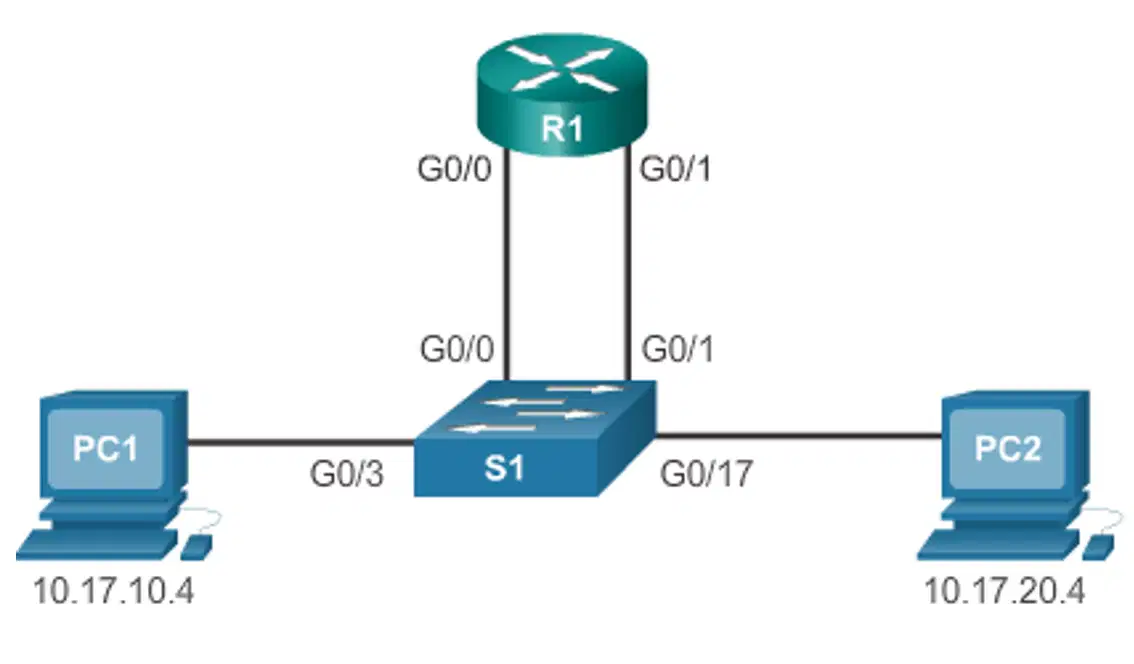
Refer to the attached figure. Identify the type of inter-vlan routing in this figure
a)
Legacy
b)
Router-on-a-stick
118.
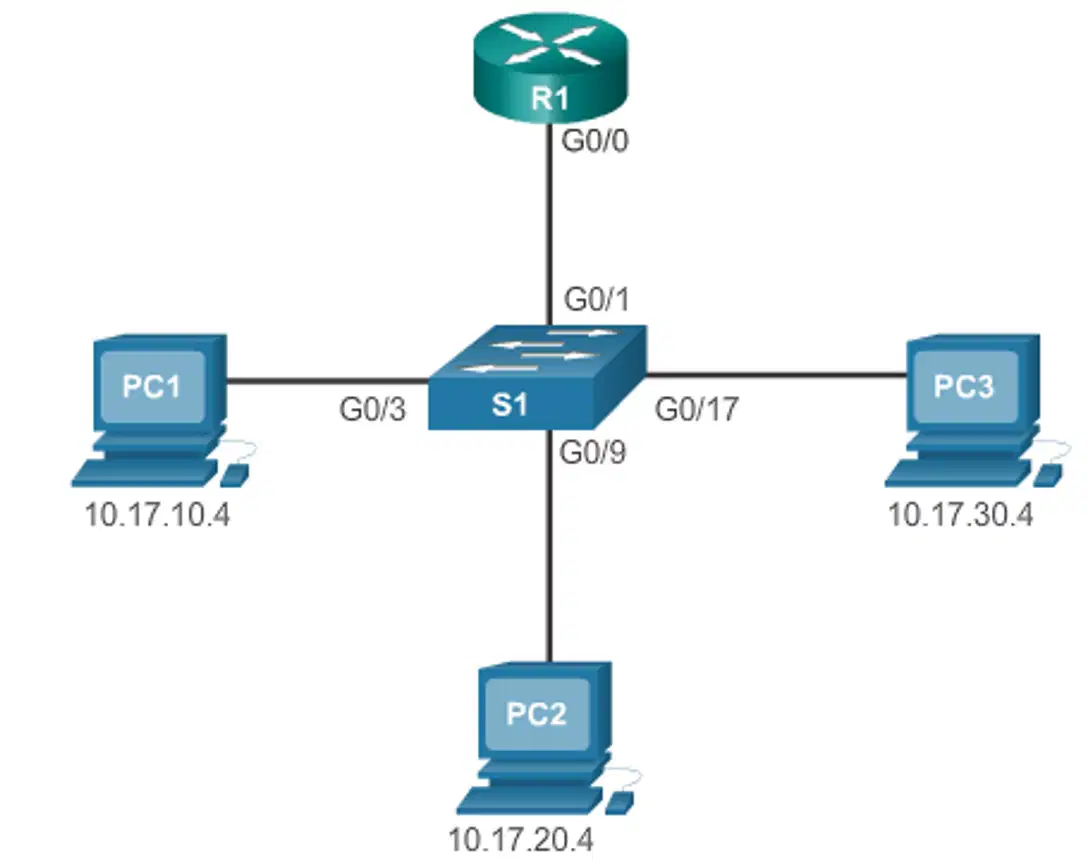
Refer to the attached figure. Identify the type of inter-vlan routing in this figure
a)
Legacy
b)
Router-on-a-stick
119.

Refer to the attached figure. What happens to the packet coming from 192.168.10.10?
a)
The packet will be denied
b)
The packet will be permitted
100 %

