wayground logo

Free Printable Worksheets

Font size

S
M
L
XL
Worksheets

CP Biology FINAL EXAM REVIEW

Total questions: 47

Worksheet time: 8hrs 50mins

Name
Class
Date
1.
What is the pigment in chloroplasts that performs photosynthesis?
a)
Chlorosynthesis
b)
Chlorophyll
c)
ADP
d)
Electron Transport
2.
The interior space of the chloroplast is called:
a)
Lamellae
b)
Grana
c)
Stroma
d)
Thylakoids
3.

Which of the following equations represents the overall chemical reaction for photosynthesis?

a)

6O2+ 6H2O → C6H12O6+ 6O2

b)

C6H12O6 + 6H2O→ 6O2+ 6O2

c)

6CO2+ 6H2O→ C6H12O6+ 6O2

d)

6O2 + 6H2O→ C6H12O6 + 6CO2

4.

Which of the following light color is absorbed by plants?

a)

Red

b)

Green

c)

yellow

d)

Light green

5.

•An enzyme that fixes carbon from atmosphere to convert it to complex macromolecule glucose.

a)

RuBP (Ribulose bisphosphate)

b)

RuBisCo (Ribulose Bisphosphate Carboxylase)

c)

PGA (3-Phosphoglycerate)

d)

G3P (Glyceraldeyhyde 3-Phosphate)

6.
What are the two products of the light reactions that are needed for the calvin cycle?
a)
NAD and NADPH
b)
NADP + and Glucose
c)
NADPH and ATP
d)
Oxygen and NADPH
7.

The organic molecule that is the cell's primary form of energy?

a)

Glucose

b)

ATP

c)

ADP

d)

GMP

8.
Leaves look green because.....
a)
they eat their vegetables
b)
to blend into their environment
c)
they contain a molecule named chlorophyll
d)
they are sick
9.
The main source of energy for all life comes from ____.
a)
the Earth
b)
the moon
c)
the sun
d)
the food we eat/make
10.

Does the following equation refer to photosynthesis or cellular respiration? glucose + oxygen --> carbon dioxide + water + energy

a)

photosynthesis

b)

cellular respiration

11.

Cellular Respiration's goal is to

a)

make water

b)

make energy

c)

make glucose

d)

make oxygen

12.

Is CARBON DIOXIDE a product of photosynthesis or cellular respiration?

a)

photosynthesis

b)

cellular respiration

13.

What are the products of cellular respiration? (Mark all of them!)

a)

oxygen

b)

glucose

c)

carbon dioxide

d)

water

e)

energy

14.
Cells spend the majority of their lives in
a)
Interphase
b)
Mitosis
c)
Synthesis 
d)
Gap 2
15.
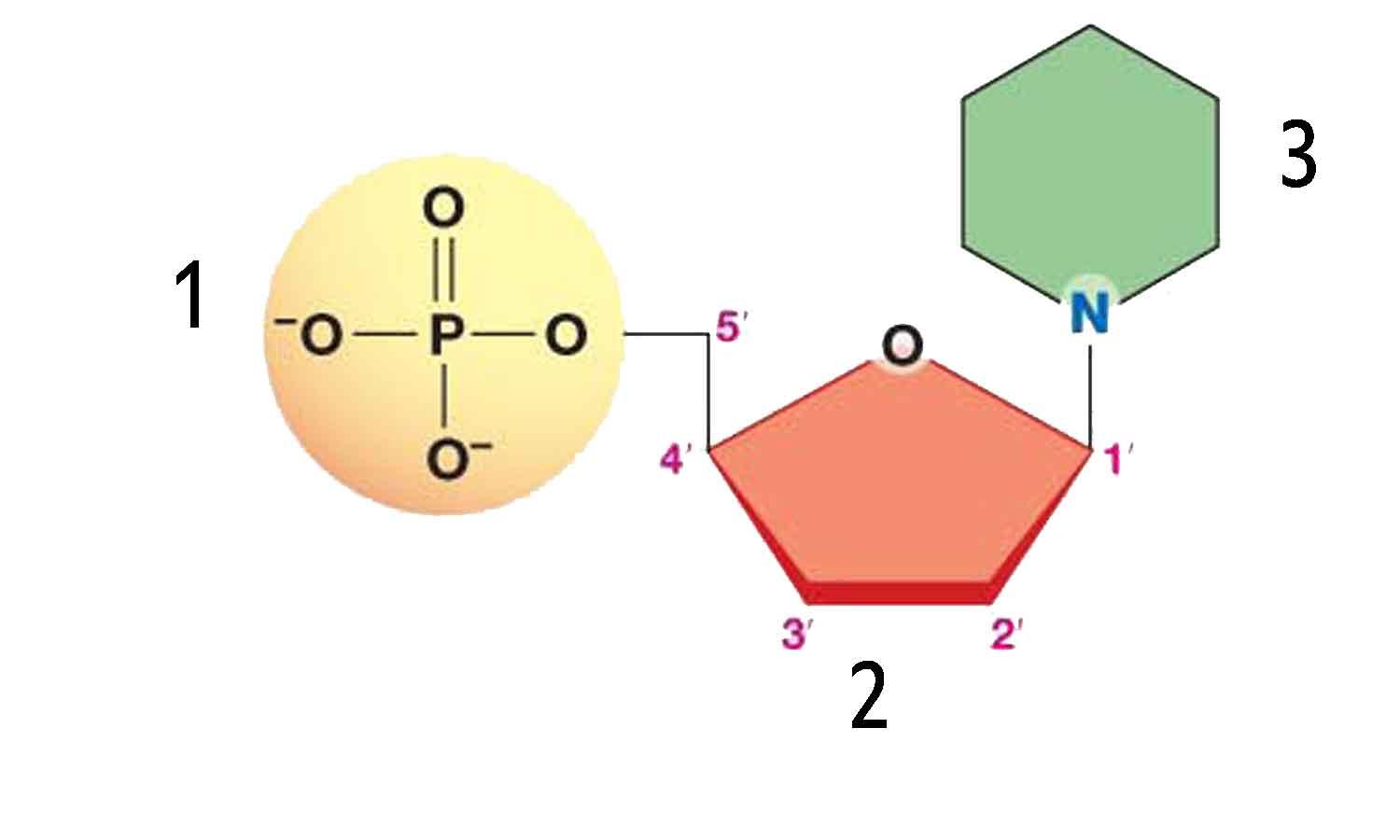
Identify the parts of the nucleotide shown:
a)
1) Ribose Sugar      2) Phosphate 
3)  Nitrogen Base
b)
1) Deoxyribose Sugar
2) Phosphate
3) Nitrogen Base
c)
1) Phosphate
2) Ribose Sugar
3) Nitrogen Base
d)
1)  Phosphate
2) Deoxyribose Sugar
3)  Nitrogen Base
16.
Identify the stage of mitosis. 
a)
interphase
b)
prophase
c)
anaphase
d)
cytokinesis
17.

What is the image above:

a)

Chromosome

b)

Chromotid

c)

Centromere

d)

Centriole

18.
Identify the stage of mitosis.
a)
interphase
b)
prophase
c)
metaphase
d)
anaphase
19.

What stage of mitosis is depicted here

a)

Prophase

b)

Metaphase

c)

Anaphase

d)

Telophase

20.
Proteins are made of which molecule?
a)
Amino Acids
b)
Lipids
c)
Carbohydrates
21.
DNA is a double helix.
a)
True
b)
False
22.

During transcription, this type of ribonucleic acid is responsible for copying the DNA and brining it out of the nucleus.

a)

tRNA

b)

mRNA

c)

rRNA

d)

dRNA

23.

How many amino acids are found on one tRNA?

a)

20

b)

4

c)

1

d)

3

24.
This is the triplet of bases on the end of a tRNA molecule
a)
Anticodon
b)
Codon
c)
Protein
25.
What is the three base sequence of mRNA that codes for a single amino acid?
a)
Anticodon
b)
Codon
c)
Protein
26.
What is the mRNA strand that would result from the DNA template strand CCTA?
a)
GGAT
b)
CCAT
c)
GGAU
d)
CCAU
27.
Which of these nitrogenous bases is NOT in RNA?
a)
Uracil
b)
Thymine
c)
Cytosine
d)
Guanine
28.
Which of the following alleles is homozygous (purebred) recessive?
a)
Tt
b)
tt
c)
TT
d)
t
29.
Aa, DD, bB, yy are all examples of
a)
genotypes
b)
phenotypes
30.
What you see, or the physical appearance.
a)
Genotype
b)
Phenotype
c)
Homozygous
d)
Heterozygous
31.
W=white hair
w= non-white hair
If you cross a horse with WW and a horse with ww what fraction of the offspring would be expected to have white hair?
a)
none
b)
3/4
c)
1/2
d)
all
32.
this image is an example of
a)
codominance
b)
dominance
c)
incomplete dominance
33.
this image is an example of
a)
codominance
b)
dominance
c)
incomplete dominance
34.
In pea plants, the tall allele is dominant to the short allele. What key would demonstrate this?
a)
Tall = T
Short = S
b)
Tall = T
Short = t
c)
Tall = t
Short = T
d)
Tall = TT
Short = tt
35.
T4 - What genotype is missing from this Punnett Square?
a)
RrYy
b)
RRYY
c)
rryy
d)
RrYY
36.
A lab technique used in crime fighting to prove a suspects innocence or guilt is known as:
a)
genetic engineering
b)
PCR
c)
electrophoresis
d)
gene therapy
37.

Which suspect left the blood stain?

a)

Bob

b)

Sue

c)

John

d)

Lisa

38.
Mistakes or changes that occur int he DNA sequence are called....
a)
adatations
b)
Darwinism
c)
mutations
d)
natural selection
39.
The preserved remains or physical evidence of an organism that lived in the past are called...
a)
evolutionary features
b)
fossils
c)
mutations
d)
variations
40.
What most likely caused the finches on the Galapagos Islands to have beaks that were differnt from the finches living on the South American mainland?
a)
They were different types of food available on the island.
b)
The finches on the islands had to drink salt water.
c)
There were different types of predators living on the island.
d)
The finches on the mainland built different types of nests.
41.
Where the better adapted organisms survive to pass traits along to offspring.
a)
Evolution
b)
Natural Selection
c)
Extinction
d)
Artifical Selection
42.
Study of embryos of various organisms to show a common ancestor because of similarities in development
a)
natural selection
b)
embryology
c)
speciation
d)
evolution
43.
What does Darwin's theory of evolution suggest?
a)
species change over time
b)
extinct species are not related to living species
c)
different species can interbreed
d)
animals that look alike are most closely related
44.
The ability of an organism to survive and reproduce in its specific environment 
a)
diversity.
b)
evolution
c)
adaptation
d)
 fitness
45.

What mutation has occurred here?

T-G-A-C-C-A

T-G-A-G-C-A

a)

Substitution

b)

Deletion

c)

Insertion

d)

Frameshift

46.

ATTTGAGCC- Original

ATTGAGCC - Mutated

The example above is an example of a

a)

Insertion- Frameshift

b)

Deletion- Substitution

c)

Deletion -Frameshift

d)

All of the above

47.

Why are insertion and deletion (frameshift) mutations so harmful?

a)

They change all of the codons from the mutation on down the line, which changes the amino acid sequence

b)

They insert things that an organism doesn't need.

c)

They often delete things that organisms need.

d)

Insertion and deletions are not any more harmful than substitution mutations.