
 Worksheets
EnzymeRespPhoto
Total questions: 21
Worksheet time: 11mins
Which substances are inorganic compounds?
water and salts
proteins and carbohydrates
fats and oils
enzymes and hormones
An iodine test of a tomato plant leaf revealed that starch was present at 5:00 p.m. on a sunny afternoon in July. When a similar leaf from the same tomato plant was tested with iodine at 6:00 a.m. the next morning, the test indicated that less starch was present in this leaf than in the leaf tested the day before. This reduction in starch content occurred because starch was
changed into cellulose
transported out of the leaves through the stomates
conducted downward toward the roots through vessels
digested into simple sugars
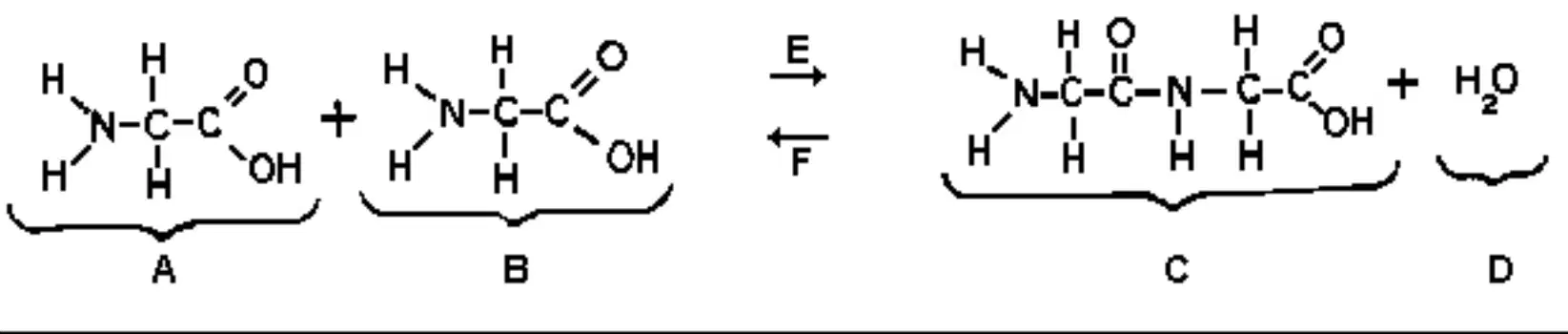
Base your answer on the chemical equation shown in the diagram and your knowledge of biology. The reaction indicated by arrow E illustrates
hydrolysis
(breaking with water)
dehydration synthesis
(putting something together to make a bigger molecule by removing water)
photolysis
aerobic respiration
A sample of food containing one type of a large molecule was treated with a specific digestive enzyme. Nutrient tests performed on the resulting products showed the presence of simple sugars, only. Based on these test results, the original large molecules contained in the sample were molecules of
protein
glucose
starch
DNA
Which activity occurs in the process of photosynthesis?
Chemical energy from organic molecules is converted into light energy.
Organic molecules are obtained from the environment.
Organic molecules are converted into inorganic food molecules.
Light energy is converted into the chemical energy of organic molecules.
The dense needles of Douglas fir trees can prevent most light from reaching the forest floor. This situation would have the most immediate effect on
producers
carnivores
herbivores
decomposers
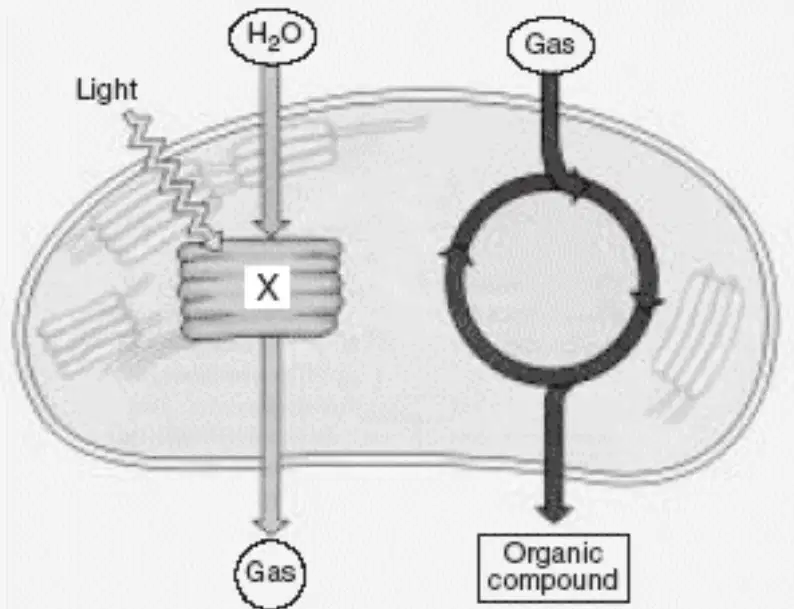
The diagram represents part of a life process in a leaf chloroplast. If the process illustrated in the diagram is interrupted by a chemical at point X, there would be an immediate effect on the release of
chlorophyll
nitrogen
carbon dioxide
oxygen

What are the products (what is released) of cellular respiration? (Mark all of them!)
oxygen
glucose
carbon dioxide
water
ATP (energy)
Cellular respiration and photosynthesis are considered to be....
the same equation
opposites of one another
unique in every way
not important at all!
What is the equation for photosynthesis?
O2+ H2O → C6H12O6 + CO2
CO2+ Light → C6H12O6 + O2
CO2+ H2O+ light → C6H12O6 + O2
O2 + H2O + light
-> C6H12O6 + CO2
Leaves of green plants contain openings known as stomates, which are opened and closed by specialized cells allowing for gas exchange between the leaf and the outside environment. Which phrase best represents the net flow of gases involved in photosynthesis into and out of the leaf through these openings on a sunny day?
water and ozone move in; carbon dioxide moves out
carbon dioxide moves in; oxygen moves out
oxygen moves in; nitrogen moves out
carbon dioxide and oxygen move in; ozone moves out
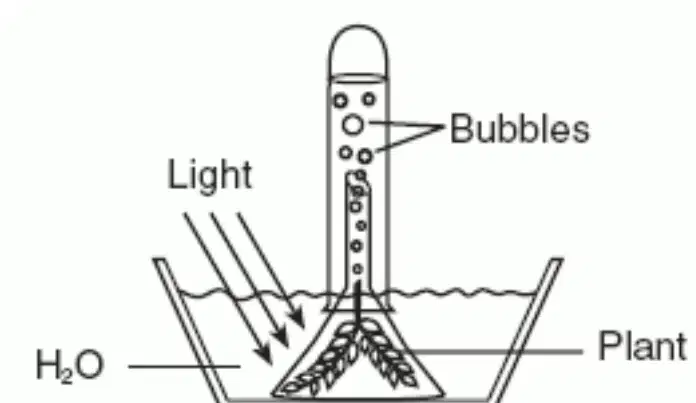
The green aquatic plant represented in the diagram below was exposed to light for several hours. Which gas would most likely be found in the greatest amount in the bubbles?
nitrogen
oxygen
carbon dioxide
ozone
Which statement describes all enzymes?
They control the transport of materials.
They provide energy for chemical reactions.
They affect the rate of chemical reactions.
They denature (deform/change shape) after catalyzing a reaction.

he photograph below shows a microscopic view of the lower surface of a leaf.What is the main function of the cells indicated by the black pointer?
regulate the rate of gas exchange
store food for winter dormancy
undergo mitotic cell division
give support to the veins in the leaf
A green plant is kept in a brightly lighted area for 48 hours. What will most likely occur if the light intensity is then reduced slightly during the next 48 hours?
Photosynthesis will stop completely.
The rate at which oxygen is released from the plant will decrease.
The rate at which nitrogen is used by the plant will increase.
Glucose production inside each plant cell will increase
Compound X increases the rate of the reaction shown below
X
CO2 + H20 –> H2CO3
Compound X is most likely
an enzyme
a lipid molecule
an indicator
an ADP molecule
The enzyme beta-galactosidase is involved in a certain body reaction. What will most likely happen if beta-galactosidase is not available?
A different enzyme will be used in the reaction.
The rate of the reaction will change.
Different chemicals will be used in the reaction to replace the enzyme.
Coenzymes will produce beta-galactosidase.
In order to survive, all organisms must carry out
autotrophic nutrition
heterotrophic nutrition
the process of locomotion
enzyme-controlled reactions
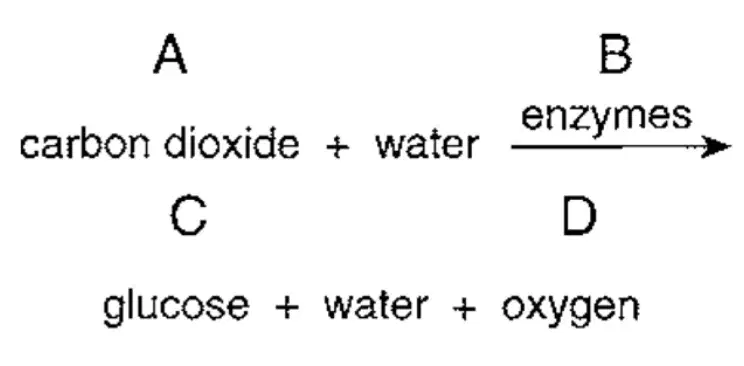
The equations below represent a summary of a cellular process. Letters A, B, C, and D represent some components of this process. A chemical that destroys proteins was added to a cell in which this process was taking place. Which component would most likely have been affected first?
A
B
C
D

The equation below summarizes the process that produces the flashing light of a firefly. The molecule luciferin is broken down, and energy is released in the form of heat and light.
In this process, luciferase functions as
a reactant
a substrate
an inorganic catalyst
an enzyme
Although a certain molecule is involved in a specific reaction, its structure and chemical composition are exactly the same after the reaction as before the reaction. This molecule is most likely classified as
an enzyme
salt
sugar
acid

