
Font size
 Worksheets
2nd monthly test revision
Total questions: 58
Worksheet time: 49mins
The starting molecule for glycolysis is
ADP
pyruvic acid
glucose
crtric acid
Glycolysis requires
ATP
oxygen
sunlight
NADP+
Which of the following is NOT a product of glycolysis?
NADH
pyruvic acid
ATP
glucose
Which of the following is an electron carrier that plays a role in cellular respiration?
NAD+
pyruvic acid
NADP+
ATP
Which of the following is an electron carrier that plays a role in photosynthesis?
NAD+
NADP+
FAD+
ADP
The starting molecule for the Krebs cycle is
glucose
NADH
pyruvic acid
critric acid
The first acid produced in the Krebs cycle is
citric acid
pyruvic acid
CO2
FADH2
The number of ATP produced in glycolysis___
2
4
32
36
Glycolysis provides a cell with a net gain of___
2 ATP
4 ATP
32 ATP
36 ATP
Krebs cycle provides a cell with a gain of
2 ATP
4 ATP
32 ATP
36 ATP
Electron transport chain provides a gain of ____
2 ATP
4 ATP
32 ATP
36 AT{
Cellular respiration provides a cell with a net gain of___
2 ATP
4 ATP
32 ATP
36 ATP
Glycolysis takes place in
cytoplasm
matrix
inner membrane of mitocondria
outer membrane of mitocondria
The Krebs cycle takes place in
the matrix
the inner memrbane of the mitochondria
the cytoplasm
the inner membrane of the chloroplast
The proteins of the electron transport chain is located at the
inner membrane of the mitochondria
outer membrane of the mitochondria
the matrix
the intermembrane space
The Krebs cycle produces
ATP
FADH2
CO2
NADH
The glycolysis produces
pyruvic acid
NADH
ATP
FADH2
The electron transport chain produces
ATP
ADP
NADH
FADH2
In the Krebs cycle, the carbon atoms in a three-carbon molecule are released in
one molecule of water.
three molecules of oxygen.
one molecule of glucose.
three molecules of carbon dioxide.
The Krebs cycle mainly releases energy in the form of
ATP
FADH2
NADH
pyruvic acid
The Krebs cycle releases energy not in the form of
ATP
NADH
FADH2
NADPH
Glycolysis rearranges a 6-carbon glucose molecule into two 3-carbon molecules of
pyruvic acids
citric acid
NADH
ATP
One pyruvic acid produces ___ATP in the Krebs cycle
1
2
4
3
2 pyruvic acids produce ____ATP in the Krebs cycle.
1
2
3
4
Why is the Krebs cycle also known as the citric acid cycle?
It because that citric acid is the first compound produced in this process.
It is because citric acid is produced in this process.
Label the process of glycolysis
NAD+ picks up 4 highenergy electrons from a
glycolysis reaction. This
step makes 2 NADH.
Splitting glucose to
make 2 smaller
molecules takes 2
molecules of ATP
The last steps make
4 molecules of ATP,
which means a net
gain of 2 ATP
How do organisms get the energy they need?
by burning food molecules and releasing their energy as heat
by breathing oxygen into the lungs and combining it with carbon dioxide
by breaking down food molecules gradually and capturing their chemical energy
by using the sun’s energy to break down food molecules and form chemicals
The cellular respiration involves which stages?
Electron transport
Glycolysis
fermentation
the Krebs cycle
Which of the following is the correct sequence of events in cellular respiration?
glycolysis fermentation Krebs cycle
Krebs cycle electron transport glycolysis
glycolysis Krebs cycle electron transport
Krebs cycle glycolysis electron transport
Cellular respiration releases energy by breaking down
food molecules
ATP
CO2
water
Which of the following processes are aerobic?
glycolysis
electron transport
the krebs cycle
fermentation
Cellular respiration is called an aerobic process because it requires
light
exercise
oxygen
glucose
Which type of organisms is NOT likely to carry out cellular respiration?
cypress tree
tiger
mushroom
anaerobic bacterium
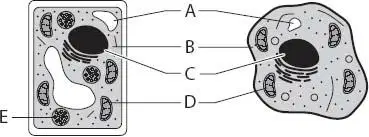
Where does the cellular respiration take place in this diagram?
A
B
C
D
E
Which process does NOT release energy from glucose?
glycolysis
photosynthesis
krebs cycle
cellular respiration
Which of the following is one of the ways that cellular respiration and photosynthesis are opposite processes?
Photosynthesis releases energy, and cellular respiration stores energy.
Photosynthesis removes carbon dioxide from the atmosphere, and cellular respiration puts it back.
Photosynthesis removes oxygen from the atmosphere, and cellular respiration puts it back.
Photosynthesis consumes glucose, and cellular respiration produces glucose.
Photosynthesis is to chloroplasts as cellular respiration is to
chloroplasts
mitochondria
cytoplasm
nuclei
Unlike photosynthesis, cellular respiration occurs in
animals only
plants only
prokaryotic cells only
eukqryotic cells only
The products of photosynthesis are the
products of cellular respiration.
reactants of cellular respiration.
products of glycolysis.
reactants of fermentation.
Which of these processes takes place in the cytoplasm of a cell?
glycolysis
electron transport
Krebs cycle
photosynthesis
A calorie is the amount of energy needed to raise the temperature of 1 gram of water 1 degree Celsius.
T
F
Animals breathe in order to take in the carbon dioxide their cells need to perform cellular respiration.
T
F
A calorie is the amount of energy needed to raise the temperature of 1 gram of water 10 degree Celsius.
T
F
Muscle cells, which need a lot of ATP, would be expected to have a lot of ____, the organelles involved in cellular respiration.
mitochondria
chloroplast
nuclei
cytoplasm
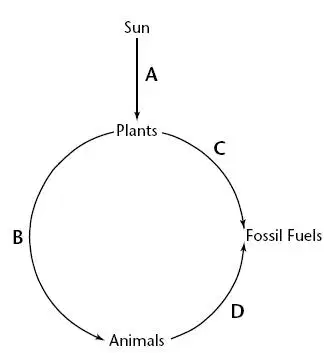
Which part indicates cellular respiration?
A
B
C
D
Write out the formula of cellular respiration on paper.
List the three main stages of cellular respiration in order. Where does each stage take place in the cell?
List out the three types of electron carriers and their symbols with high-energy electrons.
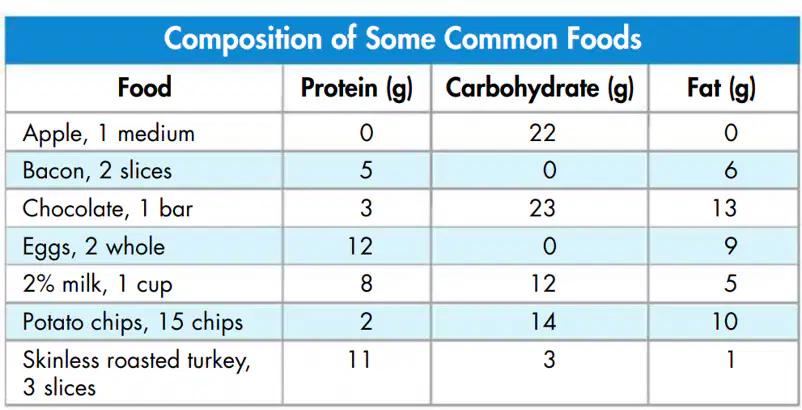
Lily has eaten a bar of chocolate, calculate her energy intake in Calories.
Pyruvic acid from
glycolysis enters the
mitochondrion’s matrix.
Enzymes split CO2
off from pyruvic acid,
leaving a 2-carbon
molecule. NADH is
produced from NAD+.
The 4-carbonatom molecule can
go through the
cycle again.
More
reactions make
high-energy
molecules of
ATP, FADH2,
and NADH
The 2-carbon-atom
molecule joins a
4-carbon-atom molecule
to become citric acid.
More CO2 and
NADH are made as
citric acid becomes
a 4-carbon-atom
molecule

