
 Worksheets
biological test
Total questions: 20
Worksheet time: 13mins
Name
Class
Date
1.
1. niche is Niche is
(a) the biological factors in the organism’s environment
(b) range of temperature that the organism needs to live
(c) physical space where an organism lives
(d) functional role played by the organism where it lives
a)
a
b)
b
c)
c
d)
d
2.
2. Which system jointly coordinates and regulates the physiological functions in the body?
(a) Nervous system
(b) Endocrine system
(c) Both (a) and (b)
(d) Excretory system
a)
(a)
b)
(b)
c)
(c)
d)
(d)
3.
3. Hormonal system is very important because
(a) Neural coordination is fast
(b) Nerve fibres do not innervate all the cells of body.
(c) Neural system provides point to point coordination among organs.
(d) Neural coordination is short-lived.
a)
(a)
b)
(b)
c)
(c)
d)
(d)
4.
4. Endocrine glands
(a) Are ductless
(b) Secrete hormones
(c) Pour their secretion in blood
(d) All of these
a)
(a)
b)
(b)
c)
(c)
d)
(d)
5.
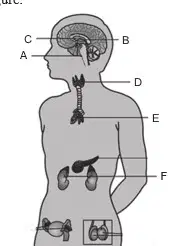
5. Identify A to F in the given figure.
(a) A–Hypothalamus, B–Pineal, C–Thymus, D–Adrenal, E–Pituitary, F–Thyroid and parathyroid
(b) A–Pituitary, B–Pineal, C–Hypothalamus, D–Thyroid and parathyroid, E–Thymus, F–Adrenal
(c) A–Thymus, B–Pituitary, C–Thyroid and parathyroid, D–Pineal, E–Hypothalamus, F–Adrenal
(d) A–Pineal, B–Thyroid and parathyroid, C–Pituitary, D–Hypothalamus, E–Adrenal, F–Pineal
a)
(a)
b)
(b)
c)
(c)
d)
(d)
6.
6. Hormones are
(a) Non-nutrient chemicals
(b) Intercellular messengers
(c) Produced in traces
(d) All of these
a)
(a)
b)
(b)
c)
(c)
d)
(d)
7.
7. Select from the following the total number of endocrine glands:
Pituitary, pineal, thyroid, parathyroid, adrenal, pancreas, thymus, gonads, liver, kidney
(a) 7 (b) 8
(c) 6 (d) 5
a)
(a)
b)
(b)
c)
(c)
d)
(d)
8.
8. The following organs produce hormones except
(a) GIT
(b) Liver and kidney
(c) Heart
(d) Urinary bladder
a)
(a)
b)
(b)
c)
(c)
d)
(d)
9.
9. Hypothalamus contains several groups of neurosecretory cells called which produce hormones.
(a) Ganglion
(b) Plexus
(c) Nuclei
(d) Astrocytes
a)
(a)
b)
(b)
c)
(c)
d)
(d)
10.
10. Hypothalamus is a part of
(a) Forebrain
(b) Mid-brain
(c) Hindbrain
(d) None of these
a)
(a)
b)
(b)
c)
(c)
d)
(d)
11.
11. Hypothalamus is
(a) Roof of diencephalon
(b) Basal part of diencephalon
(c) Lateral wall of diencephalon
(d) All of these
a)
(a)
b)
(b)
c)
(c)
d)
(d)
12.
12. Hypothalamus directly regulates the endocrine gland.
(a) Pituitary
(b) Thyroid
(c) Thymus
(d) Pancreas
a)
(a)
b)
(b)
c)
(c)
d)
(d)
13.
13. Releasing hormones and inhibiting hormones are produced by
(a) Pituitary (b) Thyroid
(c) Thymus (d) Hypothalamus
a)
(a)
b)
(b)
c)
(c)
d)
(d)
14.
14. Pars distalis produces how many trophic hormones?
(a) 4 (b) 5
(c) 6 (d) 8
a)
(a)
b)
(b)
c)
(c)
d)
(d)
15.
15. The following hormones are released by hypothalamus except
(a) GnRH
(b) Somatostatin
(c) TSH–RH
(d) PRL
a)
(a)
b)
(b)
c)
(c)
d)
(d)
16.
16. Select the incorrect statement from following:
(a) Invertebrates possess very simple endocrine system.
(b) Anterior pituitary is under control of hypothalamus by portal system.
(c) Posterior pituitary is under direct neural regulation of hypothalamus.
(d) Hypothalamus secretes tropic hormones.
a)
(a)
b)
(b)
c)
(c)
d)
(d)
17.
17. Which of the following is incorrect about pituitary?
(a) Located in bony cavity called sella turcica.
(b) Attached to hypothalamus by stalk.
(c) Divided anatomically into adenohypophysis and neurohypophysis.
(d) Secretes released and inhibitory hormones.
a)
(a)
b)
(b)
c)
(c)
d)
(d)
18.
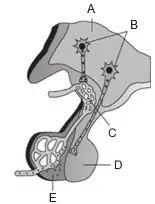
18. Identify A to E in the given figure.
(a) A–Hypothalamus, B–Hypothalamic neurons, C–Portal circulation, D–Posterior pituitary, E–Anterior pituitary
(b) Posterior pituitary, B–Hypothalamic neurons, C–Hypothalamus, D–Anterior pituitary, E–Posterior pituitary
(c) A–Anterior pituitary, B–Portal circulation, C–Hypothalamus, D–Posterior pituitary, E–Hypothalamic neurons
(d) A–Hypothalamic neurons, B–Posterior pituitary, C–Anterior pituitary, D–Portal circulation, E-Hypothalamus
a)
(a)
b)
(b)
c)
(c)
d)
(d)
19.
19. Adenohypophsyis consists of
(a) Pars distalis
(b) Pars intermedia
(c) Pars nervosa
(d) Both (a) and (b)
a)
(a)
b)
(b)
c)
(c)
d)
(d)
20.
20. Neurohypophysis consist of
(a) Pars distalis (b) Pars intermedia
(c) Pars nervosa (d) All of these
a)
(a)
b)
(b)
c)
(c)
d)
(d)
100 %

