
 Worksheets
Assessment Revision 2023 year 8
Total questions: 125
Worksheet time: 1hrs 14mins
Recycling is the process of:
Buying new things
Taking old or unwanted products and using the materials to make new things.
Putting unwanted products in landfill.
Burning unwanted products.
Select some benefits of recycling:
Uses fewer limited resources.
Uses less energy.
Difficult to separate components of some materials.
Makes less rubbish, which ends up in landfill sites.
What has to be done to aluminium ore to produced aluminium?
It must be oxidised.
It must be extracted.
It must be carbonated.
It must be redoxed.
Recycling could help to prevent further increases in greenhouse gas level.
True
False
It is important to recycle aluminium because it uses less energy to recycle aluminium than to mine and extract aluminium from aluminium ore.
True
False
Recycling saves money because it is completely free.
True
False
Select ways in which mining can harm the environment.
Destroys habitats
Yields materials humans need
Is an energy-intensive process
Causes pollution


What does this sign mean?
walk in circles
reduce, reuse, recycle
save the environment
green is my favourite colour
What are the benefits of recycling?
Increases carbon dioxide emissions and keeps the planet warm so we are not as cold Mars
Reduces the amount of waste sent to landfills and incinerators, Conserves natural resources, Prevents pollution by reducing the need to collect new raw materials, Saves energy.
Wind farms become more economical and mining companies need to give more money to the poor.
Cars can go faster on recycled petrol
Parallel circuits split at (a) .
In a series circuit...
the current is the same everywhere.
the current is split between components.
the voltage is the same everywhere.
the voltage is split between components.
Ammeters should always be connected in (a) .
In a series circuit, if one component breaks the others will remain on.
True
False
In parallel circuits...
the current is the same everywhere.
the current splits at a junction.
the voltage is the same everywhere.
the voltage splits at a junction.

What is the missing value on the ammeter?
(a)

What is the missing value on the voltmeter?
(a)

What is the reading on the labelled voltmeter?
(a)

What is the reading on the labelled ammeter?
(a)

What is the reading on the labelled ammeter?
(a)

What is the reading on the voltmeter around the cell?
(a)
Voltmeters should always be connected in (a) around a component.
Potential difference is another word for (a) .
How bright are the bulbs in the circuit?
As bright as if there was only one bulb
Dimmer than if there was only one bulb
Brighter as if there was only one bulb
Why are the bulbs not so bright in this circuit?
Because there are fewer blue wires
Because the batteries are not as powerful
Because the bulbs are sharing the energy
How bright are the bulbs in this circuit compared to the series circuit?
The same
Dimmer
Brighter
Why do you think the bulbs are brighter in this circuit?
The batteries are more powerful
The bulbs are less powerful
Each bulb has its own path
There are more blue wires
What do you predict will happen to the bulb that we are unscrewing and the other bulb?
Both bulbs will go out
One bulb will go out
No bulbs will go out
Something else
Click on the answer that you think is correct
Both bulbs will go out
One bulb will go out
No bulbs will go out
Something else
Why do you think one bulb stayed lit?
It is a stronger bulb
We broke the circuit
It has its own path
Something else
Which of the "Halogens" is found in liquid state at room temperature?
Flourine
Astatine
Iodine
Bromine
As you move down the group, halogens' reactivity...
increases
decreases
doesn't change
shows no trend.
Which halogens can displace bromide ions to make bromine?
Fluorine and iodine.
Fluorine and bromine.
Fluorine and chlorine
Chlorine and iodine.

A displacement reaction involves...
a solution turning brown or yellow.
a less reactive element taking the place of a more reactive element.
a dislocated hip.
a more reactive element taking the place of a less reactive element.
Would a displacement reaction occur for Bromine + Potassium Iodide?
Yes
No
Maybe
How many electrons do the halogens all have in their outer shells?
1
2
7
8
The Halogens are found in which group number?
5
6
7
0
Would a displacement reaction occur for Iodine + Potassium Bromide?
Yes
No
Maybe
As you go down the group, how does the boiling point of the halogen elements change?
Increases
Decreases
They're all about the same
Which of the "Halogens" has yellowish green color?
Chlorine
Bromine
Flourine
Iodine
Which halogen would be able to replace chlorine in sodium chloride?
Flourine
Bromine
Iodine
Astatine
Which statement is true about halogens?
Form covalent compounds with other non-metallic elements
A less reactive halogen will displace a more reactive element form its ionic salt
Form ionic compound with hydrogen
form negative ion of charge -2
The process by which solid iodine particles change directly to gas without first becoming a liquid is called ____.
evaporation
ionization
condensation
sublimation
Which of the following is / are not a gas at room temperature
fluorine
bromine
iodine
chlorine
Which of the following is the most unreactive
fluorine
bromine
iodine
chlorine
Which of the following is black
fluorine
bromine
iodine
chlorine
Which of the following is explosive
fluorine and hydrogen
chlorine and hydrogen
iodine and hydrogen
bromine and hydrogen
Which of the following is the correct definition of displacement?
when a reactive element pushes out, displaces, a less reactive element from a reactive element that contains the less reactive element
when a more reactive element displaces, or pushes out, a less reactive element from a compound that contains the less reactive element
when a less reactive element displaces, or pushes out, a less reactive element from a compound that contains the less reactive element
when a more reactive element displaces, or pushes out, a more reactive element from a compound that contains the less reactive element

In which reaction shown (1-9) would a brown coloration of iodine be observed?
1, 2 & 3
4 & 5
3, 6 & 9
3 & 6
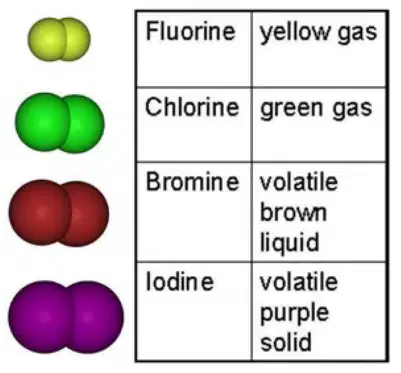
Which elements in group 7 are more reactive than chlorine?
Fluorine
Chlorine
Bromine
Iodine
Which elements in group 7 are less reactive than fluorine?
Fluorine
Chlorine
Bromine
Iodine
Which elements in group 7 are less reactive than bromine?
Fluorine
Chlorine
Bromine
Iodine
Which elements in group 7 will be displaced by chlorine?
Fluorine
Chlorine
Bromine
Iodine
Which elements in group 7 are will be displaced by bromine?
Fluorine
Chlorine
Bromine
Iodine

Fill in the missing box.
(a)

Fill in the missing box.
(a)
Astatine is below Iodine in the periodic table. Which prediction(s) about Astatine could be true?
Astatine is more reactive than iodine
Astatine is less reactive than Bromine
Astatine will not displace Chlorine
Astatine is not a halogen
Which genotype is homozygous? (a)
Which genotype is heterozygous? (a)

Complete the punnett square; what is the likelihood that an offspring is homozygous recessive?
1 in 4, or 25%
2 in 4, or 50%
1 in 2, or 50%
0 in 4, or o%
A homozygous yellow gummy (YY) and green gummy (yy) mate. What percentage of the offspring are green?
0
25
75
100
A yellow offspring from the last mating is heterozygous. What is its genotype?
YY
yy
Yy
Two heterozygous yellow gummies mate. What percentage of their offspring are yellow?
0
25
75
100
Two green gummies mate. What is the expected percentage of green offspring?
0
50
100
75
Assume that gummy eye colors are brown (B) and blue (b). How many genotypes are possible for a brown-eyed gummy?
0
1
2
3
How many genotypes are possible for a blue-eyed gummy?
0
1
2
3
Two blue eyed gummies mate. Predict the likelihood of brown-eyed offspring.
0%
25%
50%
75%
A brown-eyed bear and blue-eyed bear mate and produce 300 offspring; all of the offspring are brown-eyed. Which is true of the brown-eyed parent?
it is homozygous dominant
it is heterozygous
it is homozygous recessive
If only (a) phenotypes are possible, the inheritance pattern is normal (b) . When three (c) are possible, and a heterozygote has a blended appearance, the inheritance pattern is (d) dominance.
When 3 (a) are possible and a heterozygote is (b) in appearance, the inheritance pattern is (c) . When (d) phenotypes are present, the trait likely includes multiple (e) (more than 2).
A pink flower (RW) and a white flower (WW) breed and produce offspring. Complete a Punnett square to determine the probability that offspring are red.
0%
25%
50%
75%
Two roan cattle (RW) mate and produce offspring. Use a punnett square to determine the probability of having offspring with red and white spots.
0%
25%
50%
75%
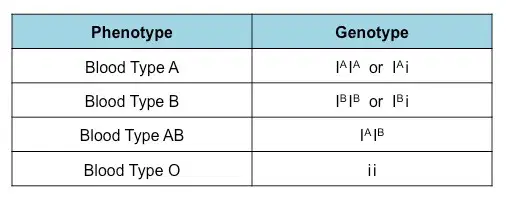
Math the blood type description to its likely genotype
Homozygous type A
IAIA
Heterozygous Type A
IAi
Type AB
IAIB
Type O
ii
Homozygous Type B
IBIB

Fruit and vegetables are a good source of ?
Vitamins
Minerals
Both of the above

What group do these foods belong to?
Sugars and Fat
Dairy
Carbohydrates
Proteins
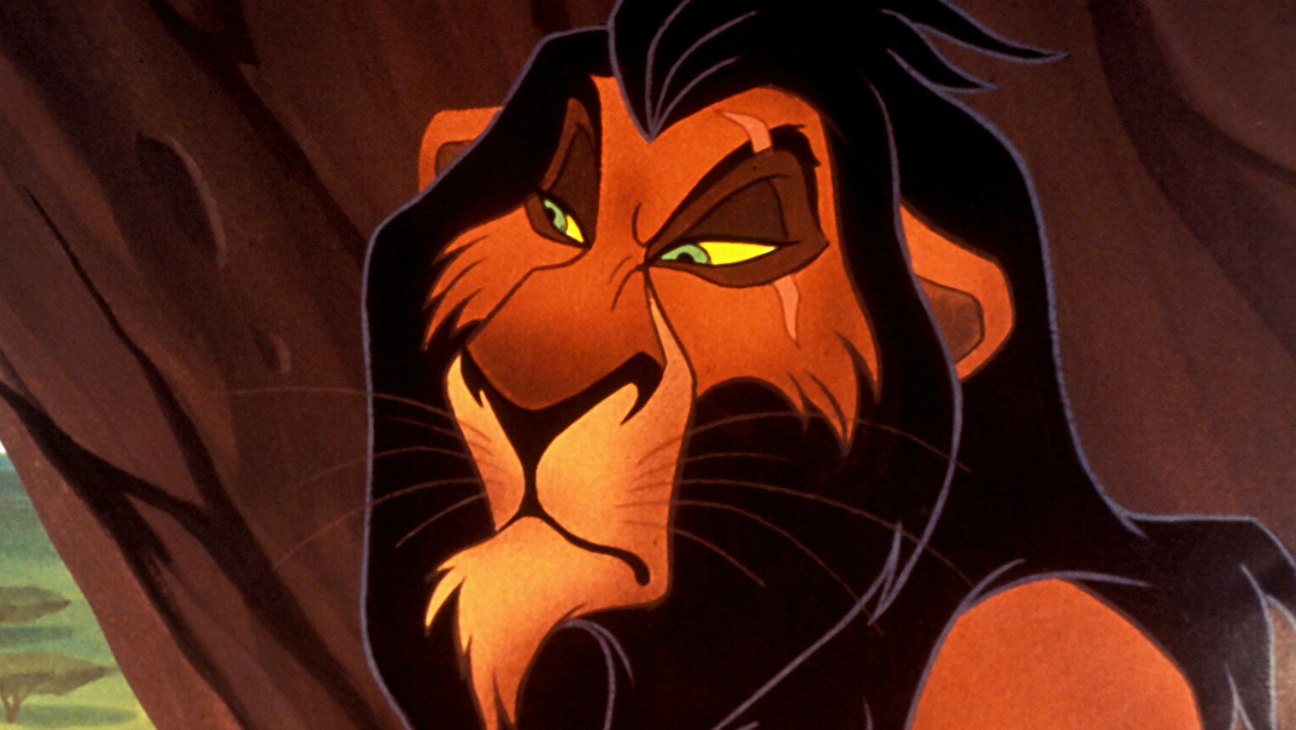
Why does Scar have a scar but his brother Mufasa does not?
Mufasa did not inherit it
The scar gene skipped a generation
The scar is an environmental trait
Mufasa is not his brother
How do extrusive igneous rocks form?
from lava that erupted onto Earth's surface
from magma that hardened beneath Earth's surface
How do intrusive igneous rocks form?
from lava that erupted onto Earth's surface
from magma that hardened beneath Earth's surface
Fine-grained igneous rocks with small crystals formed from
rapidly cooling lava
slowly cooling magma
Coarse-grained igneous rocks with large crystals formed from
rapidly cooling lava
slow cooling magma
The process by which igneous rocks are formed _?_.
heat and pressure deep underneath earth's surface
melting and cooling of magma
compaction and cementation of sediments
Igneous rock that formed when magma hardened beneath the surface of Earth is called _?_ igneous rock.
extrusive
intrusive
Sandstone is a sedimentary rock made of _____
Skeletons and shells of dead sea animals
tiny particles
rounded rocks
Sand quartz
Limestone is a sedimentary rock made up of _______
Skeletons and shells of dead sea animals
rounded rocks
tiny particles
quartz of sand
In what kind of stone would we expect to find fossils?
Conglomerate
Halite
Limestone
Gypsum
(a) – removal of rock particles by wind, water, ice or gravity
Weathering
acts slowly over time
acts quickly over time
Important factors that determine the rate at which weathering occur are the type of _____ and the _________.
rock and climate
erosion and weathering
acid rain and weather
All rocks break down into smaller material.
True
False
Weathering breaks down rock and creates fragmented materials or (a) .
Muscles can only (a)
In an antagonistic pair, one muscle will contract, whilst the other (a)
How does an antagonistic pair work?
Muscles move.
Paired muscles move.
Muscles relax and contract to move bones.
As one muscle relaxes the other contracts to allow movement at a joint.
What gas diffuses out of the blood, after respiration?
Oxygen
Nitrogen
Carbon Dioxide
Hydrogen

The pathway of air into the lungs is:


As you breath in and out when do your lungs expand?
when air rushes in
when air rushes out
when your diaphragm expands
when your chest cavity relaxes
Why is recycling so important?
The world's resources are unlimited.
It's not
The world's resources are limited, saves energy and reduces air and water pollution.