wayground logo

Free Printable Worksheets

Font size

S
M
L
XL
Worksheets

All Questions - Acad Geometry

Total questions: 213

Worksheet time: 9hrs 48mins

Name
Class
Date
1.

How would you name the triangle congruent to triangle ABC?

a)

Triangle FMN

b)

Triangle NMF

c)

Triangle MNF

d)

Triangle MFN

2.

The interior angles of a triangle add to (a)   degrees.

3.

What type of angles are highlighted above?

a)

Alternate Exterior Angles

b)

Consecutive Interior Angles

c)

Corresponding Angles

d)

Alternate Interior Angles

4.

Which of the following CAN you conclude from the diagram?

a)

lines l and m are perpendicular

b)

<a and <b are adjacent

c)

<a and <b are complementary

d)

m<a = m<b

5.

What is the length of DE?

(a)  

6.
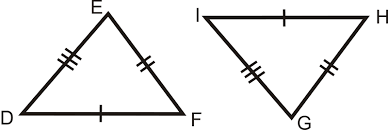
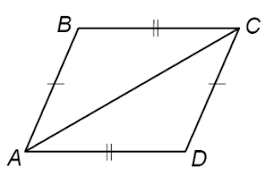
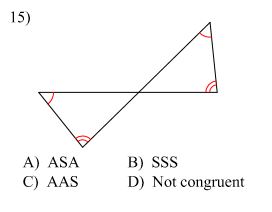
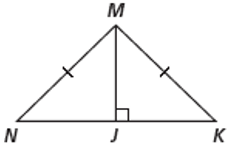
Which triangle congruence theorem can be used to prove the triangles are congruent?
a)
SAS
b)
SSS
c)
ASA
d)
HL
7.

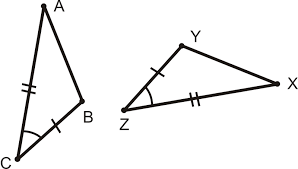
Which triangle congruence theorem can be used to prove the triangles are congruent?

a)

SSS

b)

ASA

c)

AAS

d)

SAS

8.

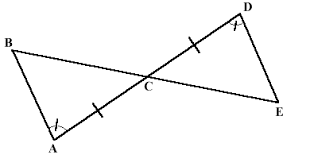
Which triangle congruence theorem can be used to prove the triangles are congruent?

a)

ASA

b)

SAS

c)

SSS

d)

Not enough information

9.

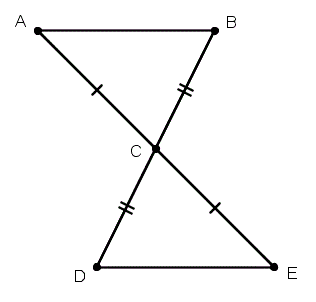
Which triangle congruence theorem can be used to prove the triangles are congruent?

a)

ASA

b)

SSS

c)

SAS

d)

SSA

10.

Which triangle congruence theorem can be used to prove the triangles are congruent?

a)

AAS

b)

SAS

c)

HL

d)

ASA

11.

Which of the following is NOT a triangle congruence theorem?

a)

SSS

b)

SAS

c)

ASA

d)

AAA

12.

Which triangle congruence theorem can be used to prove the triangles are congruent?

a)

SAS

b)

Not enough information

c)

SSS

d)

ASA

13.

Which of the following are NOT sufficient to prove two triangles are congruent? Choose all that apply.

a)

SSS

b)

AAA

c)

ASA

d)

SSA

e)

SAS

14.

Are the following triangles congruent? If so, how do you know?

a)

Yes, SSS

b)

Yes, SAS

c)

Yes, ASA

d)

Yes, AAS

e)

No, insufficient information given

15.

What property states that a side or angle is congruent to itself?

a)

Substitution POE

b)

Addition POE

c)

Reflexive POE

d)

Transitive POE

16.

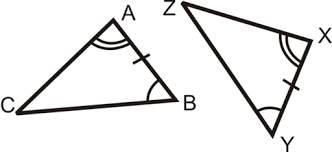
Name the postulate or theorem, if possible, that makes the triangles congruent.

a)

SSS

b)

SAS

c)

ASA

d)

Not Congruent

17.
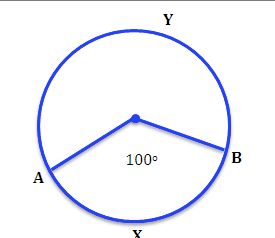
What is the measure of arc AYB
a)
50
b)
100
c)
180
d)
260
18.
How big is angle b?
a)
50 degrees
b)
60 degrees
c)
70 degrees
d)
75 degrees
19.
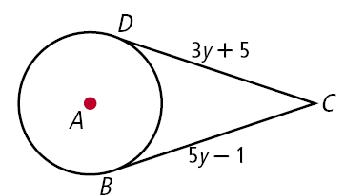
Two tangents CD and CB intersect circle A. Find the length of the tangent segment BC.
a)
2
b)
3
c)
9
d)
14
20.
What is the measure of angle 2?
a)
80
b)
45
c)
125
d)
40
21.
What is the m∠C?
a)
50
b)
25
c)
100
d)
55
22.
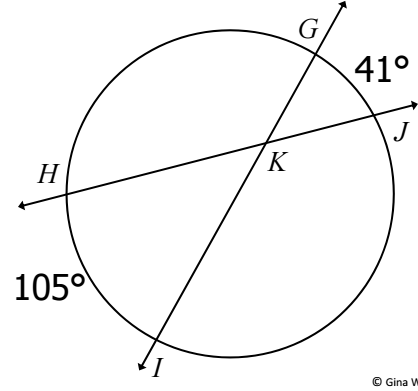
What is the measure of angle HKI?
a)
72
b)
73
c)
74
d)
75
23.
In a circle (or congruent circles), chords that are the same distance from the center:
a)
are similar
b)
have the same name
c)
are congruent to each other
d)
are walking dead
24.
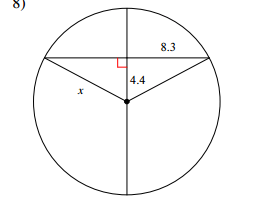
Find x.
a)
4.4
b)
8.3
c)
9.4
d)
8.8
25.
A tangent is a line that _______. 
a)
passes through the center of the circle
b)
intersects the circle at two points
c)
intersects the circle at one point
d)
follows the circumference of a circle
26.
Name a chord.
a)
Segment XC
b)
Segment KM
c)
Segment HJ
d)
LINE BD
27.
a)
81
b)
22
c)
51.5
d)
73.5
28.
Which of the following names a radius?
a)
segment AC
b)
segment DB
c)
segment AB
d)
segement BC
29.
Which of the following names a diameter?
a)
segment AC
b)
segment DB
c)
segment AB
d)
segment BC
30.
What is the part of the circle highlighted in red called?
a)
semi-circle arc
b)
major arc
c)
minor arc
d)
sector
31.
What is the part of the circle highlighted in red called?
a)
semi-circle arc
b)
major arc
c)
minor arc
d)
sector
32.
What is the part of the circle highlighted in red called?
a)
semi-circle arc
b)
major arc
c)
minor arc
d)
sector
33.
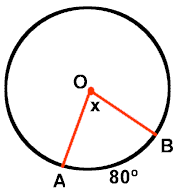
What is the value of x?
a)
x = 160
b)
x = 40
c)
x = 80
d)
x = 360
34.
What is the measure of ∠PTQ?
a)
100°
b)
140°
c)
180°
d)
120°
35.
If the measure of arc ABC = 210°, what is the measure of ∠AOC?
a)
150°
b)
100°
c)
210°
d)
105°
36.
Find the measure of arc JH
a)
93
b)
130
c)
120
d)
95
37.

Vertical Angles are...

a)

complementary

b)

supplementary

c)

congruent

d)

none of these

38.
What is an "Acute" Angle
a)
Angle that measures 180
b)
An Angle that measure 90
c)
An angle that measures more than 90
d)
An angle that measures less than 90
39.
Angles whose measure sum up to 180 degrees.
a)
Vertical
b)
Adjacent
c)
Complementary
d)
Supplementary
40.
 What is the name of this polygon?
a)
a pentagon
b)
a quadrilateral
c)
an octagon
d)
a triangle
41.
Which is a pair of corresponding angle?
a)
Angle 1 & Angle 4
b)
Angle 2 & Angle 7
c)
Angle 8 & Angle 6
d)
Angle 3 and Angle 5
42.

Name 3 collinear points.

a)

S, Q, R

b)

T, Q, R

c)

S, Q, P

d)

P, Q, R

43.

How many pets do you have at home?

a)

0-2

b)

3-4

c)

5-6

d)

7+

44.

I am an angle that measures

exactly 90 degrees. Who am I?

a)

acute

b)

obtuse

c)

right

d)

straight

45.

Parallel lines have the ______ slope.

a)

opposite reciprocal

b)

same

c)

negative

46.
How are the triangles congruent?
a)
AAS
b)
SAS
c)
ASA
d)
SSS
47.
a)
A
b)
B
c)
C
d)
D
48.

Which of the following are NOT sufficient to prove two triangles are congruent? Choose all that apply.

a)

SSS

b)

AAA

c)

ASA

d)

SSA

e)

AAS

49.
Are these triangles congruent?
a)
Yes, by SSS
b)
Yes, by SAS
c)
Yes, by AAS
d)
Yes, by HL
50.

Solve for x. (Just type the number, not x = )

(a)  

51.

How many FULL weeks do we have left in the semester?

a)

1

b)

2

c)

3

d)

4

52.

Vertical Angles are...

a)

complementary

b)

supplementary

c)

congruent

d)

none of these

53.

The interior angles of a triangle add to (a)   degrees.

54.

Which is your favorite? (You MUST pick ONE)

a)

Breakfast

b)

Lunch

c)

Dinner

d)

Midnight Snack

55.

An angle bisector cuts and angle into two pieces that are NOT congruent.

a)

True

b)

False

56.

What type of angles are highlighted above?

a)

Alternate Exterior Angles

b)

Consecutive Interior Angles

c)

Corresponding Angles

d)

Alternate Interior Angles

57.

What is the length of DE?

(a)  

58.
What is an "Acute" Angle
a)
Angle that measures 180
b)
An Angle that measure 90
c)
An angle that measures more than 90
d)
An angle that measures less than 90
59.
Angles whose measure sum up to 180 degrees.
a)
Vertical
b)
Adjacent
c)
Complementary
d)
Supplementary
60.
 What is the name of this polygon?
a)
a pentagon
b)
a quadrilateral
c)
an octagon
d)
a triangle
61.
Which is a pair of corresponding angle?
a)
Angle 1 & Angle 4
b)
Angle 2 & Angle 7
c)
Angle 8 & Angle 6
d)
Angle 3 and Angle 5
62.

Name 3 collinear points.

a)

S, Q, R

b)

T, Q, R

c)

S, Q, P

d)

P, Q, R

63.

How many pets do you have at home?

a)

0-2

b)

3-4

c)

5-6

d)

7+

64.

I am an angle that measures

exactly 90 degrees. Who am I?

a)

acute

b)

obtuse

c)

right

d)

straight

65.

Parallel lines have the ______ slope.

a)

opposite reciprocal

b)

same

c)

negative

66.
How are the triangles congruent?
a)
AAS
b)
SAS
c)
ASA
d)
SSS
67.
a)
A
b)
B
c)
C
d)
D
68.

Which of the following are NOT sufficient to prove two triangles are congruent? Choose all that apply.

a)

SSS

b)

AAA

c)

ASA

d)

SSA

e)

AAS

69.
Are these triangles congruent?
a)
Yes, by SSS
b)
Yes, by SAS
c)
Yes, by AAS
d)
Yes, by HL
70.

Solve for x. (Just type the number, not x = )

(a)  

71.

How many FULL weeks do we have left in the semester?

a)

1

b)

2

c)

3

d)

4

72.
What is it called when points lie on the same line.
a)
Midpoint
b)
Coplanear
c)
Segment Bisector
d)
Collinear
73.
A location in space that is represented by a dot and has no dimensions
a)
Point
b)
Line
c)
Plane
d)
Angle
74.
What are the arrows pointing to?
a)
Ray
b)
Endpoints
c)
Midpoint
d)
Vertex
75.
Consists of 2 endpoints and all the points in between.
a)
Ray
b)
Line
c)
Line Segment
d)
Angle
76.
What is this Symbol called?
a)
Congruent
b)
Equal
c)
Parallel Lines
d)
Angle
77.
Points that lie in the same plane.
a)

Colinear

b)

Intersection

c)

Parallel Planes

d)

Coplanar

78.

Having the same size and shape, (check all that apply)

a)

Congruent

b)

c)

=

d)

Similarity

79.

a straight path that has no thickness and extends forever

a)

point

b)

line

c)

ray

d)

plane

80.

Two rays that have a common endpoint and form a line.

a)

Linear Pair

b)

Opposite Rays

c)

Right Angle

d)

Supplementary Angles

81.

flat surface that has no thickness and extends forever.

a)

point

b)

line

c)

plane

d)

ray

82.

part of a line that starts at an endpoint and extends forever in one direction

a)

line

b)

segment

c)

ray

d)

vertex

83.

A basic figure that is not defined in terms of other figures. (Check all that apply)

a)

Undefined term

b)

Point

c)

Line

d)

Ray

84.
This is a(n):
a)
Line
b)
Ray
c)
Angle
d)
Line Segment
85.
This is a(n):
a)
Line
b)
Ray
c)
Angle
d)
Line Segment
86.
This is a(n):
a)
Line
b)
Ray
c)
Angle
d)
Line Segment
87.
This is a(n):
a)
Line
b)
Ray
c)
Angle
d)
Line Segment
88.
In this picture, point E is called a:
a)
Ray
b)
Line
c)
Vertex
d)
Angle
89.

Which of the following is named by a lower case letter?

a)

point

b)

line

c)

segment

d)

ray

e)

plane

90.

Which of the following is named by a single Upper case letter?

a)

point

b)

line

c)

segment

d)

ray

e)

plane

91.

How many noncollinear points are needed to name a plane?

a)

3

b)

1

c)

2

d)

4

92.

This geometric object has no dimension and is represented as a single dot in space

a)

point

b)

line

c)

plane

d)

ray

93.

These two lines will never intersect

a)

Parallel Lines

b)

Perpendicular lines

c)

Bisector

d)

Not possible

94.

This is a......

a)

an obtuse triangle

b)

an equilateral triangle

c)

a scalene triangle

d)

a right triangle

95.

Formed by two rays that share a common end point

a)

Angle

b)

Opposite Rays

c)

Congruent

d)

Line

96.

Two angles that add to be 90 degrees

a)

Supplementary

b)

Complementary

c)

Angles

d)

Right Angle

97.

The Pythagorean Theorem only works on what type of triangle?

a)

Scalene

b)

Isosceles

c)

Obtuse

d)

Right

e)

All Triangles

98.

If the measure of ABC=98\angle ABC=98^{\circ}  and BD\overrightarrow{BD}  is an angle bisector. What is the measure of ABD and DBC\angle ABD\ and\ \angle DBC  ?

a)

196

b)

98

c)

49

d)

Can't be determined

99.

The symbol ⊥ is used for which of the following notations?

a)

Parallel Lines

b)

Perpendicular lines

c)

Congruency

d)

Opposite Rays

100.

If the angles of one of two similar triangles are 30, 60, and 90 degrees, what are the angles for the other triangles?

a)

60, 120, 180

b)

30, 60, 90

c)

45, 45, 90

d)

Not enough information

101.

Two angles that add to be 180 degrees

a)

Supplementary

b)

Complementary

c)

Angles

d)

Straight Line

102.

Name the angle in the image

a)

∠OAB

b)

∠OBA

c)

∠AOB

d)

∠BOA

103.

If the measure of two angles of a triangle are 60 and 100 degrees, what is the measure of the third angle?

a)

30°

b)

60°  

c)

90°  

d)

20°  

104.

Which shapes represents the sides of a pyramid?

a)

trapezoid

b)

square

c)

triangle

d)

rectangle

105.

The vertical cross section of a cube is a ________

a)

circle

b)

square

c)

triangle

d)

parallelogram

106.

means having the same shape and size

a)

congruent

b)

small

c)

large

d)

equal

107.

What is the opposite of squaring a number?

a)

divide

b)

square root

c)

fractions

d)

multiply

108.

What is the perimeter of this polygon?

a)

36

b)

80

c)

33

d)

43

109.

The space inside of a 3-dimensional figure is called:

a)

surface area

b)

volume

c)

circumference

d)

mass

110.

Which of the following represents pi?

a)

3.5

b)

3.1

c)

3.14

d)

3.1867

111.

Angles on a line add up to......

a)

90

b)

180

c)

160

d)

360

112.
What type of angles are c and h?
a)
corresponding
b)
alternate interior
c)
alternate exterior
d)
supplementary
113.
Find the value of x.
a)
6
b)
8
c)
9.42
d)
67
114.
Which angles are alternate interior?
a)
c and h
b)
e and g
c)
f and i
d)
g and f
115.
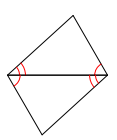
Congruent by
a)
SSS
b)
SAS
c)
ASA
d)
AAS
116.
Congruent by
a)
SSS
b)
SAS
c)
ASA
d)
AAS
117.
Congruent by
a)
SSS
b)
SAS
c)
ASA
d)
AAS
118.
Congruent by
a)
SSS
b)
SAS
c)
ASA
d)
AAS
119.
What are complementary angles?
a)
Angles that add up to 180°
b)
Angles that add up to 90°
c)
Angles that are equal to each other
d)
Angles that are opposite of each other when lines intersect.
120.
What are supplementary angles?
a)
Angles that add up to 180°
b)
Angles that add up to 90°
c)
Angles that are equal to each other
d)
Angles that are opposite of each other when lines intersect
121.
What is the slope of the line that passes through the following points:
(9, 3) and (7, 8).
a)
6
b)
3
c)
-5/2
d)
6
122.
Slopes of perpendicular lines are...
a)
opposite reciprocals.
b)
opposites.
c)
identical.
d)
always 7.
123.
What type of triangle is this? 
a)
equilateral
b)
obtuse
c)
scalene
d)
isosceles
124.
What type of triangle? 
a)
Acute
b)
Obtuse
c)
Right
d)
Isosceles
125.
Find the exterior angle
a)
100
b)
55
c)
45
d)
80
126.
Find the length of AB
a)
6
b)
11
c)
17
d)
68
127.
The figure is an example of a(n) ...
a)
altitude 
b)
perpendicular bisector
c)
midsegment
d)
angle bisector
128.
The figure is an example of a(n) ...
a)
angle bisector
b)
midsegment
c)
altitude
d)
median
129.
The figure is an example of a(n) ...
a)
angle bisector
b)
perpendicular bisector
c)
median
d)
midsegment
130.
The figure is a parallelogram.  
Solve for x.  
a)
1
b)
11
c)
7
d)
6
131.
Find the missing angle.
a)
60
b)
120
c)
140
d)
180
132.

Name the angle with three arcs. Choose all that apply.

a)

< FIE

b)

< EIF

c)

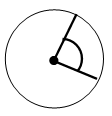
< I

d)

< EIR

133.

A part of a line consisting of two points and all points between them.

a)

ray

b)

endpoint

c)

line segment

d)

plane

134.

A flat surface that has no thickness

and extends forever.

a)

point

b)

line

c)

plane

d)

ray

135.

If points A, B, C are collinear with B between A and C, the segment addition postulate is:

a)

AB + BC = AC

b)

BA + CB = AC

c)

CA + CB = AB

d)

BC + AC = CA

136.

Name 3 collinear points.

a)

S, Q, R

b)

T, Q, R

c)

S, Q, P

d)

P, Q, R

137.

I am a location in space. I have no dimension. Who am I?

a)

Plane

b)

Point

c)

Segment

d)

Line

138.

I am part of a line. I have one end point and continue forever in one direction. What am I?

a)

segment

b)

line

c)

ray

d)

opposite ray

139.

I am made up of a minimum of 2 points with no thickness or width. What am I?

a)

plane

b)

line segment

c)

line

d)

ray

140.

I am an angle that measures

exactly 90 degrees. Who am I?

a)

acute

b)

obtuse

c)

right

d)

straight

141.

Name the angle that is pictured.

a)

Acute

b)

Right

c)

Obtuse

d)

Straight

142.

Lines that intersect and create a

right angle are called:

a)

line segments

b)

parallel lines

c)

perpendicular lines

d)

ray

143.

Q is the midpoint of PR.

PQ = 6x – 7 and QR = 5x + 1.

Find the length of PR.

a)

8

b)

16

c)

41

d)

82

144.

I am a line, ray or segment that intersects a segment at its midpoint. What am I?

a)

congruent segments

b)

perpendicular line

c)

angle bisector

d)

segment bisector

145.

Find the m ∠A.

a)

79 degrees

b)

87 degrees

c)

90 degrees

d)

97 degrees

146.

If ray OR is the angle bisector of ∠POQ, and m∠POR = 38°, what is the m∠POQ?

a)

19°

b)

38°

c)

62°

d)

76°

147.

If ∠ABC= 103⁰, find m∠ ABD

a)

45

b)

13

c)

57

d)

46

148.

Find the missing angle measure.

a)

43 degrees

b)

47 degrees

c)

57 degrees

d)

67 degrees

149.

What is the measure of the

missing angle?

a)

92 degrees

b)

102 degrees

c)

82 degrees

d)

72 degrees

150.
Which triangle congruence theorem can be used to prove the triangles are congruent?
a)
SAS
b)
SSS
c)
ASA
d)
HL
151.

Which triangle congruence theorem can be used to prove the triangles are congruent?

a)

SSS

b)

ASA

c)

AAS

d)

SAS

152.

Which triangle congruence theorem can be used to prove the triangles are congruent?

a)

ASA

b)

SAS

c)

SSS

d)

Not enough information

153.

Which triangle congruence theorem can be used to prove the triangles are congruent?

a)

ASA

b)

SSS

c)

SAS

d)

SSA

154.

Which triangle congruence theorem can be used to prove the triangles are congruent?

a)

AAS

b)

SAS

c)

HL

d)

ASA

155.

Which of the following is NOT a triangle congruence theorem?

a)

SSS

b)

SAS

c)

ASA

d)

AAA

156.

Which triangle congruence theorem can be used to prove the triangles are congruent?

a)

SAS

b)

Not enough information

c)

SSS

d)

ASA

157.

Congruent figures...

a)

Have the same dimensions (side lengths and angle measures)

b)

Are the same shape and size

c)

Can be mapped onto one another using rigid motions

d)

All of the above

158.

Are the following triangles congruent? If so, how do you know?

a)

Yes, SSS

b)

Yes, SAS

c)

Yes, ASA

d)

Yes, AAS

e)

No, insufficient information given

159.

How would you name the triangle congruent to triangle ABC?

a)

Triangle FMN

b)

Triangle NMF

c)

Triangle MNF

d)

Triangle MFN

160.

What property states that a side or angle is congruent to itself?

a)

Substitution POC

b)

Addition POC

c)

Reflexive POC

d)

Transitive POC

161.

Name the postulate or theorem, if possible, that makes the triangles congruent.

a)

SSS

b)

SAS

c)

ASA

d)

Not Congruent

162.

Fill in the blank.

a)

Given

b)

Reflexive POC

c)

Transitive POC

d)

Symmetric POC

163.

What does CPCFC stand for?

a)

Congruent parts of congruent figures are congruent

b)

Corresponding parts of congruent figures are congruent

c)

Corresponding parts of corresponding figures are corresponding

d)

Corresponding parts of congruent figures are Canadian.
164.
If ∆PIG ≅ ∆COW, WO≅?
a)
GI
b)
PI
c)
PG
165.

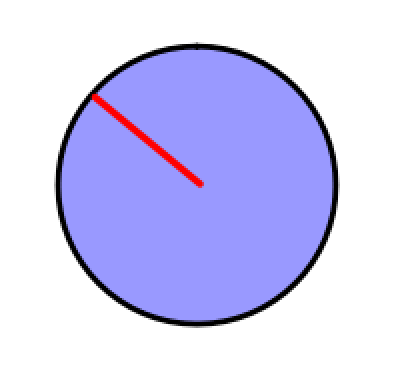
Is the red line a radius or diameter of the circle?

a)

Radius

b)

Diameter

166.

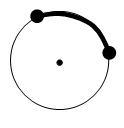
What is this called?

a)

Circumference

b)

Minor Arc

c)

Major Arc

d)

Inscribed Angle

167.

What is half of a circle

a)

Semicircle

b)

Center of a circle

c)

Inscribed angles

168.
This is a picture of ___________.
a)
Major Arc
b)
Minor Arc
c)
Central Angle
d)
Inscribed Angle
169.
Which best describes line AB?
a)
chord
b)
secant
c)
tangent
d)
diameter
170.
The _____________ of a circle is two times the radius. 
a)
chord
b)
diameter
c)
circumference 
171.
Circles with exactly the same radius measures
a)
Similar Circles
b)
Concentric Circles
c)
Congruent Circles
d)
Semicircle
172.
What do we call the red line?
a)
Chord
b)
Arc
c)
Diameter
d)
Segment
173.
What is C?
a)
diameter
b)
center
c)
circumference
d)
radius
174.
This is a picture of ___________.
a)
Minor Arc
b)
Major Arc
c)
Semi-Circle
d)
Central Angle
175.
What is Dilation?
a)
Dilation means to enlarge or reduce
b)
Dilation means to reflect on something
c)
Dilation means to like something
d)
Dilation means to make something different by making it smaller
176.
A scale factor of less than one means
a)
that the prime image will be larger than the pre-image.
b)
That the prime image will be the same as the preimage.
c)
That you need to subtract that amount off  of each side.
d)
That the prime image will be a reduction of the preimage.
177.
Definition: The figure before a transformation has occurred. 
a)
Pre-image
b)
Image
c)
Translation
d)
Reflection
178.
Definition: The figure after a transformation has occurred. 
a)
Pre-image
b)
Image
c)
Translation
d)
Reflection
179.
The __________ is the ratio of a length of the image to the corresponding length on the original figure.
a)
reduction
b)
enlargement
c)
scale factor
d)
center of dilation
180.
A triangle has vertices with coordinates (2,0), (3, -1) and (-2,-5). If the triangle is dilated by a scale factor of 3 with the origin as the center of dilation, what are the coordinates of the vertices of the image?
a)
(5,3), (6,2), (1,-2)
b)
(6,0), (9,-3), (-6,-15)
c)
(2/3,0), (1,-1/3), (-2/3,-5/3)
d)
(-1,-3), (0,-4), (-5,-8)
181.
Does the image show a dilation?
a)
Yes
b)
No
182.
Does the image show a Dilation?
a)
Yes
b)
No
183.
A triangle has vertices A(0,0), B(8,0), C(3,-2). Find the coordinates of the triangle after a dilation with a scale factor of  4. The dilation is (X,Y) --- (4x,4y)
a)
A(3,3), B(4,4), C(-3,-4)
b)
A(-4,8), B(6.5,8), C(7,7)
c)
A(0,0), B(32,0), C(12,-8)
184.
State the coordinate of the image of the given point B (-10,-6) under a dilation with center at the origin with the given scale factor k = 1/2.
a)
(5,3)
b)
(20,12)
c)
(-20,-12)
d)
(-5,-3)
185.
a)
1/2
b)
3/2
c)
2
d)
1
186.
a)
(-2,-2)
b)
(0,0)
c)
(1,1)
d)
(-2,-1)
187.
Dilate Point A by a scale factor of 1/2
a)
(-4,-4)
b)
(-1,-4)
c)
(-1,-1)
d)
(-2,-2)
188.
Choose the correct scale factor:
a)
2.5
b)
1.5
c)
3.5
d)
4
189.
Choose the correct scale factor:
a)
2
b)
3
c)
1/3
d)
1/2
190.
(x, y) -> (2x, 2y) 
What is the coefficient 2 mean?
a)
plot 2 to the right and 2 up
b)
scale factor is 2 creating a new figure half the size
c)
scale factor is 2 making a figure twice the 
original
d)
I don't understand this question : ( 
191.
What is the value of X?
a)
X=4
b)
X=6
c)
X=3
d)
X=2
192.
Are the triangles similar?
a)
Yes
b)
No
193.
Are the triangles similar?
a)
Yes
b)
No
194.
Similarity Ratio: _
a)
2/3
b)
1/2
c)
2
d)
3
195.
When you dilate a figure you...
a)
slide it.
b)
turn it.
c)
flip it.
d)
make it larger or smaller.
196.
All corresponding angles are congruent in similar figures.
a)
True
b)
False
197.
All corresponding sides are proportional (same ratio) in similar figures.
a)
True
b)
False
198.
Find x
a)
21
b)
27/7
c)
13
d)
18
199.
How does a dilation change the angles of a polygon?
a)
It changes by the scale factor.
b)
Dilations do not change the angles.
c)
It is impossible to answer this question.  The angles change unpredictably.
d)
The angles all change to larger angles.
200.

Given: B is the midpoint of AC. What should you conclude?

a)

AB + BC = AC

b)

AB = BC

c)

A is the segment bisector of BC

d)

ABC is a straight angle

201.

Given: OR \perp QP.  What should you conclude by definition of perpendicular?

a)

<ORP is a right angle

b)

QR + RP = QP

c)

<ORQ and <ORP are complementary

d)

<QRP = 180 °\degree  

202.

Given: <1 and <3 are vertical angles. What should you conclude by the vertical angles theorem?

a)

<1 and <2 are a linear pair

b)

<1 and <3 are right angles

c)

<2 and <4 are vertical angles

d)

<1<3<1\cong<3  

203.

Given: <1 and <2 are supplementary. What can you conclude?

a)

m<1 + m<2 = 180

b)

m<1 + m<2 = 90

c)

m<1 = m<2

d)

nothing

204.

Given: <1 and <2 are a linear pair. Conclusion: m<1 + m<2 = 180. What is the reason that allows you to draw that conclusion?

a)

Angle addition postulate

b)

Definition of straight angle

c)

Linear Pair Postulate

d)

Definition of supplementary

205.

Which of the following is an example of the transitive property?

a)

If x = 5 and and x = y, then y = 5.

b)

If x = y then y = x

c)

x = x

d)

If 2x + 4 = 2, then x = -1

206.

Given: AB is the segment bisector of PQ. What conclusion can you draw?

a)

PF = QF

b)

F is the midpoint of PQ

c)

m<PFA = m<QFA

d)

<PFQ is a straight angle

207.

If an angle is a straight angle, then its measure is 180°180\degree

 Given:  <ABC is a straight angle.
What conclusion can you draw?

a)

<ABC is not an acute angle

b)

<ABC is supplementary to another angle

c)

m<ABC = 180°180\degree  

d)

<ABC is a straight angle

208.

An animal has spots if and only if it's a cheetah. True or false?

a)

True because cheetahs have spots

b)

False because cheetahs don't have spots

c)

False because cheetahs are not the only animals that have spots

d)

True because cheetahs are fast

209.

Which of the following conclusions CANNOT be drawn just by looking at the diagram?

a)

GH and AB intersect at D

b)

<GDA and <HDB are vertical angles

c)

D is the midpoint of GH

d)

G, D, and H are collinear

210.

Given: PL is the angle bisector of <RPQ


What can you conclude by definition of angle bisector?

a)

m<RPL = m<LPQ

b)

<RPL + m<LPQ = m<RPQ

c)

<RPQ is acute

d)

m<RPQ = 90

211.
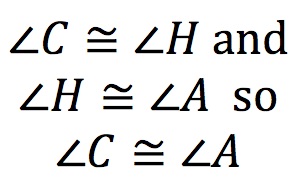
What is the justification?
a)
Symmetric Prop.
b)
Angle addition postulate
c)
Reflexive Prop
d)
Transitive Prop.
212.

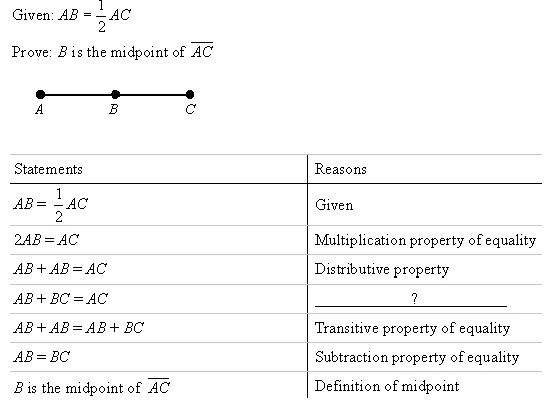
What is the missing statement in the proof?

a)

Addition property

b)

Segment Addition Postulate

c)

Substitution property

d)

Transitive property

213.

When trying to prove two angles are supplementary, what must you show in your proof?

a)

that the angles are equal

b)

that the angles add up to 180 degrees

c)

that the angles are a linear pair

d)

that the angles are right angles