
 Worksheets
Unit 7 Review
Total questions: 28
Worksheet time: 21mins
The evolutionary history of an organism is portrayed by its...
Phylogeny
Cladogram
DNA
Fossil
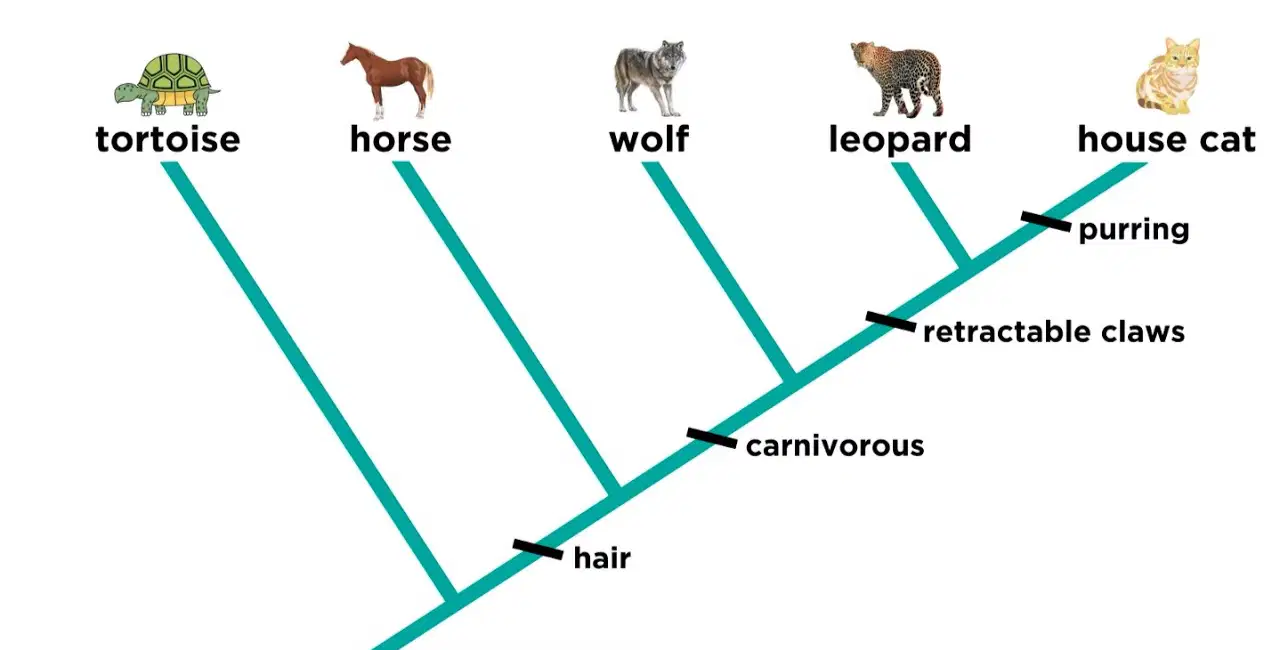
This image shows a cladogram. Which of the following best describes its purpose?
Shows organisms that do not show any evolutionary relationship.
It is used to show how each organism obtains its energy,
Shows the relationships between organisms based on characteristics.
Demonstrates how one organism evolved into another.
The type of evolution where closely related organisms that share a common ancestor evolve differences over time that results in speciation.
(a)
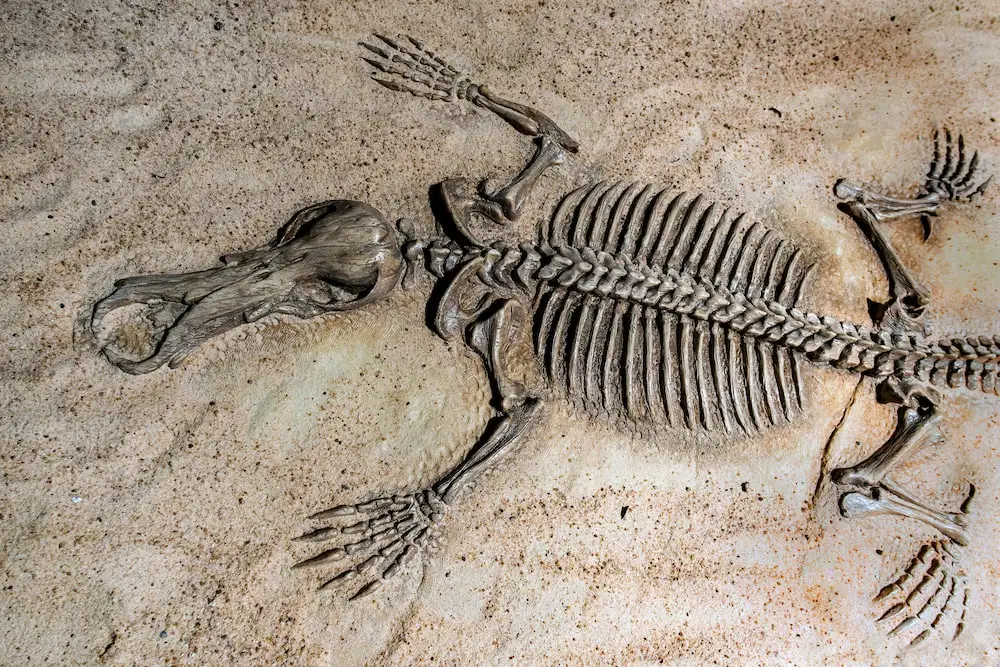
What is the most accurate fossil dating method used to get the exact date of a fossil?
cladogram
observations
Law of Superstition
radiometric dating
The fossil dating method where they aged fossils based on their position in the earth's crust.
Radiometric dating
Law of Superstition
Rock cycle
Fossil record
The type of evolution where organisms are not closely related but independently evolve similar characteristics for a similar function.
(a)
A unit of DNA that determines a specific structure and function of an organism is called a...
gene
characteristic
trait
nucleus
Which of the following is an example of a trait?
Sense of humor
eye color
brown eyes
height
Passing down characteristics from parents to offspring is referred to as...
Genetic drift
Gene flow
Inheritance
Mutation
Purple butterflies migrating from the north to the south during the winter and mating with orange butterflies is an example of...
genetic drift
gene flow
mutation
selective breeding

The scenario in the image is showing what phenomena?
Genetic drift
Gene flow
Mutation
Extinction
A species gets to continue to exist and reproduce because they are better adapted to their environment. This refers to...
Law of Supersition
Natural selcetion
Extinction
Survival of the Fittest
If an organism does not have the adaptions needed to survive, its population will significantly decrease. If an organism has the necessary adaptations, then it will survive. This is known as which mechanism?
Survival of the Fittest
Extinction
Natural Selection
Competition
How an animal reacts to a change in their environment is a (a) adaption.
Long claws, thick fur, and blubber are all examples of (a) adaptations.
Bat wings and butterfly wings are examples of which of the following?
Analogous structures
Homologous structures
Divergent evolution
Natural Selection
How does evolution occur by natural selection occur?
Organisms will adapt in the moment to fit in with their environment to survive.
Organisms that are stronger will survive.
Organisms that are fit for their environment will survive and then pass down their traits to their offspring.
Organisms naturally select which adaptations they want to help them survive.

The image shows examples of (a) structures.
Which of the following is not a resource for evidence of evolution?
Structures
DNA sequence
Climate record
Taxonomy
Traits that help an organism survive are called...
adaptations
Survival of the Fittest
speciation
Darwinism
The process in which organisms reproduce due to other reasons besides chance.
Random mating
Gene flow
Genetic Drift
Nonrandom mating
A (a) is a change in DNA sequence. Ex: ATC GCA --> AAC GCA
The bat and the whale descended from a common ancestor and both use echolocation. Which of the following statements is true about the bat and the whale?
They evolved divergently and echolocation is an analogous trait.
They evolved convergently and echolocation is a homologous trait.
They evolved divergently and echolocation is an homolgous trait.
They evolved convergently and echolocation is an analogous trait.
True/False: Structures inherited from a common ancestor is a homologous structures.
(a)
Which of the following describes speciation?
If an entire species is unfit for an environment, then it will adapt to it to survive.
When a common ancestor goes extinct because they have unfit traits.
The rise of a new species from convergent evolution.
The rise of a new species from divergent evolution.
Speciation derives from...
Divergent evolution
Convergent evolution
Adapting
Extinction
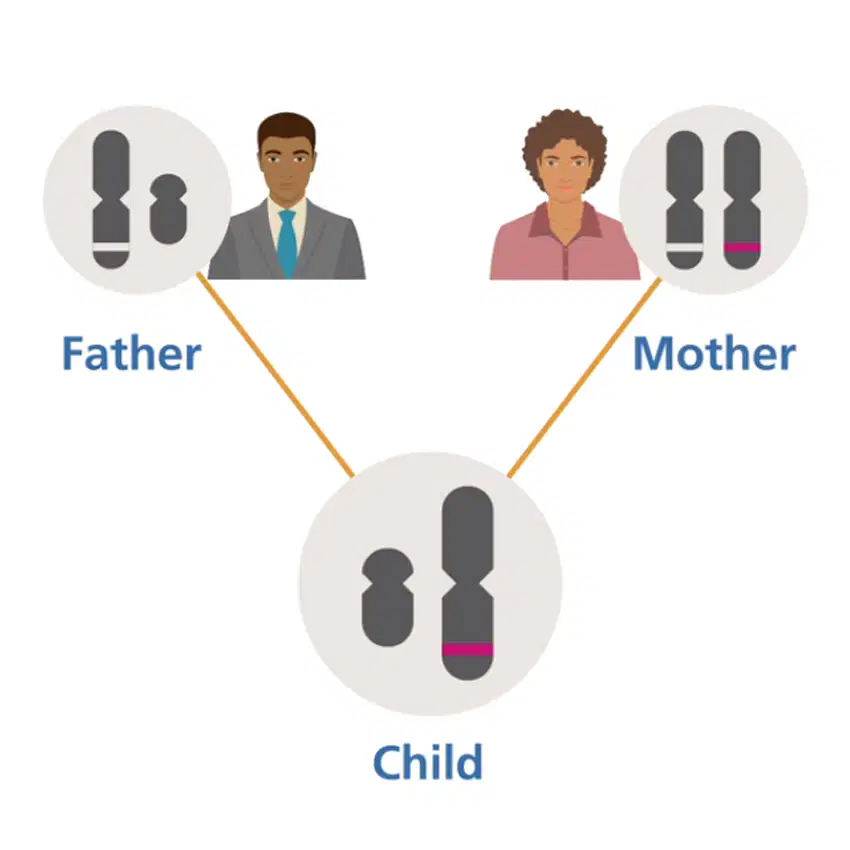
The term that refers to the passing down of characteristics from parent to offspring is called...
Speciation
Descent
Inheritance
Development
_______ is the continued existence of organisms that are better adapted to their environment
than others.
Survival of the Fittest
Natural selection
Evolution
Speciation

