
 Worksheets
G6 - Topic 1- Week 4
Total questions: 50
Worksheet time: 38mins

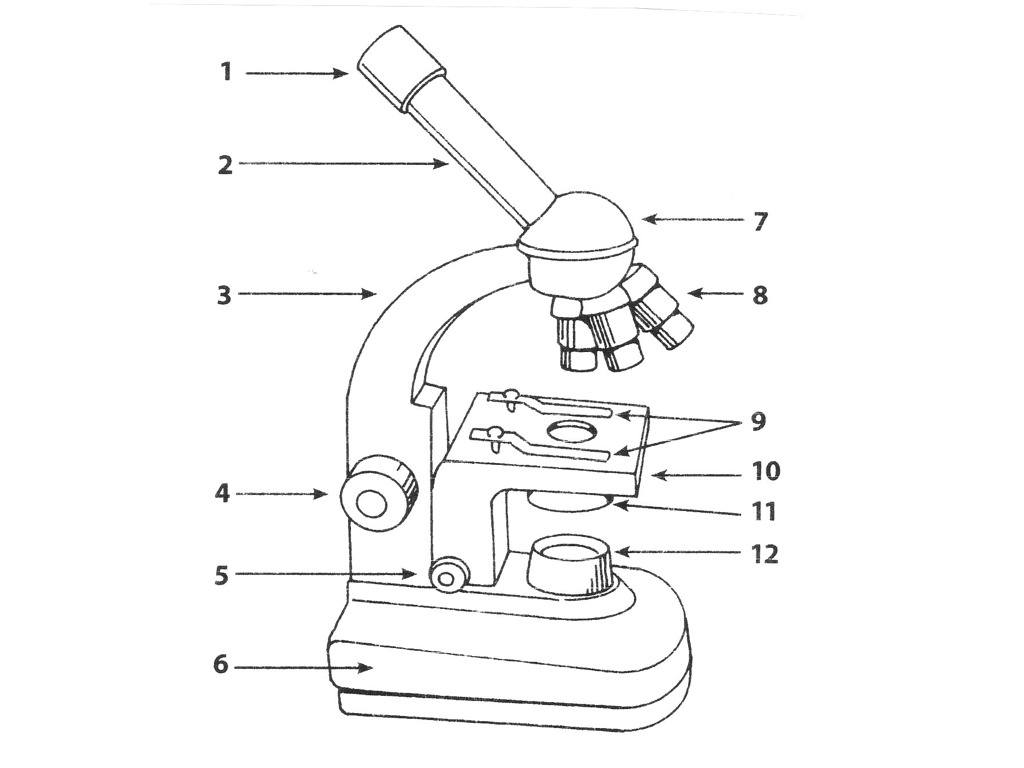
The picture shows a piece of technology that has helped scientists.
Which of the following best explains how this piece of technology has helped scientists?
It has helped scientists to see other planets.
It has helped scientists to see other moons.
It has helped scientists see very large objects.
It has helped scientists see very small objects.
Allie needs to draw a picture of cell for class. What should she use to make a tiny cell look much larger?
microscope
telescope
magnifying glass
binoculars
located on the stage, adjust the amount of light passing into the slides.
objective
base
Nosepiece
Diaphram

The lens or systems of lenses in a microscope that is nearest the object being viewed.
light source
eyepiece
objectives
tube

Small platform where the specimen is mounted for examination
base
arm
tube
stage

Holds the slide in place on the stage
nosepiece
adjustment knob
tube
stage clips
Supports upper part of the microscope
light source
arm
diaphram
base
Connects the eyepiece to the objective lenses
eyepiece
stage
diaphram
tube
The bottom of the microscope, used for support
base
adjustment knob
arm
stage clips

Identify the part of the microscope with the letter I.
nosepiece
light source
course adjustment
fine adjustment

Identify the part of the microscope with the letter D.
nosepiece
light source
course adjustment
fine adjustment

Identify the part of the microscope with the letter K.
nosepiece
light source
course adjustment
fine adjustment

Identify the part of the microscope with the letter E.
objectives/objective lens
stage clips
diaphragm
nosepiece

Identify the part of the microscope with the letter J.
objectives/objective lens
stage clips
diaphragm
nosepiece

Identify the part of the microscope with the letter G.
objectives
stage clips
diaphragm
nosepiece
Stage clips are used to hold a slide in place on the stage.
TRUE
FALSE
To calculate the power of magnification, multiply the power of the __________ by the power of the _________.
eyepiece, diaphragm
eyepiece, nosepiece
eyepiece, objective
nosepiece, objective
What would the magnification be if the power of the ocular lens is 10x and the power of the objective is 4x?
10x
40x
400x
14x
What is the scientific term for "making an image larger"?
resolution
rotation
magnification
magnetize
The ___________ adjustment knob is used for moving the stage a little at a time, while making images more clear.
coarse
fine
diaphram
small
Which part of the microscope regulates the amount of light on the specimen?
diaphragm
nosepiece
light source
eyepiece
When moving the stage, you have to be careful not to __________.
break the slide
move it to far down
break the lightbulb
When you clean the lens what should you use?
lens paper
tissues
When should the fine focus be used?
Only after using coarse focus
on low power before using coarse focus

Which image shows the correct way to carry a microscope?
A
B
Body tube
connects objective and eye piece
helps to focus for high power
provides light.

All living things are made of one or more...
electrons
atoms
molecules
cells

In 1673, this person used an improved microscope to observe bacteria from teeth scraping and red blood cells.
Leeuwenhoek
Flemming
Pasteur
Schwann

Who first used the term "cell" to describe the empty "rooms" he saw in his microscope?
Leeuwenhoek
Virchow
Pasteur
Hooke
The microscopes we used in class had three ________________ which allows different amounts of magnification.
detail
magnification
objectives
body

When we combine two convex lenses in parallel, we've made a simple (a)
The higher the magnification, the (a) and larger the image tends to be.
Lenses with thicker (a) and thinner edges are usually more powerful.
Choose all daily applications of the convex lens.


Is a convex lens thicker or thinner in the middle?
thicker.
thinner.
Which one of these is a convex lens?


None of the above
In an experiment, the hypothesis is...
what the experiment shows you.
what the scientist thinks that is going to happen.
The conclusion.
just a guess.
A variable is...
Something that is always measured
Something that can be changed
Something that has to stay the same
Factors that remain the same in an experiment to make it fair are called the
controlled variables
manipulated variables
responding variables
tested variables

Siti is testing how the age of a seed affects how fast plants grow. Look at the picture to see if you can figure out what makes her experiment unfair.
She used different types of seeds/plants.
Seed age might not make a difference.
She did not plant very many plants.

Mr. Pransky wants to see how different surfaces affect how high a tennis ball can bounce. What is the independent variable?
the different surfaces
using the same ball
how high they bounce

A students was doing an experiment using the scientific method. Every three days the student plans to count the green leaves. Which would be a good hypothesis for this experiment?
If plants are placed in direct sunlight, then they will grow more green leaves.
If plants are places in bright light, then they will grow more green leaves than in dim light.
If plants are place in clay pots, then they will grow more green leaves than plastic pots.
If plants are in warmer temperatures, then they will grow more green leaves.

According to the diagram, which question is being tested?
How does color of light affect plant growth?
How does the amount of fertilizer added to plants affect growth?
How will different amounts of water affect plant growth?
How does the type of soil affect plant growth?

