
 Worksheets
P2 Spring US History Final Review 2022-23
Total questions: 67
Worksheet time: 34mins
Name
Class
Date
1.
Which nation(s) signed a nonaggression pact with Germany that led to the invasion and division of Poland?
a)
Italy
b)
Spain
c)
Italy and Japan
d)
the Soviet Union
2.
Which of the following correctly matches the politician with his nation?
a)
Austria -- Joseph Stalin
b)
Spain -- Francisco Franco
c)
Britain -- Charles de Gaulle
d)
France -- Neville Chamberlainulle
3.
In following a policy of appeasement, what did Britain and France do?
a)
declared war on Germany
b)
submitted to Hitler's demands
c)
entered into a formal defense alliance
d)
pressured the United States to enter the war
4.
What was the Lend-Lease Act?
a)
a statement of war aims compiled by Roosevelt and Churchill
b)
a nonaggression pact between Germany and the Soviet Union
c)
a policy allowing the president to provide arms to certain foreign countries
d)
an order to shoot German U-boats on sight
5.
How did "bank runs" impact the American people during the Great Depression?
a)
Banks eventually ran out of money to loan, and people's life savings were gone.
b)
Banks made loans throughout the Great Depression, helping people pays bills until they could find work.
c)
Banks were able to people's deposits safe, but they could not loan out any more money.
d)
Banks were not at all involved in the Great Depression because people did not use them.
6.
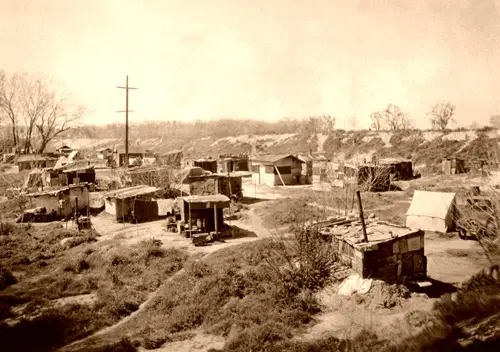
What was the main reason for the emergence of “Hoovervilles” like the one shown in the photograph?
a)
Many Americans had lost jobs during the Great Depression.
b)
Thousands of homes had been destroyed by the effects of the Dust Bowl.
c)
Housing projects could not keep up with the demand for homes needed by the poor.
d)
Preparations for World War I had created a shortage of building materials.
7.
During the 1930s, poor land management and severe drought conditions across parts of the Midwest resulted in the
a)
formation of the United States Department of Agriculture
b)
creation of wheat surpluses
c)
growth of the Populist movement
d)
development of Dust Bowl conditions on the Great Plains
8.
The Civilian Conservation Corps (CCC) and the Works Progress Administration (WPA) were both New Deal programs developed to address the problem
a)
excessive stock market speculation
b)
high unemployment
c)
increased use of credit
d)
limited income of senior citizens
9.
An advocate of President Franklin D. Roosevelt’s farm policy would have likely supported which economic strategy?
a)
Reducing agricultural output to increase product values
b)
Utilizing minimum wage laws to stimulate farm productivity
c)
Allowing market forces to operate freely to achieve stabilization
d)
Increasing agricultural production to ensure an affordable food supply
10.
What event brought the country out of the Great Depression?
a)
the Bonus Army
b)
the building of the Hoover Dam
c)
going off of the gold standard
d)
World War II
11.
What protects one's money in the bank?
a)
CCC
b)
NRA
c)
FDIC
d)
FBLA
12.
General _____ led the Third Army into Paris to liberate the city from German occupation
a)
George Patton
b)
George Marshall
c)
Douglas MacArthur
d)
Dwight D. Eisenhower
13.
The Battle of the Bulge was significant because it marked the ___
a)
liberation of the death camps
b)
last German offensive
c)
Axis powers' first loss in a land battle
d)
Allies' first victory in a land battl
14.
V-E Day, or May 8, 1945, was the day when _____.
a)
the United States entered the war.
b)
Allied forces invaded France
c)
Germany surrendered
d)
the Soviets stopped the Germans at the Volga
15.
When forced to abandon the Philippines, _____ made the vow, "I shall return."
a)
Hideki Tojo
b)
Chester Nimitz
c)
Douglas MacArthur
d)
Franklin D. Roosevelt
16.
Truman's aim in deciding to drop the atomic bomb was to _____.
a)
find out how destructive the bomb really was
b)
end the war and save American lives
c)
teach Japanese military leaders a lesson
d)
show how powerful the United States was
17.
Nisei who lived on the West Coast were subjected to _____ during the war.
a)
interrogation
b)
torture
c)
internment
d)
internmentcompensation
18.
With respect to finding better jobs, the war years marked a period of _____ for African
a)
decline
b)
advance
c)
stagnation
d)
uncertainty
19.
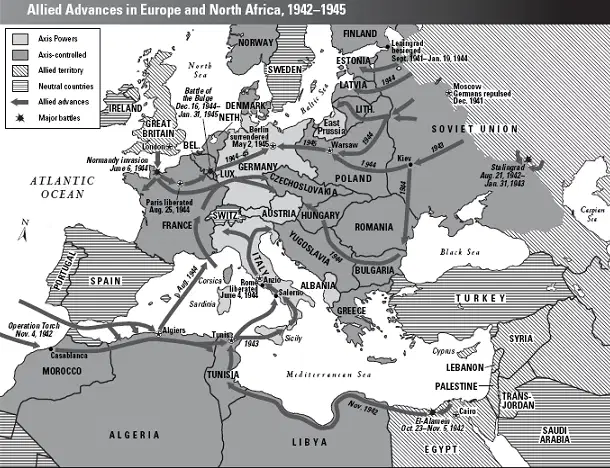
Where did the Allied forces first invade Axis-controlled Europe
a)
the coast of Normandy
b)
the island of Sicily
c)
Paris, France
d)
Anzio, Italy
20.
During the war, women in the WAACs served as
a)
fighter pilots and foot soldiers.
b)
shipbuilders and waitresses.
c)
scientists and factory workers.
d)
nurses and radio operators.
21.
Germany's goal in the Battle of the Atlantic was to
a)
invade the coast of Great Britain and then take over the entire country.
b)
keep food and war supplies from reaching Great Britain and the Soviet Union.
c)
prevent Allied forces from landing in Normandy and liberating France.
d)
prevent the invasion of North Africa
22.
The Supreme Commander of U.S. forces in Europe was
a)
George Patton.
b)
George Marshall.
c)
Douglas MacArthur.
d)
Dwight D. Eisenhower.
23.
Which of the following events turned the tide of the war in the Pacific against Japan and allowed the Allies to begin taking the offensive?
a)
Battle of Guadalcanal
b)
Battle of the Coral Sea
c)
Battle of Midway
d)
Doolittle's raid on Japan
24.
Why is Isoroku Yamamoto famous?
a)
ordering and overseeing the Bataan Death March
b)
leading the Japanese government during World War II
c)
masterminding the Japanese naval strategy during World War II
d)
breaking the Japanese secret code during World War
25.
What does the use of kamikaze pilots show about Japanese culture?
a)
They hated Americans enough to die killing them.
b)
They did not mind dying because they expected to lose the war.
c)
They valued national honor more than individual life.
d)
They were full of despair after the atomic bombs fell on Japan.
26.
What was the goal of Hitler's "Final Solution"?
a)
It was a process to divide up his territories among his generals.
b)
It was a system for winning the war before the Americans entered
c)
It was a way to amass more soldiers for the invasion of Russia.
d)
It was genocide of people the Nazis considered inferior
27.
How did Kristallnacht demonstrate Nazi persecution of Jews?
a)
A law passed on that day required Jews to wear yellow stars.
b)
That was the day the Nazis began large deportations of Jews.
c)
Nazi troops attacked Jewish homes, businesses, and synagogues
d)
all of the above
28.
Which two countries emerged as superpowers after World War II?
a)
United States and Great Britain
b)
United States and Soviet Union
c)
Soviet Union and Germany
d)
France and China
29.
What was the Soviet Union's justification for claiming Eastern Europe?
a)
To stop future invasions from the west
b)
To gain more territory
c)
To spread communism
d)
To establish a buffer zone
30.
What did Stalin announce in his 1946 speech?
a)
Another war was impossible
b)
Communism was the only way forward
c)
The Soviet Union would focus on consumer goods
d)
Communism and capitalism were incompatible
31.
What did the Soviet Union concentrate on producing after Stalin's 1946 speech?
a)
Clothing
b)
Consumer goods
c)
Weapons
d)
Food
32.
What did the countries dominated by the Soviets become known as?
a)
Neutral nations
b)
Satellite nations
c)
Enemy nations
d)
Allied nations
33.
What were the political differences between the United States and the Soviet Union?
a)
Both countries had a monarchy
b)
Both countries had a democratic system
c)
The United States had a Communist government
d)
The Soviet Union had a totalitarian government with no opposing parties
34.
What fueled the fear of communism in the United States during the early years of the Cold War?
a)
The Communist takeover of China
b)
Both A and B
c)
The Soviet domination of Eastern Europe
d)
None of the above
35.
What was the impact of the House Un-American Activities Committee on the movie industry?
a)
Both A and B
b)
It condemned approximately 500 actors, writers, producers, and directors for having a Communist background
c)
It instituted a blacklist of people who were condemned for having a Communist background
d)
None of the above
36.
Why did the Hollywood Ten refuse to cooperate with the House Un-American Activities Committee?
a)
Because they were afraid of being blacklisted
b)
Because they believed that the hearings were unconstitutional
c)
Because they were loyal to the Soviet Union
d)
None of the above
37.
What was the role of the House Un-American Activities Committee?
a)
To investigate possible Communist influence, both inside and outside the U.S. government
b)
To investigate possible Fascist influence, both inside and outside the U.S. government
c)
To promote Communist influence, both inside and outside the U.S. government
d)
None of the above
38.
What led to political instability and talk of revolution in Europe after World War II?
a)
Economic devastation
b)
Political corruption
c)
Military occupation
d)
Social unrest
39.
What were the accusations against the Rosenbergs?
a)
Lying about passing government documents
b)
Perjury
c)
Planning to establish a totalitarian dictatorship in the United States
d)
Espionage
40.
What did the Rosenbergs claim in their defense?
a)
They were being persecuted for being spies
b)
They were being persecuted for being Jewish and for holding radical beliefs
c)
They were being persecuted for being Communists
d)
They were innocent of all charges
41.
What were Truman's motives for establishing the policy of containment and creating new intelligence agencies?
a)
To provide aid to European nations
b)
To establish strong alliances with the nations of Western Europe
c)
To rebuild Western Europe
d)
To prevent increased Soviet influence and the establishment of new Communist regimes
42.
What impact did the Cold War have on Germany's reunification?
a)
The United States and its allies clashed with the Soviet Union over the issue of German reunification
b)
The Communist Party lost much of its appeal to voters in Western Europe
c)
Germany was divided into four zones occupied by the United States, Great Britain, France, and the Soviet Union
d)
Germany was not affected by the Cold War
43.
What did Secretary of State George Marshall propose in June 1947?
a)
That the United States reduce the danger of Communist subjugation in Europe
b)
That the United States provide aid to all European nations that needed it
c)
That the United States contain Soviet influence in Greece and Turkey
d)
That the United States establish new intelligence agencies
44.
What did Congress decide about the Truman Doctrine?
a)
It would cause political instability and talk of revolution in some countries
b)
It was unnecessary and would lead to increased Soviet influence in Europe
c)
It was essential to keep Soviet political and economic influence from spreading
d)
It would lead to the establishment of new Communist regimes in Asia
45.
What did the Marshall Plan offer to the Soviet Union and its allies?
a)
Military aid
b)
Assistance
c)
Economic sanctions
d)
Containment
46.
What was the significance of Nixon's visit to China for the American public?
a)
It led to the recognition of Taiwan as a separate country
b)
It was a failure and resulted in a military engagement with China
c)
It was a huge success and opened up diplomatic and economic relations with China
d)
It resulted in the domination of the Pacific by the United States
47.
What was the cornerstone of Jimmy Carter's actions as president?
a)
Military expansion
b)
Human rights
c)
Environmental protection
d)
Economic growth
48.
What was Reagan's stance on communism?
a)
He wanted to destroy it
b)
He wanted to accommodate it
c)
He wanted to ignore it
d)
He wanted to negotiate with it
49.
What did opponents of the Strategic Defense Initiative argue?
a)
That the system would work
b)
That the system was too expensive
c)
That the system would not work
d)
That the system was too cheap
50.
What did Gorbachev promote to address the problems he inherited?
a)
Glasnost and perestroika
b)
Isolation and aggression
c)
Negotiation and compromise
d)
Détente and containment
51.
What was Carter's response to the Soviet invasion of Afghanistan?
a)
He sent troops to Afghanistan
b)
He signed a peace treaty with the Soviet Union
c)
He declared war on the Soviet Union
d)
He withdrew his support for the SALT II agreement
52.
What was the mujahideen?
a)
A US military unit in Afghanistan
b)
A strong Muslim rebel group in Afghanistan
c)
A Soviet military unit in Afghanistan
d)
A pro-Soviet government in Afghanistan
53.
What countries and regions did Nixon's foreign policy focus on beyond Asia?
a)
Canada and Mexico
b)
Europe and Africa
c)
Australia and New Zealand
d)
South America and the Middle East
54.
What was the significance of the Brown v. Board of Education of Topeka, Kansas case?
a)
It ruled that African Americans could not attend white schools
b)
It ruled that separate schools for whites and blacks were equal
c)
It ruled that separate schools for whites and blacks were unconstitutional
d)
It ruled that segregation was legal
55.
What challenges did African-American students face in Little Rock, Arkansas?
a)
They were not allowed to attend school
b)
They were not allowed to attend black schools
c)
They were not allowed to attend white schools
d)
They were not allowed to attend any schools
56.
Who refused to give up her seat on a Montgomery bus in 1955?
a)
Martin Luther King Jr.
b)
Rosa Parks
c)
Philip Randolph
d)
Jesus
57.
From whom did Martin Luther King Jr. learn the idea of civil disobedience?
a)
Mohandas Gandhi
b)
Jesus
c)
Philip Randolph
d)
Henry David Thoreau
58.
What was the Southern Christian Leadership Conference (SCLC)?
a)
A group that supported segregation
b)
A group that advocated for violent resistance
c)
A civil rights group formed by ministers and leaders
d)
A group that focused on political action
59.
What was the Student Nonviolent Coordinating Committee (SNCC)?
a)
A civil rights group formed mostly by college students
b)
A group that advocated for violent resistance
c)
A group that supported segregation
d)
A group that focused on political action
60.
What happened to a bus of Freedom Riders in Anniston, Alabama?
a)
It was burned by a white mob
b)
It was rerouted to a different city
c)
It was escorted by U.S. marshals
d)
It was welcomed by the local community
61.
What did President Kennedy's civil rights bill outlaw?
a)
Discrimination based on religion only
b)
Discrimination based on gender only
c)
Discrimination based on race only
d)
Discrimination based on race, religion, national origin, and gender
62.
What was the role of the Mississippi Freedom Democratic Party in challenging Mississippi's political structure?
a)
To unseat Mississippi's regular party delegates at the Democratic National Convention
b)
To influence Congress to pass a voting rights act
c)
To gain voting rights for African Americans in the South
d)
To give an emotional speech at the Democratic National Convention
e)
63.
What was the impact of Fannie Lou Hamer's speech on the seating of the MFDP delegates?
a)
The regular party delegates were unseated at the convention
b)
Many Americans supported the seating of the MFDP delegates
c)
Congress passed a voting rights act
d)
The MFDP delegates were not seated at the convention
64.
Who led a massive march through Alabama in response to the violent resistance faced by civil rights workers in Selma?
a)
Fannie Lou Hamer
b)
Rosa Parks
c)
Malcolm X
d)
Martin Luther King Jr.
65.
What were the views of Malcolm X and Elijah Muhammad?
a)
They believed that whites were responsible for blacks' misery.
b)
They believed that whites were not responsible for blacks' misery.
c)
They believed in non-violent resistance.
d)
They believed in integration with white society.
66.
Who introduced the notion of Black Power?
a)
Robert Kennedy
b)
Stokely Carmichael
c)
Martin Luther King Jr.
d)
Malcolm X
67.
What was the main cause of urban violence according to the Kerner Commission report?
a)
Gang activity
b)
White racism
c)
Poverty
d)
Lack of education
100 %

