
 Worksheets
ENTROPY AND GIBBS FREE ENERGY
Total questions: 17
Worksheet time: 4hrs 15mins
What does Gibbs Free Energy tell us?
How much energy is given off by a reaction.
The tendency of a reaction to become "random"
How spontaneous a reaction is.
Which of the following would most likely lead to a spontaneous reaction.
A high negative enthalpy.
A low negative enthalpy.
A high positive enthalpy.
A low positive enthalpy.
What are the best conditions to lead towards a spontaneous reaction?
high negative enthalpy, high temp, high negative entropy
high positive enthalpy, high temp, high negative entropy
high negative enthalpy, low temp, high positive entropy
high negative enthalpy, high temp, high positive entropy.
Your enthalpy is -20 and your entropy is -8. Which temperature will give you a spontaneous reaction?
1
3
5
Which of the following situations demonstrates high entropy?
water freezing
water vaporizing
steam condensing to water
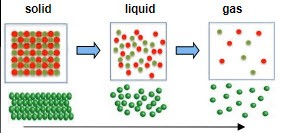
Which sample has the lowest entropy?
HINT - Look at the phase of each chemical....
1 mole of KNO3(l)
1 mole of KNO3(s)
1 mole of H2O(l)
1 mole of H2O(g)
Which phase change represents a decrease in entropy?
solid to liquid
gas to liquid
liquid to gas
solid to gas
Given the change of phase:
CO2(g) —> CO2(s)
As CO2(g) changes to CO2(s), the entropy of the system
decreases
increases
remains the same
6. The formation ½ A2 + 2 B2 + C --> CAB4 has an enthalpy of formation of -104 kJ and a change in entropy of -60.8 J/K at 30 °C. What is the free energy and spontaneity of the reaction?
-85.6 kJ, spontaneous
-18.3 kJ, not spontaneous
+18.3 kJ, spontaneous
+85.6 kJ, not spontaneous
Which combination of ΔH and ΔS NEVER has a spontaneous reaction?
+ΔH and +ΔS
+ΔH and -ΔS
-ΔH and -ΔS
-ΔH and +ΔS
At what temperature would a given reaction become spontaneous if ΔH =+119kJ and ΔS=+263J/K.mol
452 K
2210 K
382 K
363 K
1. Given the following information, calculate ΔG0 for the reaction below at 250C: (K = 0C + 273)
SnCl4(l) + 2 H20(l) → SnO2(S) + 4HCl(g),
ΔH0=133.0 kJ and ΔS0 =401.5 J/K
-252.6 kJ
-13.4 kJ
13.4 kJ
252.6 kJ
Which reaction has the greatest increase in entropy of the system?
A. HCl (g) + NH3 (g) → NH4Cl (s)
B. (NH4)2Cr2O7 (s) → Cr2O3 (s) + N2 (g) + 4H2O (g)
C. CaCO3 (s) → CaO (s) + CO2 (g)
D. I2 (g) → I2 (s)
A
B
C
D

A
B
C
D
E

A
B
C
D
E

A
B
C
D

