
 Worksheets
Ancient Greece Test Review
Total questions: 68
Worksheet time: 2hrs 16mins
What makes much of Greece a peninsula?
the lack of large rivers
the water on three sides
the steep mountain slopes
the large number of islands
The ancient Greeks did not like to travel on land because they.......
did not want to offend the earth god.
were afraid of people from other villages.
used the land for farming instead of roads.
found traveling through the mountains difficult.
How did the Greek mountains affect communication?
They promoted road building.
They led people to write letters.
They isolated communities.
They made farmers stop speaking.
What made farming in ancient Greece especially difficult?
mud
rocks
robbers
climate/weather
The ancient Greeks worshiped the sea god Poseidon. What does this tell about the Greeks?
They believed in only one god.
They lived in separated villages.
They relied on the sea for travel and trade.
They stayed away from the sea as much as they could.

Greece is on which continent?
Europe
Africa
North America
Asia


The ancient Greeks were excellent sailors.
The earliest civilization in Europe was ?
Minoans
Mycenaen
Trojans
Spartans

Crete is the oldest European Civilization.
True
False
A group of islands
Archipelago
Sea
Tributary
Basin
A narrow strip of land that connects two larger land areas
Isthmus
Valley
Basin
Tributary
A piece of land that is surrounded by water on three sides
Peninsula
Dune
Shamal
Simoom
Why did the King of Athens make a deal with King Minos of Crete?
to make money
to keep the people of Athens safe
to frighten King Minos

How did the Aegean Sea supposedly get its name?
The King Aegean named the sea after himself
The King Aegean named the sea after Theseus returned home.
The King Aegean fell into the sea after seeing King Minos's ship with the Black sails.
What is Homer famous for being?
Philosopher
Warrior
Leader
Poet
What are Homer's famous stories?
Iliad & Odyssey
Iliad & Trojan War
Odyssey & Psyche
Eros & Psyche


Most girls in Ancient Athens received a good education in all subjects.
Athenian men joined the army for only two years
What legendary trip did the long distance runner, Philippides make?
Marathon to Athens
Athens to Marathon
Athens to Sparta
Sparta to Marathon
During the 2nd Persian War a Spartan force of 300 held off the Persian army at a place called __________.
Marathon
Salamis
Thermopylae
Ionia

The Spartan leader who led the Greek army at Thermopylae was
Lycurgus
Themistocles
Leonidas
Pheidippides
This naval battle fought in 480 BCE was a decisive victory for the Greeks
Thermopylae
Marathon
Salamis
Sardis
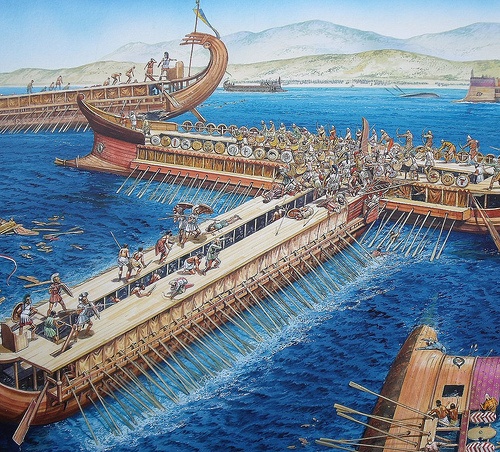
Name that battle:
- 480 B.C.E.
- King Leonidas refused to surrender
- 300 brave Spartans died
- Persian victory
Battle of Marathon
Battle of Thermoplyae
Battle of Salamis
Battle of Plataea

Greece is surrounded by the ____________.
Mediterranean Sea
Aegean Sea

The ________________ borders Greece to the east.
Aegan Sea
Ionian Sea

The __________ borders Greece to the west.
Aegean Sea
Ionian Sea

An _________ is a skinny piece of land that connects two bigger pieces of land.
peninsula
isthmus
island

_________ is one of the biggest islands to the south of Greece.
Crete
Peloponnesus
_________ cover most of Greece.
Mountains
Rivers

Greece was divided into ___________ because of its geography and size.
city-states
states
cities
The Greeks excelled in philosophy, art, architecture, and ___________________.
theater
map making
electronics
transportation
After the Persian Wars, Athens entered a time period of peace, prosperity, and great achievements called the _____________.
Periclean Age
Golden Age
Great Age
Hellenistic Age
During the Golden Age, _________________ is best known for leading the rebuilding of Athens.
Socrates
Cleisthenes
Pericles
Phidias
During the Golden Age, the __________________, a temple dedicated to the goddess Athena, was rebuilt.
Parthenon
Pantheon
Oracle of Delphi
Erechtheion
Ancient Greek philosophers helped develop the study of...
history
science
logic
reasoning

What was Socrates main belief, or, what did he encourage his students to do?
Question everything
Know everything
Prove everything wrong
Who is this Greek Philosopher!: He was put on trial and sentenced to death
Socrates
Plato
Aristotle
*He is sometimes referred to as the "Father of Philosophy"
Sculpted a statue of Athena; designed the Parthenon.
Euclid
Herodotus
Pericles
Phidias

What is the name of this building?
The Colosseum
The Parthenon
The Acropolis
The Citidell
Who was the head of the sculptural program of the Parthenon?
Poseidon
Pericles
Phidias
Plato
The temple known as the __________ was built on the Acropolis of Athens between 447 and 438 B.CE.
Theatre
Baths
Parthenon
Colosseum
Inside the temple (Parthenon) stood a colossal statue representing _________, patron goddess of the city.
Aphrodite
Hera
Hestia
Athena
The Olympic games were held in honor of what?
Athena, the Goddess of Wisdom
Zeus, the King of all Gods
The Summer Solstice
In which city-state were the Olympic games held?
Olympia
Athens
Sparta
__________ was the first event to be included in the Olympic Games.
Wrestling
Jumping
Running
Crying

