wayground logo

Free Printable Worksheets

Font size

S
M
L
XL
Worksheets

Math I: 2nd Semester FINAL Review - PART 2 (2023)

Total questions: 144

Worksheet time: 2hrs 14mins

Name
Class
Date
1.
A slide is also called a _________.
a)
Translation
b)
Reflection
c)
Rotation
d)
Transformation
2.
A turn is also called a ___________.
a)
Translation
b)
Reflection
c)
Rotation
d)
Transformation
3.
Write a rule for the translation.
a)
 (x -1, y  + 2)
b)
 (x -2, y  + 1)
c)
 (x +2, y  - 1)
d)
(x +1, y  -  2)
4.
Identify the transformation.
a)
Reflection across y axis
b)
Reflection across x-axis
c)
180 Rotation
d)
Translation 2 units down
5.

If point H(–6, 2) is translated 4 units up and 3 units right, what are the coordinates of the translated image?

a)

(-2, 5)

b)

(-3, 6)

c)

(-9, -2)

d)

(-9, 6)

6.

Point N(6, –5) is reflected across the

x-axis. What are the coordinates of the image?

a)

(-6, -5)

b)

(-5, 6)

c)

(5, -6)

d)

(6, 5)

7.

Triangle LMN has vertices L(–1, 4), M(–2, 4), and N(–1, –1). What are the coordinates of the image of point M after a dilation with a scale factor of 3?

a)

(-6, 12)

b)

(-6, 4)

c)

(-2, 12)

d)

(12, -6)

8.

If the figure is rotated 90 degrees clockwise, what are the coordinates of R?

a)

(-3, 3)

b)

(3, -3)

c)

(-3, -3)

d)

(3, 3)

9.
Determine how to translate triangle A'B'C' to triangle ABC.
a)
(x+2, y-5)
b)
(x+2, y-9)
c)
(x-2, y-9)
d)

(x-2, y+9)

10.

A reflection is

a)

flipping a figure

b)

turning a figure

c)

enlarging a figure

d)

sliding a figure

11.
Reflect the point (2, -4) over the y-axis.
a)
(-4, 2)
b)
(-2, 4)
c)
(-2, -4)
d)
(2, 4)
12.
After being transformed the new point is called a(n):
a)
Pre-Image
b)
Post Image
c)
Transformed
d)
Image
13.
The point that is to be transformed is called the:
a)
Pre-Image
b)
Image
c)
Post-Image
d)
Transformation
14.
State the coordinate of the image of the given point B (-10,-6) under a dilation with center at the origin with the given scale factor k = 1/2.
a)
(5,3)
b)
(20,12)
c)
(-20,-12)
d)
(-5,-3)
15.
The point Z(4, -2) is rotated 180 degrees about the origin.  What is the image of Z?
a)
Z'(2, 4)
b)
Z'(-4, 2)
c)
Z'(-2, -4)
d)
Z'(-4, -2)
16.
Apply the following rule to the point (-5,6):
(x,y)-->(y,-x)
a)
(-5,-6)
b)
(5,-6)
c)
(6,5)
d)
(-6,5)
17.

The image of the point (-5, 3) reflected over the x-axis would be:

a)

(-5, -3)

b)

(5, 3)

c)

(5, -3)

d)

(3, -5)

18.

The image of the point (-5, 3) reflected over the y-axis would be:

a)

(-5, -3)

b)

(5, 3)

c)

(5, -3)

d)

(3, -5)

19.

The image of the point (2, -7) reflected over the what line would be (-7, 2).

a)

x - axis

b)

y - axis

c)

y = x

d)

x = 1

20.

Given the point Y at (5, 2), where would the image be after the following translation: (x + 2, y - 7)?

a)

(7, 7)

b)

(3, 9)

c)

(4, -5)

d)

(7, -5)

21.

Given the point A at (-6, -2), where would the image be after the translation T(-4, 2)?

a)

(-2, 4)

b)

(-10, 0)

c)

(2, 0)

d)

(-8, -4)

22.
The point ( -2,5) is reflected over the line x = 1.  Find its image.
a)
(  4,  5)
b)
( -2  , -5)
c)
( 2  ,  5)
d)
(2   , -5)
23.
∆QRS contains the points: Q(4, 2) R(5, 1) S(3,7). If the triangle is reflected across the y-axis, what will S' be?
a)
S'(3, 7)
b)
S'(-3, 7)
c)
S'(-3, -7)
d)
S'(3, 7)
24.
Identify the transformation from ABC to A'B'C'.
a)
(x+8, y+4)
b)
(x-8, y-4)
c)
(x+4, y+8)
d)
(x-4, y-8)
25.

Reflect Point C over the line x = 1

a)

(-1, 2)

b)

(3, 0)

c)

(0, 2)

d)

(3, -1)

26.

What is the rule for the following reflection?

a)

Reflection across y = −2

b)

Reflection across x = −2

c)

Reflection across x = 2

d)

Reflection across y = 2

27.

Reflect the shape over the line y = x. Where is A'?

a)

(7, 2)

b)

(-2, 7)

c)

(2, -7)

d)

(-7, -2)

28.

The coordinates of triangle JRB are ,J(1, -2) , R(-3, 6) and B(4, 5) . What are the coordinates of the vertices of its image after the

transformation T(2, -1) then ry-axis ?

a)

(3, 1), (-1, -7), (6, -6)

b)

(3, -3), (-1, 5), (6, 4)

c)

(-3, -3), (1, 5), (-6, 4)

d)

(-1, -2), (3, 6), (-4, 5)

29.
If ∆LMK ≅ ∆LMT, then
∠K ≅ ____
a)

T

b)

∠T

c)

∠M

d)

∠L

30.
If ∆XYZ ≅ ∆KLM, then
∠Y≅ _____
a)
∠K
b)
∠M
c)
∠L
d)
∠Z
31.
Complete the congruence statement.
a)
CRP
b)
PCR
c)
RPC
d)
PRC
32.
Complete the congruence statement.
a)
OEG
b)
OGE
c)
EGO
d)
GOE
33.
a)
A
b)
B
c)
C
d)
D
34.
a)
A
b)
B
c)
C
d)
D
35.
Which statement indicates that the triangles in each pair are congruent.
a)
∆LMK ≅ ∆LMT
b)
∆LMK ≅ ∆TMK
c)
∆LTKM ≅ ∆LMT
d)
∆TMK ≅ ∆TLK
36.
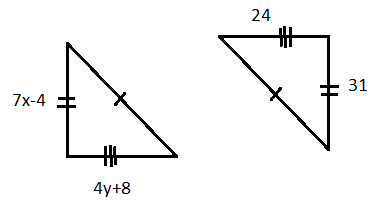
Solve for x
a)
5
b)
4
c)
3
d)
2
37.
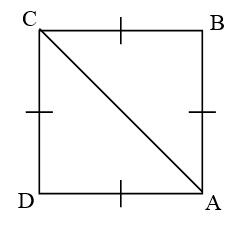
Name the postulate, if possible, that makes the triangles congruent.
a)
SAS
b)
ASA
c)
AAS
d)
Not Possible
38.
Name the postulate, if possible, that makes the triangles congruent.
a)
SSS
b)
SAS
c)
ASA
d)
AAS
39.
What postulate proves these triangles congruent?
a)
SSS
b)
SAS
c)
ASA
d)
AAS
40.

Are the triangles definitely congruent? If so, by what theorem?

a)

SSS

b)

SAS

c)

AAS

d)

Not Possible

41.
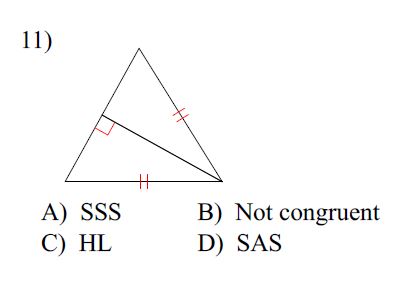
If the two triangles are congruent, answer with the criterion that proves them congruent. 
a)
SSS
b)
Not Congruent
c)
HL
d)
SAS
42.

Which method will not prove triangles are congruent?

a)

ASA

b)

SAS

c)

SSA

d)

AAS

43.
The Triangle Sum Theorem states that the sum of all angles in a triangle is ______. 
a)
45°
b)
90°
c)
180°
d)
360°
44.
Find the measure of the missing angle.
a)
90o
b)
100
c)
130o
d)
50o
45.

Find the measure of the indicated angle.

a)

95

b)

85

c)

35

d)

45

46.

What is the measure of angle b?

a)

36o

b)

56o

c)

63o

d)

117o

47.
Find the value of x.
a)
A
b)
B
c)
C
d)
D
48.
Find the value of x.
a)
A
b)
B
c)
C
d)
D
49.
Solve for x.
a)
-11
b)
-12
c)
-6
d)
11
50.

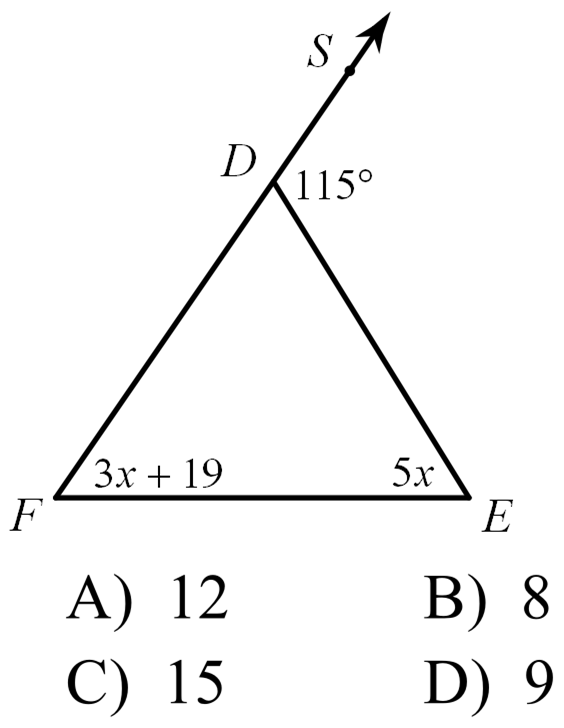
Find the measure of the exterior angle. Just enter the number only.

(a)  

51.

Find the measure of the exterior angle. Just enter the number only.

(a)  

52.

Find the measure of the exterior angle. Just enter the number only.

(a)  

53.
What are complementary angles?
a)
Angles that add up to 180°
b)
Angles that add up to 90°
c)
Angles that are equal to each other
d)
Angles that are opposite of each other when lines intersect.
54.
What are supplementary angles?
a)
Angles that add up to 180°
b)
Angles that add up to 90°
c)
Angles that are equal to each other
d)
Angles that are opposite of each other when lines intersect
55.
If angle ∠ABD is 67°. What is ∠DBC?
a)
180°
b)
90°
c)
67°
d)
23°
56.
Find the value of x
a)
-5
b)
28
c)
19
d)
-3
57.
Find the value of x.
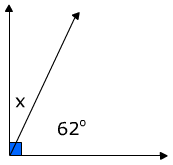
a)
14
b)
60
c)
35
d)
180
58.
Name the angle relationship.
a)
Alternate Interior
b)
Alternate Exterior
c)
Corresponding
d)
Vertical Angles
59.
Name the angle relationship.
a)
Alternate Interior
b)
Alternate Exterior
c)
Corresponding
d)
Vertical Angles
60.
Name the angle relationship.
a)
Alternate Interior
b)
Alternate Exterior
c)
Corresponding
d)
Vertical Angles
61.
Name the angle relationship.
a)
Alternate Interior
b)
Alternate Exterior
c)
Corresponding
d)
Vertical Angles
62.
If m∠1 = 30°, then m∠3 = 
a)
30°
b)
60°
c)
150°
d)
undetermined
63.
Find the value of x.
a)
18°
b)
28°
c)
38°
d)
118°
64.
a)
15
b)
16
c)
18
d)
19
65.

Find the value of x.

a)

14

b)

60

c)

35

d)

180

66.

Identify the angles below that represent a corresponding relationship. Select 2.

a)

∠1

b)

∠3

c)

∠8

d)

∠5

67.

What is the value of x?

a)

x = 18

b)

x = 20

c)

x = 95

d)

x = 5

68.
Find the measure of angle 1.
a)
28o
b)
136o
c)
44o
d)
6o
69.
Solve for x
a)
6
b)
140
c)
20
d)
90
70.
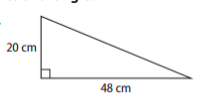
Find the length of the missing side. 
a)
25 cm
b)
42 cm
c)
52 cm
d)
48 cm
71.
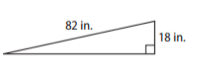
Find the length of the missing side. 
a)
20 in.
b)
68 in.
c)
16 in.
d)
80 in.
72.
The Pythagorean Theorem ONLY works on which triangle? 
a)
obtuse
b)
scalene
c)
isosceles
d)
right
73.
State if the three sides lengths form an acute, obtuse, or right triangle:
6 mi, 14 mi, 17 mi
a)
acute
b)
obtuse
c)
right
74.
Find the length of the missing side. 
a)
25 cm
b)
42 cm
c)
52 cm
d)
48 cm
75.
State if the three sides lengths form an acute, obtuse, or right triangle:
7 in, 11 in, 13 in
a)
acute
b)
obtuse
c)
right
76.

The Pythagorean Theorem is _________

a)

a + b = c

b)

a2 + b2 = c2

c)

a2 + b2 + c2

d)

A = LW

77.
Find the length of the missing side. 
a)
17 cm
b)
22 cm
c)
15 cm
d)
13 cm
78.
Find the length of the missing side. 
a)
25 cm
b)
42 cm
c)
52 cm
d)
48 cm
79.
What is the distance between the two points?
a)
6.3
b)
6.5
c)
6.7
d)
16
80.
Find the distance.
a)
9.7
b)
10.7
c)
11.7
d)
12.7
81.

Use the Distance Formula to find the distance between: (3, 2) and (5, 8)\left(3,\ -2\right)\ and\ \left(-5,\ -8\right)  


(a)  

82.

Use the Distance Formula to find the distance between:
(7, 8) and (2, 4)\left(7,\ 8\right)\ and\ \left(2,\ -4\right)  


(a)  

83.

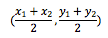
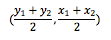
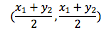
Which of the following is the correct midpoint formula given two endpoints (x1, y1) and (x2, y2)?
a)
b)
c)
d)
84.

Find the midpoint of the line segment with the given endpoints (1,1) and (9,9)

a)

(5,5)

b)

(1,9)

c)

(17,17)

d)

(-4,-4)

85.

Find the midpoint: (2,7),(10,1)\left(2,-7\right),\left(10,1\right)  

a)

(-3,6)

b)

(6,-3)

c)

(4,4)

d)

none

86.

Find the midpoint:

a)


(3,1)\left(3,-1\right)

b)

(1,3)\left(-1,3\right)

c)

(3,4)\left(3,4\right)

d)

(4,3)\left(4,3\right)

87.

Find the midpoint: (3,9),(1,5)\left(3,9\right),\left(-1,-5\right)  

a)

(1,2)\left(-1,-2\right)  

b)

(2,7)\left(2,7\right)  

c)

(2,7)\left(-2,-7\right)  

d)

(1,2)\left(1,2\right)  

88.
What slope is parallel to:  
m = 4
a)
4
b)
-1/4
c)
-4
d)
1/4
89.
What slope is perpendicular to:  
m = 5/8
a)
-5/8
b)
5/8
c)
-8/5
d)
8/5
90.
Which of the following lines goes through the point (0, 4) and is parallel to y = 5x - 3?
a)
y = 1/5x - 3
b)
y= 5x - 7
c)
y = 5x + 4
d)
y = -5x - 3
91.
Which of the following lines goes through the point        (-3, 4) and is perpendicular to  y = 3/2x + 6?
a)
y = 3/2x - 6
b)
y = 2/3x + 3
c)
y = -2/3x - 2
d)
y = -2/3x + 2
92.

Write an equation of a line passing through (2, 2) and perpendicular to

y=23x3y=\frac{2}{3}x-3  .

a)

y = -3/2x + 5

b)

y = 2/3x -1

c)

y = -3/2x

d)

y = -3/2x - 6

93.

What is the equation of a line that passes through (-2, -5) and is parallel to

y=x+3y=x+3  

a)

y = x - 3

b)

y = x + 5

c)

y = -x - 3

d)

y = -x + 5

94.

What is the equation of a line that passes through the point (0, -4) and is perpendicular to

y=32x+1y=-\frac{3}{2}x+1  

a)

y=23x4y=\frac{2}{3}x-4  

b)

y=23x+4y=\frac{2}{3}x+4  

c)

y=23x4y=-\frac{2}{3}x-4  

d)

y=23x+4y=-\frac{2}{3}x+4  

95.

Which of the following is the correct opposite reciprocal for

44  ?

a)

41\frac{4}{1}  

b)

14-\frac{1}{4}  

c)

41-\frac{4}{1}  

d)

14\frac{1}{4}  

96.
Is this a line of symmetry?
a)
Yes
b)
No
97.
How many lines of symmetry does the picture have? 
a)
0 lines of symmetry
b)
1 line of symmetry
c)
2 lines of symmetry
d)
4 lines of symmetry
98.

Which of the following shapes does not have a line of symmetry?

a)
b)
c)
d)
99.

Which of the following shapes has line symmetry?

a)
b)
c)
d)
100.

How many lines of symmetry are there on an equilateral triangle?

a)

0

b)

1

c)

2

d)

3

101.
How many lines of symmetry does this shape have?
a)
0
b)
1
c)
2
d)
4
102.
How many lines of symmetry does this shape have?
a)
1
b)
2
c)
4
d)
6
103.

Using the given measurements, find the perimeter of the rectangle.

a)

46 ft

b)

120 ft

c)

23 ft

d)

32 ft

104.

What is the perimeter of the square?

a)

28 cm

b)

49 cm

c)

7 cm

d)

14 cm

105.
Find the perimeter of this triangle.
a)
12 in
b)
22 in
c)
18 in
d)
24 in
106.

Find the perimeter of the trapezoid.

a)

112 ft

b)

32 ft

c)

172.8 ft

d)

56 ft

107.

Find the area of the trapezoid.

a)

112 ft2

b)

38.5 ft2

c)

32 ft2

d)

56 ft2

108.

How many sides does a hexagon have?

a)

4

b)

5

c)

6

d)

7

109.

How many sides does an octagon have?

a)

3

b)

5

c)

8

d)

10

110.

How many sides does a quadrilateral have?

a)

3

b)

4

c)

5

d)

6

111.
What does area mean?
a)
the distance around a shape
b)
half the distance around a shape
c)
the amount of space outside a shape
d)
the amount of space inside a shape
112.
What does perimeter mean?
a)
the amount of space inside a shape
b)
the distance around the shape
c)
the amount of space inside a shape divided by two
d)
half the distance around a shape
113.
a)

1720

b)

1440

c)

2340

d)

4500

114.
Find the measure of ONE interior angle of a regular dodecagon.
a)
150
b)
120
c)
1800
d)
20
115.
The sum of the interior angles of a polygon is __________________ where n is the number of sides.
a)
(n - 2)180
b)
(n - 1)180
c)
360
d)
(n - 3)(180)
116.
The sum of the exterior angles of a polygon is __________________ where n is the number of sides.
a)
360
b)
n
c)
(n - 2)180
d)
(n - 1)180
117.
Find the sum of the interior angles of a nonagon.
a)
1260
b)
900
c)
1620
d)
180
118.
A polygon's interior angles add up to 2700.  How many sides does the polygon have?
a)
17
b)
15
c)
19
d)
11
119.
What is the measure of one interior angle of a regular 45-gon?
a)
180°
b)
360°
c)
172°
d)
93°
120.
Solve for X.
a)
90° 
b)
98° 
c)
100° 
d)
115° 
121.
What is the name of a twelve sided figure?
a)
dodecagon
b)
decagon
c)
hendecagon
d)
dgon
122.

Find the product:

(3x + 2)(2x + 4)

a)

6x2 + 16x + 8

b)

5x2 +11x + 6

c)

5x2 + 16x + 6

d)

6x2 + 11x + 8

123.

Find the product:

(x − 9)(x − 7)

a)

x2 − 2x − 63

b)

x2 − 16x − 63

c)

x2 − 2x + 63

d)

x2 − 16x + 63

124.
Which of the following is a binomial?
a)
5x + 11
b)
x² + 3x + 6
c)
12x²y
d)
x² - 4x + 10
125.

Solve the following using the box method:
(2x3)(x+6)=\left(2x-3\right)\left(x+6\right)=  

a)

2x215x92x^2-15x-9  

b)

2x2+15x+182x^2+15x+18  

c)

2x2+9x182x^2+9x-18  

d)

2x2+9x92x^2+9x-9  

126.

Used the distributive (FOIL) method to solve (6x1)(x2)=\left(6x-1\right)\left(x-2\right)=  

a)

6x2+11x26x^2+11x-2  

b)

6x213x36x^2-13x-3  

c)

6x211x+26x^2-11x+2  

d)

6x213x+26x^2-13x+2  

127.

Use any method to solve  (y+4)2=\left(y+4\right)^2=  

a)

y2+16y^2+16  

b)

y2+8y+16y^2+8y+16  

c)

2y+82y+8  

d)

y2+16y+8y^2+16y+8  

128.
Find the product:
(n - 5)(n - 1)
a)
n2 - 5n + 5
b)
n2 - 6n + 5
c)
n+ 5
d)
n2 + 6n + 5
129.
Simplify the following radical: √300
a)
3√10
b)
2√150
c)
100√3
d)
10√3
130.
Simplify the following radical: √150
a)
5√15
b)
5√2
c)
5√6
d)
15√5
131.
Simplify:
√45
a)
9√5
b)
3√5
c)
5√9
d)
3√15
132.
Simplify:
√96
a)
16√6
b)
6√16
c)
9√6
d)
4√6
133.
√48
a)
4√2
b)
6√3
c)
4√3
d)
4√2
134.
√125
a)
5√5
b)
25√5
c)
5√25
d)
5√2
135.

Simplify:

√72

a)

√72

b)

2√2

c)

6√2

d)

4√18

136.
Simplify the following radical: √24
a)
2√6
b)
4√6
c)
2√12
d)
3√8
137.
√16
a)
4
b)
8
c)
16
d)
64
138.
√1
a)
1
b)
2
c)
10
d)
100
139.
√121
a)
11
b)
12
c)
21
d)
121
140.
√28
a)
7√2
b)
7√4
c)
4√7
d)
2√7
141.

Simplify √216

a)

6√4

b)

4√6

c)

36√6

d)

6√6

142.

Simplify √243

a)

3√3

b)

9√3

c)

81√3

d)

3√81

143.

Simplify √80

a)

16√5

b)

2√20

c)

4√5

d)

8√5

144.
Simplify √18
a)
3√2
b)
9√2
c)
3√9
d)
2√3