
 Worksheets
Year 8 Assessment Week 2023
Total questions: 60
Worksheet time: 34mins
Which of these do NOT affect food choice?
Eating habits
The weather
Lifestyle
Nutrition
The time of year when a particular food crop is ready to harvest and is at its best flavour, colour and texture is known as (a)
The distance travelled by all the ingredients in a food product until it reaches your plate is known as _________ ______________
(a)
It is important for young children to eat a variety of foods because it helps them maintain a __________ _________
(a)
Which is the best term for the concept of giving farmers a reasonable price for their produce?
Locally Produced
Ethically Sourced
Fair Trade
Red Tractor
Which of the following factors affect the amount of food you should consume?
physical activity level
pregnancy
age/gender
all of the above
Lactose intolerance means you can't eat...
meat
dairy
fruit
legumes
Carbohydrates are the body's main source of...
Fat
Energy
Fibre
Minerals

What is the difference between white bread and brown bread?
White bread has more fibre
Brown bread has more fibre
Brown bread contains less gluten
White bread contains more gluten

What is this knife skill called?
Claw technique
Slicing
Bridge technique
Peeling
Protein is found in eggs, eggs are a natural .... meaning they help to combine two liquids which would not normally go together.
Thickening agent
Emulsifier
Raising agent
Glucose

The ingredient in eggs that acts a natural emulsifier is called...
Lactose
Lecithin
Liquid
Lactulose

Which section of the Eatwell Guide contains chick peas and lentils?
Meat, fish and alternatives (pink)
Fruit and Vegetables (green)
Dairy (blue)
Oils and spreads (purple)
Select the carbohydrates that will keep you feeling full for longer.
*There are 3 correct answers!
Table sugar
Vegetables
Pop tart
Oatmeal
Potato

Chocolate provides a quick burst of energy. This is because it is a ..................
lipids
simple carbohydrate
proteins
complex carbohydrate
How many sugar units (monomers) make up polysaccharides?
one
two
more than two
zero
Monosaccharides are the building blocks of...
Lipids
Nucleic Acids
Proteins
Carbohydrates
What is the name given to the way bacteria reproduce?
cracking open
binary fission
shaking hands
sneezing

What is the danger zone?
A song title
A biology lab
Temperatures where bacteria produce quickly
Temperatures where bacteria divide slowly

What does inert mean when referring to bacteria?
They die
They reproduce very quickly
They change colour
They do not reproduce because they become inactive
What should the temperature of your fridge be?
0 to 5C
2 to 7C
-1 to 5C
0 to 7C
What is the name for the special thermometer used in food technology?
Temperature thermometer
Accurate thermometer
Large display probe
Temperature probe
Above what temperature should you cook and reheat food to ensure it is safe to eat?
63C
100C
50C
75C
Which of the following do bacteria need to reproduce
Food, warmth, moisture and time
Sugar, protein, acid and warmth
Acid, time, yeast and warmth
Food, acid, oxygen and sunlight
Raw meats should be kept separate from ready to eat foods to prevent what?
Cross contamination
bad tasting foods
food borne illnesses
pathogens from forming
Where should raw meat be stored in the fridge?
Top of the fridge
Middle of the fridge
Bottom of the fridge
Hindus do not eat (a) .
Muslims do not eat (b) ; also they fast during (c) .
(d) follow dietary restrictions to "keep kosher" (the laws of kashrut).
Catholics don’t eat meat on Fridays during (e) .
The amount of (a) a country is surrounded by can affect the type of (b) that grows there. The ingredients that are readily available in a specific country are known as (c) . If a country is surrounded by water you would expect (d) to be a staple food in the diet and if a climate is (e) you may expect root vegetables to grow.
Label the macronutrient that is contained in the pasta sheets in this lasagne.
Define 'Multicultural'.
A word to describe a society of people from different cultures and races where all the cultures are respected.
A society of people from different cultures and races that merge into a one society.
A person from a foreign country who may stay and work in a county for their personal safety.
What does mise en place refer to?
Cooking only with high-quality equipment and utensils
To put things into place, organize kitchen and get ready to prepare food
Measuring out ingredients
Reading through the recipe before baking
Sustainability when referring to food can include (a) products which are foods such as (b) , (c) and chocolate where the farmers are given a reasonable price for their crops. Sustainability can also refer to (d) meaning foods that are in season. (e) are the distance a food has travelled from the farm to the fork.
When we refer to eggs as an 'emulsifier', what does that mean?
An egg can hold a fat and a liquid together without separating
When a fresh egg is heated, the shell membranes bond between the shell and whites
An egg can be prepared in as many ways as a chef's toque has pleat
The protein in the egg may 'curdle' when exposed to too high of heat
Denatured proteins take up so much space that they knock into each other and bind together. They trap air or water as they
coagulate
denature
gelatinise
create a foam

_________ are the building blocks of protein. When the body digests the proteins in food, it breaks them down into __________ (same answer).
Saccharides
Triglycerides
Amino Acids

What is the Recommended Daily Allowance of protein (in grams ) that should be consumed each day?
10-20g
20-30g
40-50g
50-60g
Low Biological Value proteins (LBV's) are from... and don't contain all 9 essential amino acids
Animal Sources
Plant Sources
A food that contains all the essential amino acids is known as a...
High Biological Value
Low Biological Value
An example of a protein complementation is
There is a total of _____ amino acids.
20
5
9
11

The functions of protein in the body are...
Secondary source of energy
Repairs muscles and tissues
Promotes growth
All of the above
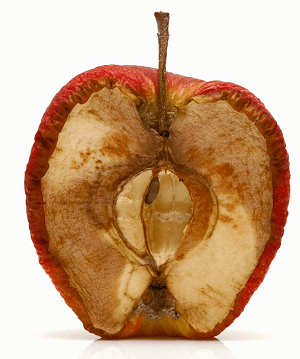
Enzymic browning occurs when...
enzymes are damaged and oxidation takes place
Fruit is spoiled and unsafe to eat
Fruit goes mouldy
Food gets bacteria on it and makes your enzymes go brown
The enzyme in fruit which causes it to go brown is...
Polyphenol Oxidase
Enzymic browning is...
a chemical reaction that causes fruit do go brown when exposed to oxygen
Enzymes are catalysts...
they speed up chemical reactions
Apples, potatoes, avocados, bananas and aubergines are fruits and vegetables...
that are commonly affected by enzymic browning
When the cell of a fruit is cut open,
enzymes react with oxygen in the air and oxidation takes place.

Fats are made up of molecules called ......
Chemicals
Saturates
Triglycerides
Unsaturates

What are the functions of fat in the body?
Uptake of fat soluble vitamins (A, D, E & K)
Flavour - fat in food improves ‘mouth feel’ takes longer to digest ‘satiety value’.
Protection of internal organs
All of the above
What are some examples of monounsaturated fats (good fats)?
Butter, mayonaise, dairy
Vegetable oil
Olive oil, avocados, peanuts
Animal products

When you add nutrients to foods that do not already have them, it is known as......
Natural
Tick three colloidal systems.
Mayonnaise
Mashed potato
Ice-Cream
Marshmallows

What is a colloid system in food?
A solution made up of 2 liquids that dissolve
one substance is dispersed through another, and forms a solution
one substance is dispersed through another, but does not combine to form a solution
Which of the following are types of colloidal systems?
Solution, Emulsion & Gel
Emulsion, Foam & Gel
Foam, Solution & Gas
Gel, Gas and Liquid
Colloidal systems give structure, texture and (a) to many different products, for example:
An emulsifier acts as an ingredient to bind together 2 ........
Soluble ingredients
Immerse liquids
Invisible ingredients
Immiscible liquids

When egg whites are whipped and baked they turn solid e.g. meringue but what causes this to happen?
Starch dextrinises
Sugar caramelises
Proteins coagulate
Fats melt

A semi-rigid colloidal dispersion of a solid with a liquid or gas is the definition of a....
Emulsion
Gel
Foam
How can I avoid cross contamination?
Use the correct coloured chopping board
Wash hands before handing food and equipment
Ensure all equipment and utensils are clean
All of the above
What happens to bacteria when they are cooled to below 5c?
Bacteria is dormant - grows slowly or not at all
Bacteria dies
Bacteria is in a deep sleep
Bacteria is active so multiplying fast

Which of these are fat soluble vitamins?
A,B,C
A,D,E
B,K,C
A,C,D

Which of these are water soluble vitamins?
B,A
A,D
B,C
A,K

