wayground logo

Free Printable Worksheets

Font size

S
M
L
XL
Worksheets

HM Science Retake STEMS Force, Motion, Energy, and Matter

Total questions: 58

Worksheet time: 52mins

Name
Class
Date
1.
Molecules spread out and move FAST!
a)
solid
b)
gas
c)
liquid
2.
Molecules are tightly packed together
a)
solid
b)
liquid
c)
gas
3.
If an ice cube is left out in  room it will change from one state of matter to another.  Which is the correct order of State of Matter that the ice cube will go through?
a)
Gas, Solid, Liquid
b)
Liquid, Solid, Gas
c)
Liquid, Gas, Solid
d)
Solid, Liquid, Gas
4.
A substance that resists change and holds it's shape.
a)
liquid
liquid
b)
solid
c)
water
d)
clouds
5.
What is the definition of Solid
a)
definite shape and size
b)
the ability of a substance to dissolve in another substance, such as sugar dissolving in water
c)
a type of mixture in which the particles of one or more substances are dissolved (uniformly dispersed throughout) in another substance
d)
the forms matter can take, such as solid, liquid, and gas; sometimes called phases of matter
e)
energy related to the temperature of an object or a substance
6.

The temperature at which a gas turns into a liquid

a)

Melting point

b)

Freeing point

c)

Boiling point

d)

Condensation point

7.

The temperature at which a substance changes from a liquid to a gas

a)

Melting point

b)

Boiling point

c)

Freezing point

d)

Condensation point

8.

What is the state of matter that has a fixed volume but not a fixed shape?

a)

Solid

b)

Liquid

c)

Gas

9.

What property shows that an eraser is a solid

a)

its shape is definite when placed in a new spot

b)

the color stays the same

c)

the temperature goes up

d)

it size changes when you use it

10.

Molecules in a _____ have definite volume and no shape(they take the shape of their container).

a)

solid

b)

liquid

c)

gas

d)

neither

11.

Molecules in a ________ have definite shape and definite volume.

a)

solid

b)

liquid

c)

gas

d)

neither

12.

Molecules in a ______ have no shape and no volume.

a)

solid

b)

liquid

c)

gas

d)

neither

13.
In which state does matter completely fill its closed container?
a)
Gas
b)
Liquid
c)
Solid
d)
Ice
14.
Which state of matter has a fixed shape and volume and it's molecules move very slowly?
a)
Liquid
b)
Gas
c)
Solid
d)
Plasma
15.
At higher temperatures
a)
particles in an object have less energy
b)
particles in an object move faster
c)
a gas contracts
16.

Particles of a liquid

a)

are tightly packed together and stay in a fixed position.

b)

are free to move around one another but still touch.
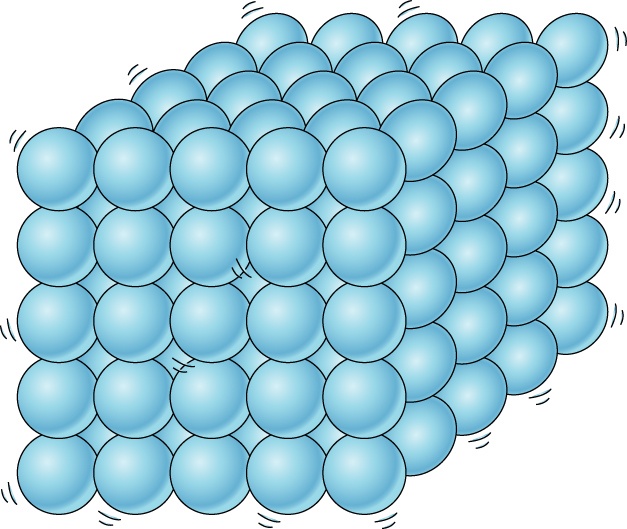
17.

What state of matter?

a)

Solid

b)

Liquid

c)

Gas

d)

Plasma!!!

18.

What state of matter?

a)

Solid

b)

Liquid

c)

Gas

19.

What state of matter?

a)

Solid

b)

Liquid

c)

Gas

20.
When the temperature of matter increases the particles...
a)
speed up and move closer
b)
speed up and move farther apart
c)
slow down and move closer together
d)
slow down and move farther apart
21.

What is the phase change of a solid to a liquid?

a)

freezing

b)

melting

c)

boiling

d)

condensation

22.
Define a liquid.
a)
Indefinite shape, indefinite volume
b)
Definite shape, definite volume
c)
Found in stars
d)
Definite volume, indefinite shape
23.
What term describes a liquid changing to a gas?
a)
Deposition
b)
Sublimation
c)
Freezing
d)
Evaporation
24.
What term describes a liquid changing to a solid?
a)
Deposition
b)
Sublimation
c)
Evaporation
d)
Freezing
25.
What term describes a gas changing to a liquid?
a)
Deposition
b)
Sublimation
c)
Evaporation
d)
Condensation
26.

Work occurs whenever something is moved and an object is put into motion. The motion of an object is described with three things: position, direction and speed. Forces come into play with work because they push and pull objects. All forces have size and direction. Some, like the pull of gravity toward a black hole, are immense, while others, like the push of an ant on a breadcrumb, are very small.


Work is possible because all objects have mechanical energy, including potential (energy based on position) and kinetic (energy of motion) energy. Mechanical energy is transferred from one object to another by pushing or pulling it. How fast these objects move depends on the position they began in and how much force was applied to them.


Which of the following is an example of a situation where work occurs?

a)

a glass of water sitting on the counter

b)

a leaf resting on a rock

c)

a student sitting at a desk

d)

a baseball soaring through the air

27.

The energy of motion is called ________ energy.

a)

potential

b)

electrical

c)

chemical

d)

kinetic

28.

A force that opposes motion between two touching surfaces is called:

a)

friction

b)

acceleration

c)

speed

d)

direction

29.
Why is person B having a hard time moving down the hill?
a)
Person B has more friction than person A.
b)
Person B has the same friction as person A.
c)
Person B is out of shape.
d)
Person B has less friction than person A.
30.

Two factors that determine work are

a)

force

b)

acceleration

c)

mass

d)

distance

e)

velocity

31.
Which direction will the object move?
a)
Up
b)
Down
c)
Right
d)
Left
32.
How does friction affect speed?
a)
more friction decreases speed
b)
more friction increases speed
c)
less friction decreases speed
33.
What are 2 factors that determine the amount of friction between 2 objects?
a)
Force and roughness between surfaces
b)
hills and valleys and how smooth or rough the surface is
c)
Amount of force and amount of surface the comes in contact
d)
The force and the weight exerted on the surfaces
34.

Rough surfaces have _________ compared to smoother surfaces.

a)

greater friction

b)

less friction

c)

the same level of friction

35.
On which surface will a toy car travel the furthest?
a)
Carpet
b)
Polished Wood
c)
Ice
36.
On which surface will a toy car travel the furthest?
a)
Carpet
b)
Polished Wood
c)
Ice
37.
Rougher surfaces have ...
a)
greater friction
b)
less friction
c)
the same level of friction
38.
On which surface will a toy sledge travel the least distance?
a)
Carpet
b)
Polished Wood
c)
Ice
39.

Identify the force between the wheels of the cart and the ground surface that opposes forward motion of the cart

a)

Momentum

b)

Friction

c)

Magnetic

d)

Force

40.
How do you lower the friction force?
a)
By a smooth surface
b)
By a rough surface
c)
By not pushing hard
d)
By pushing down
41.
What is the bowling alley lane coated with to reduce friction?
a)
oil
b)
wood
c)
paint
d)
sand
42.

work is done when

a)

the object you apply a force on moves

b)

any force is applied to an object, regardless if it moves or not

c)

the force is zero

d)

the force and direction of motion are perpendicular

43.

Which form of energy is involved in a pencil falling from a desk?

a)

kinetic

b)

nonmechanical

c)

gravitational potential

d)

elastic potential

44.

Which of the following best describes this picture?

a)

consumer

b)

decomposer

c)

producer

45.

Why are these organisms producers?

a)

They can make their own food.

b)

They grow in the ground.

c)

They use sunlight for energy.

d)

They take water in through their roots.

46.
An apple tree is a
a)
producer
b)
consumer
c)
decomposer
47.
A hawk is an example of a
a)
consumer
b)
producer
c)
decomposer
48.
Fungi. Is it a...
a)
Producer
b)
Consumer
c)
Decomposer
49.
Earthworm. Is it a...
a)
Producer
b)
Consumer
c)
Decomposer
50.

What is an example of decomposer?

a)
b)
c)
51.
Use the diagram to answer the question.
The Mayfly is a food source for which 3 organisms?
a)
Frog, Dragon Fly and snake
b)
Frog, trout and dragon fly
c)
Frog, salamander and trout
d)
Frog and phytoplankton
52.

This microscopic organism is an example of a decomposer.

a)

algae

b)

bacteria

c)

dinosaurs

d)

amoeba

53.
A food chain shows the transfer of ___ from one organism to another. 
a)
matter
b)
consumers
c)
energy
d)
habitat
54.

What do we call the yellow dust of the flower that is attached to the stamen?

a)

pollen

b)

pistil

c)

stamen

55.
What part of the plant is this? 
a)

flower

b)

stem

c)

leaves

d)

petals

56.

Plants use sunlight, water, and carbon dioxide to create oxygen and energy in the form of sugar. This process is called.....

a)

pollination

b)

photosynthesis

c)

germination

57.

What are the functions (jobs) of the roots?

(choose 2)

a)

absorb sunlight

b)

help in photosynthesis

c)

absorb (pull) nutrients from the soil

d)

anchor, or hold the plant

58.

The ___________ produces or makes pollen.

a)

pistil

b)

petals

c)

stem

d)

stamen