
 Worksheets
Economics Final Exam Review
Total questions: 235
Worksheet time: 3hrs 32mins
The value that a person or business misses out on when choosing one alternative over another is known as
Opportunity cost
Choice
Trade-offs
Price
Which of the following best describes scarcity?
An abundant supply of something
A decrease in value
The physical space for producing goods
A low supply of something that is in demand
Money and equipment are examples of which factor of production?
Capital
Land
Labor
Entrepreneurship
A philosophy that calls for very little or no government involvement in the economy.
Industrial Capitalist
Economics
Supply and Demand
Laissez-Faire
Labor refers to...
people with all their efforts and abilities
individuals who start a new business or bring a product to market.
the tools, equipment, and factories used in production of goods and services.
The "gifts of nature" or natural resources not created by human effort.
Entrepreneurs are...
people with all their efforts and abilities
individuals who start a new business or bring a product to market.
The "gifts of nature" or natural resources not created by human effort.
the tools, equipment, and factories used in production of goods and services
A herd of cattle is an example of ...
Land
Labor
Entrepreneur
Capital

A bulldozer is an example of...
Labor
Land
Entrepreneur
Capital
Which economic system does the government make all economic decisions and owns most of the property - it is sometimes called communism?
Traditional
Command
Market
Mixed
Which economic system are all resources privately owned and the buyers and sellers answer the three economic questions?
Traditional
Command
Market
Mixed
The circular flow model shows
how profits are made
how many firms can support the needs of how many households
the interactions between households and businesses
what inputs are required for what outputs
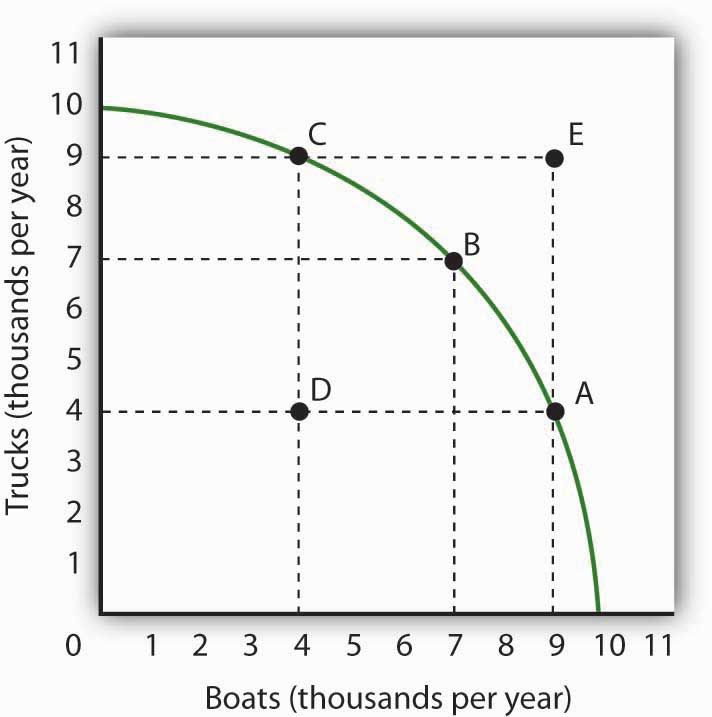
Any point on the production possibilities curve is:
just there
not efficient
not possible
efficient
Any human made resource that is used to create more goods and services
capital
entrepreneurship
cost
labor
The economics studied that focuses on a global scale
macroeconomics
microeconomics
mixed economy
command economy
What are wants?
What are needs?
What is the Law of Increasing Opportunity Costs?
When the ultimate decision is grounded in facts but based on what the decision maker values.
Most countries today are ______ economies.
Capitalist
Communist
Socialist
Mixed
In this economy, goods and services are traded without exchanging money.
economic system
traditional economy
mixed economy
According to basic economic reasoning nothing is free.
True
False
When exchange is voluntary…
the costs of the traded items are equal
one trader wins and one loses.
both traders anticipate that their gains will outweigh their costs.
both traders think the other party is
getting a bad deal.

Which of the following is true?
Point F is impossible to attain and point A is most desirable.
Point F is an inefficient use of recourses.
Points A and E are most desirable
Resource charts
None of the these answers is true.
The options given in an economic decisions is known as
Opportunity cost
Choice
Trade-offs
Price
The economics studied that focuses on the choices of individuals
macroeconomics
microeconomics
mixed economy
command economy
What is a consumer?
Someone who comes up with an idea
Someone who buys a good or service
Someone who makes a product
Someone who cannot afford a product
What is a producer?
Someone who comes up with an idea
Someone who buys a good or service
Someone who makes a product
Someone who cannot afford a product
What does an incentive do?
Encourage a behavior
Prevent a behavior
What is utility?
How much something costs
How something is made
How useful something is
How wasteful something is
How do you economize?
Use all of your resources at once
Try to gain as much money as possible
Use more resources than your competitor
Try to make the most of your scarce resources
What is marginal cost?
The cost of one additional unit of product
The space between two prices
The edges of a cost analysis
The benefit of one additional unit of a product
What is marginal benefit?
The cost of one additional unit of product
The space between two prices
The edges of a cost analysis
The benefit of one additional unit of a product
Which of the following is NOT one of the three economic questions?
What will be produced?
What utility is being produced?
How will it be produced?
For whom will it be produced?
Nike sneakers can be found in the _ of the circular flow model
Product market
Factor market
Household
Business
Trees can be found in the _ of the circular flow model
Product market
Factor market
Household
Business
A market failure is when a economic transaction impacts only the people invovled
True
False
An externality is a consequence of an economic transaction that impacts someone other than the buyer and seller
True
False
Which of the following is NOT an example of a public good?
Public education
Roads
National defense
Wifi
Which of the following is NOT an example of a safety net?
Social security
Food stamps
Income
Stipends
What is economics?
What does the law of demand state?
Everyone has limited income and they will spend it all
The lower the price, the more people want the good or service
Services are bought and sold just like goods
The higher the price, the more people want the good or service
If suppliers expect prices to rise next year for their product, you would expect
The demand curve will shift to the left this year
The quantity demanded will decrease this year
The supply curve will shift to the left this year
The supply curve will shift to the right this year
Which of the following is NOT a determinant of demand?
The price of related goods
Changes in income
Consumer expectations
All are determinants of demand
None are determinants of demand
Which of the following best defines market equilibrium?
The point at which supply exceeds demand and prices are stable
The point at which supply and demand equal each other and prices are stable
The point at which demand exceeds supply and prices are changing regularly
The point at which supply and demand equal each other and prices are changing regularly
Differentiate a change in quantity demanded from a change in demand.
A change in quantity demanded creates a new demand curve, while a change in demand is movement along the existing demand curve
A change in quantity demanded is never driven by price, while a change in demand is always driven by price
A change in quantity demanded is when consumer expectations delay a purchase, while a change in demand is a change in demographics
A change in quantity demanded is movement along the existing demand curve, while a change in demand creates a new demand curve
Which of the following describes the relative elasticity in demand for toothpaste?
Demand is inelastic because it is a luxury item
Demand is elastic because there are no substitutes
Demand is inelastic because it makes up a large share of most people’s budget
Demand is inelastic because it is a low-cost necessity
When the quantity demanded for a product is less than the quantity supplied, the market
has prices that are too low
is in equilibrium
has a surplus
is controlled by a monopoly
Supply depends on the willingness and ability of…
Donors to contribute
Consumers to purchase
Advertisers to promote
Producers to produce
What can cause a change in supply?
Changes in technology
Changes in the number of producers
Changes in government policy
All of the above
Why is a demand curve downward sloping?
Because quantity demanded increases as price decreases
Because of the natural elasticity of the market
Because it shows how increasing incentives changes demand
Because it reflects the desire, ability, and willingness of consumers
The Law of Demand states that as price decreases…
Demand increases
Production increases
Quality increases
Wages decrease
What is the income effect?
A change in quantity demanded caused by a change in consumer income
A change in demand caused by substitution
A proportional change in quantity demanded based on income
An increase in purchase of complements based on an increase in income
The Law of Demand states that the quantity demanded of a product varies _______________ with its price.
Inversely
in a positive correlation
Which of these is the best example of diminishing marginal utility?
Bicycles become less useful as they get old and start to rust
A shortage of bike paths make bicycles less useful
People with cards have less use for bicycles than people without cars have
Someone who has one bicycle will have less use for another
Which of these situations best illustrates market equilibrium?
The amount of soap made matches the amount of soap that people want to buy
The price of soap does not vary much from week to week.
Everyone who wants or needs soap can easily afford to buy it.
Soap production ensures a good profit for the manufacturer.
What is the usual result of setting a price ceiling on rents?
Construction jobs increase with the building of new apartment buildings
More people want to rent apartments than are available to rent
People can find apartments but cannot afford them
Houses are broken up into apartments to meet the demand.
Rent control, or the government controlling prices of rental properties is a type of …
Surplus
Price floor
Rationing
Price ceiling

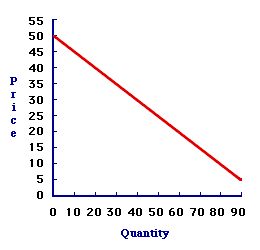

This graph represents...?
Changes in quantity demanded
Changes in quantity supplied
Changes in demand
Changes in supply

This graph represents...?
Changes in quantity demanded
Changes in quantity supplied
Changes in demand
Changes in supply


New technology advances the rate at which furniture can be assembled. Why does this change the supply?
There is a change in cost of production.
The number of producers changes.
The expectations of consumers changes.
The output rate declines.

Which of the following is the equilibrium price and quantity in Graph 1?
$2.00, 2,500
$2.00, 1,500
$3.00, 2,000
$3.00, 3,000

Which of the following graphs shows the demand and supply curves for Table 3?


The want or willingness a consumer has to purchase a good or a service is called?
French fries and ketchup
Substitutes
Compliments
A normal and an inferior good
Neither Normal nor inferior
What happens to the demand curve for computers when the price increases from $500 to $700?


A mother who buys her son two sets of school uniforms every year regardless of changes in their prices has a perfectly inelastic demand for school uniforms
TRUE
FALSE
The definition of the law of diminishing marginal utility
As more units are consumed the marginal utility falls.
As more units are consumed the marginal utility increases.
As price decreases quantity demanded increases.
As price increases consumers are willing to pay more.
The best definition for fixed costs is
Costs that do not depend on the level of production
Costs that do not change
Costs that increase when you produce more

The marginal production from 3 to 4 labors is _________.
2
7
4
8
Fixed Cost + Variable Cost =
Breakeven point
Total costs
Fixed costs
Variable costs
The increase in output that arises from an additional unit of input
Marginal product
Production function
Diminishing marginal product
The cost of production
If the price goes up for a product, consumers buy less of that product and more of another substitute.
The income effect
The substitute effect
Law of diminishing marginal utility
Law of demand
If the price goes down for a product, the purchasing power increases for consumers, allowing them to purchase more.
The income effect
The substitute effect
Law of diminishing marginal utility
Law of demand
The condition in which the quantity supplied of a good is greater than the quantity demanded.
Surplus
Shortage
Equilibrium
Disequilibrium
The condition in which the quantity demanded of a good is greater than the quantity supplied.
Surplus
Shortage
Equilibrium
Disequilibrium
Which of the following two goods is more likely to be inelastically demanded?
Demand for insulin
Demand for vitamins


Which of these would most likely increase the supply of soccer balls?
a government tax on sporting goods
a decrease in the price of raw materials
an increase in the supply of tennis balls
a transportation strike (truckers on strike)

Which letter shows the area of a shortage?
A
B
C
Which letter shows the equilibrium?
A
B
C
Which letter shows the area of surplus?
A
B
C
A price ceiling...
would be below the equilibrium
would be at the equilibrium
would be above the equilibrium
A price floor...
would be below the equilibrium
would be at the equilibrium
would be above the equilibrium

What is the goal of a firm?
to make profits
to maximize profits
to maximize revenue
none of the above
Which of the following is an example of a perfectly competitive firm?
Farmer's market stand
Fast food restaurant
Cell phone service provider
Local internet service provider
Which of the following is NOT a characteristic of perfectly competitive markets?
Many buyers and sellers
Homogeneous goods
Free entry and exit
Firms set their own prices
In monopolistic competition producers....
have a full ability to set prices
have some ability to set prices
have no ability to set prices
Which one of the following statements is not a characteristic of monopolistic competition?
Ease of entry into the industry
Product differentiation
A relatively large number of sellers
A homogenous product
What type of products will firms produce in monopolistic competition?
Firms produce significantly differentiated products
Firms produce slightly differentiated products
Firms produce homogenous products with one modification
Firms produce a variety of different products
Which of the following best describes an oligopoly?
many monopolistically competitive firms
a few firms sharing monopoly power
a former monopoly that has been broken up by the government
a government-granted franchise or monopoly
One of the requirements for a monopoly is that
products are high priced
there are several close substitutes for the product
there is a unique product with no close substitutes
the product cannot be produced by small firms
A monopoly is a market with
many suppliers
no barriers to entry
many substitutes
one supplier
A barrier to entry is
an economic term for economies of scale
illegal in most markets
anything that prevents new firms from entering the market
a factor that increases competition
Mr. Simpson is liable for all the debts of his company. He has which type of business organization?
Monopoly
Sole Proprietor
Partnership
Corporation
The fact that an owner is responsible for all losses and debts occurred by a business is known as:
Limited Liability
Limited Debt
Unlimited Liability
Unlimited Debt
Jorge and Fred have a product they would like to sell. They decide to share the risks and profits by forming an unincorporated business. The business organization Jorge and Fred have MOST LIKELY formed is a(n)
Entreprenuership
Sole Proprietor
Partnership
Corporation
A business recognized by law as a separate legal entity having all the rights of an individual.
Sole Proprietor
Partnership
Corporation
Entreprenuership
Business will end when owner dies, quits, or sells the company.
Sole Proprietor
Partnership
Corporation
Enterprenuer
The partnership and all partners are liable when any partner commits a tort while acting within the scope of the firm's business.
true
false

What is the name of a person who owns part of a corporation?
Stakeholder
Shareholder
Trust Agent
Chairman
What are the four major considerations when choosing a legal structure for your business?
Market, Control, Ownership, Size
Taxation, Liability, Cost, Control
Size, Cost, Ownership, Distribution
None of the Above
What is a co-op?
a company branded off of a franchise
a legal business structure that is owned and governed by and functions for, the benefit who use its services
a franchise
a partnership
Limited Liability means
the corporation pays its own taxes
the company can be sued but the owners only
the company can be sued but the owners only can be sued personally if they act illegally
The shareholders are the only liable party

A business that uses the name, logo and trading systems of an existing successful business.
Franchise
Cooperatives

A certificate confirming part ownership of a company and entitling the shareholder owner to dividends and certain shareholder rights.
Share
Shareholder
This type of business is created to provide a service, not to make a profit.
non-Profit
Partnership
Corporation
Sole Proprietorship
How does the government break up and prevent monopolies?
Increased Taxes
Antitrust legislation and regulation
Deregulation
Laissez-faire
Under pure competition, products are
always cheap
differentiated
accurately priced
identical
An organization of workers dedicated to protecting members' interests and improving wages, hours and working conditions for all.
Labor Union
Workers Rights
Worker Strikes
Collective Bargaining
What was the first nationwide industrial union?
the Knights of Labor
the AFL
the Pinkertons
the Anarchists
Training and experiences is considered
physical capital
human capital
labor
necessary to obtain an unskilled job
What is the price for labor
value
labor productivity
wages
human capital
Wages, just like the other factors of production are governed by
government regulation
supply and demand
labor laws
glass ceiling
(Click all that apply)
The civilian labor force is made up of...
Men and Women at least 16 years old.
Working people
People looking for a job
Institutionalized people
The wage at which the number of workers needed equals the number of workers available.
minimum wage
maximum wage
Fair Standards Act
equilibrium wage
The demand for a product or resource based on its contribution to the final product.
derived demand
equilibrium demand
excessive demand
shortage of demand
Which is not a Characteristic of Money?
Durability
Portability
Divisibility
Invincibility

Which of these are functions of money?
medium of exchange that allows the trade of goods and services
holds value over time
standard of value that allows comparison of the value of goods related to one another
used as the only means of trade between nations
You can easily carry money in a pocket or a purse. This reflects what characteristic of money?
durability
legal tender
divisibility
portability
Which of these are functions of money?
medium of exchange that allows the trade of goods and services
holds value over time
standard of value that allows comparison of the value of goods related to one another
used as the only means of trade between nations
A business or financial institution that stores and manages money for individuals and other businesses:
ATM
Bank
Credit Union
Check Cashing Center
anything that is used to determine value during the exchange of goods and services
medium of exchange
commodity money
fiat money
unit of account
the price paid for the use of borrowed money
interest
principal
unit of account
M2
Why should you diversify your investments?
Investing in a diversified portfolio guarantees that you won’t lose money with your investments
Diversifying your portfolio helps reduce risk
If you diversify your portfolio, you will definitely earn a high return
How is a bond different from stock?
A bond is a loan you give to a organization, while stock is partial ownership in a company.
Bonds are best for earning high returns while stocks are best for providing a stable source of income
Bonds are typically riskier than stocks.
How can someone make money from investing in a stock?
They receive dividends or sell the stock at a higher price than what they paid for it.
They sell the stock for the same price they bought it for.
The stock loses value but the overall market experiences a positive return
How does investing in the stock market differ from putting money in a savings account at a bank?
Investing is always a less risky option than saving
Investing is best for short-term situations like emergency funds; saving is best for the long-term
Investing typically earns between 1-2% while saving generally earns between 5-7%
Investing allows you to accumulate wealth for retirement while saving is best forshort-term purchases or emergencies
Which of the statements below BEST describes the relationship between risk and return when considering an investment?
Investors expect to earn a lower return when they invest in a high risk asset
Investors expect to earn a higher return when they invest in a low risk asset
Investors expect to earn a higher return when they invest in a high risk asset
Investors expect to earn zero return when investing in a low risk asset
_____________ is money by government decree, has no alternative value
Gold standard
Specie
Barter
Fiat money
Coins and paper that are used as money; 'legal tender'.
Money
Transfer Payments
Currency
Liquidity

When you own part of a company, this means you own ________ of that company.
a dividend
a bond
a stock
the soul

The use of assets to create income or profit
investing
trading
saving
loaning
When stock prices in general steadily rise, this kind of market exists
steady market
bear market
strong market
bull market
When stock prices steadily fall or stagnate for a period of time, it is called a
weak market
bear market
flat market
bull market
What is a savings certificate with a fixed maturity date and specified fixed interest rate?
Credit
Savings Tools
Certificate of Deposit
Money
What is a non profit financial cooperative owned by its members that provides credit and other financial services?
Schools
Credit Unions
Banks
Insurance
There are 4 common types of savings tools, ordered from lowest to highest by interest rates. A. checking accounts, savings accounts, money market deposit accounts, and certificates of deposit
Checking,Savings,Money Market,CD
Checking,Savings,CD,Money Market
Savings,Checking,Money Market,CD
Savings,Money Market,Checking,CD
The inflation rate is
the ability to buy goods or services
measured in fixed dollars
not an important measure to economists
the percentage change in prices over time
Inflation reduced people's purchasing power because
the same amount of money buys ore goods and services
the same amount of money buys fewer goods and services
the market basket has to be changed every year
there is not enough money in the economy
Is this counted in the GDP of the US?
The federal government purchases a new submarine for the US Navy.
Yes
No
In which part of the GDP calculation does this fit?
You spend $15 at AMC to see the latest Avengers movie.
Consumer spending
Government spending
Investment spending
Net exports
In which part of the GDP calculation does this fit?
The US military spends $5 billion on five new helicopters.
Consumer spending
Government spending
Investment spending
Net exports
In which part of the GDP calculation does this fit?
The local taxi service purchases new vehicles for the
company.
Consumer spending
Government spending
Investment spending
Net exports
In which part of the GDP calculation does this fit?
Australia exported $6 billion worth of goods in 2018, but imported $10 billion in goods.
Consumer spending
Government spending
Investment spending
Net exports
Which of the following would be included in the calculation of GDP?
Final goods
Intermediate goods
Second hand goods
Black market activity

The _______ is a measure of the average change over time in the prices paid by urban consumers for a market basket of consumer goods and services.
Consumer Price Index
Aggregate supply
Producer Price Index
Aggregate demand

According to the wage-price spiral, if a company gives a worker a raise in pay, what must they also do?
Raise the price of their products
go out of business
lower the price of their products
merge with a competitor
The Business Cycle measures ___ over time.
wealth
inflation
economic growth
The business cycle rises above the trendline during-
rescessions
expansions
troughs
GDP declines during a(an)
peak
contraction
expansion
Economic recovery begins-
above the trend line
at the end of a recession (trough)
at the "boom" period
When GDP rises faster than the long-run trend then the economy is experiencing-
a recession
an expansion
a recovery
GDP will begin to decline at-
the peak.
the trough.
the contractionary phase.
Inflation measures...
the value of all final goods and services produced
an increase in the general price level
the percentage of people looking for work that can't find it
the economic freedom an economy offers

Which of the following is a peak?
A
B
C
D
Which of the following is a recession, or contraction?
A
B
C
D
Which of the following is a trough?
A
B
C
D
Which of the following is an expansion, or recovery?
A
B
C
D
Nominal GDP - _____ = Real GDP
Inflation
Unemployment
Imports
Exports

The Business Cycle charts...
the ups and downs of an economy
series of stages in the economy as it expands and contracts.
the periodic growth and decline of a nation’s economy, measured mainly by its GDP (Gross Domestic Product).
All of the above
The rate of inflation is most commonly measured by use of
a price deflator
the GDP deflator
the consumer price index
all of the above
What causes inflation?
inflation occurs when there's an increase in production costs OR when demand for products and services increases faster than supply
inflation occurs when there's an increase in production costs OR when demand for products and services increases slower than supply
inflation occurs when there's a slower increase in production costs OR when demand for products and services increases faster than supply
What are the three main causes of inflation?
(a)
Who is in charge of Monetary Policy
The Government
The Federal Reserve System
The states
The Department of the Treasury
Monetary Policy is the Federal Reserve Systems attempt to...
control the amount of money in circulation
control the Federal Government's debt
control state governments' spending
none of these answers are correct.
If the Fed wants to reduce the amount of loans a bank can make, then it should adjust...
Open Market Operations
The Reserve Ratio
The Discount Rate
If the Fed wants to increase the cost of loans, then it should adjust...
Open Market Operations
The Reserve Ratio
The Discount Rate
An expansionary policy means that the Fed is attempting to
increase the size of the nation's money supply
decrease the size of the nation's money supply
A contractionary policy means that the Fed is attempting to
increase the size of the nation's money supply
decrease the size of the nation's money supply
The tools of fiscal policy are...
Interest rates
Taxes and Government spending
Checks and balances
Open market operations
Fiscal policy is actions taken by ______________ to stabilize the economy.
The federal Reserve
The Air force
the government
Wall street
Expansionary fiscal policies are laws aimed at reducing unemployment. How might Congress use expansionary fiscal policy?
Decrease the discount rate
Increase taxes
Decrease government spending
Increase government spending and decrease taxes
Contractionary fiscal policy are law aimed at reducing inflation. How might Congress use contractionary fiscal policy?
Decrease government spending and increase taxes
Decrease taxes
Send stimulus checks to every person in the economy
Increase government spending
When would Congress most likely use contractionary fiscal policy?
During periods of high unemployment
During periods of high inflation
During periods of low economic production
During periods of peace
Which is an example of expansionary fiscal policy?
The Federal reserve lowers the discount rate
The government raises taxes on all citizens by 5%
The government increases spending by building more infrastructure
The federal reserve increases the reserve requirement
Which is an example of contractionary fiscal policy?
The government increasing taxes on all goods and services by 5%
The president issues an executive order
The federal reserve purchases bonds
Government spending increasing
The federal government's overall approach to spending and taxes is called
Physical Policy
Fiscal Policy
вежба
Monetary Policy
"The Fed refers to the Federal Reserve System, the Central Bank of the United States. The FOMC is the Federal Open Market Committee, the group responsible for implementing monetary policy."
Fiscal policy
Monetary policy
"In February, lawmakers set themselves up to reach a more permanent spending agreement by the end of March. Congress agreed to increases to domestic and defense spending over the next two years, raising funding for domestic programs by $128 billion and hiking defense budgets by $160 billion. But they didn’t actually decide where the money would go."
Fiscal policy
Monetary policy
"The U.S. Federal Reserve is almost certain to hike interest rates Wednesday to the highest level in a decade: 1.5 to 1.75 percent. "
Fiscal policy
Monetary policy
A system that imposes a greater percentage of taxation on higher income levels, operating on the theory that high-income earners can afford to pay more.
Regressive tax system
Proportional tax system
Progressive tax system
Tax reform
A tax system that applies the same tax rate to all individuals regardless of income.
Progressive tax system
Regressive tax system
Proportional tax system
Efficient tax system
A tax system that levies the same percentage on products or goods purchased regardless of the buyer's income and is thought to be disproportionately difficult on low earners.
Progressive tax system
Regressive tax system
Proportional tax system
Efficient tax system
A form of demand-side economics that encourages government action to increase or decrease demand and output.
Fiscal policy
Keynesian economics
Monetary policy
Supply-side economics
A form of economics focusing on tax cuts to help the economy by raising supply.
Fiscal policy
Keynesian economics
Monetary policy
Supply-side economics
an income level below that which is needed to support families
standard of living
command economy
externality
poverty threshold
The number of unemployed people as a percentage of the labor force
Unemployment rate
GDP
GDP per capita
Inflation