
 Worksheets
Charging Systems
Total questions: 51
Worksheet time: 47mins
Alternator rebuild typically involves all of the following steps except:
Testing the Diodes
Testing the Stator
Replacing the Harmonic Balancer
Replacing The defective Bearings
During a 12-volt charging system voltmeter test, all electrical accessories are on when checking ____ voltage.
Base
Load
No Load
Cranking Load
An electronic voltage regulator cannot be repaired.
True
False
To reduce output of the alternator, the electronic voltage regulator introduces more resistance between the rotor windings and battery.
True
False
Most modern laptop computers and diagnostic tablets have a scope function.
True
False
If the no-load voltage is more than 2–3 volts higher than base voltage, the alternator is overcharging the battery.
True
False
The only way to obtain accurate charging system test results is to use a digital VOM (volt-ohm-ammeter).
True
False
Reversing polarity of electrical connections can destroy circuits in the regulator and severely damage alternator diodes.
True
False
The alternator pulley is usually brazed onto the end of the rotor shaft.
True
False
An alternator fan cools windings and diodes to prevent overheating and damage.
True
False
If the alternator comes out from the side of the engine compartment, you may have to remove the inner fender apron to gain access to the alternator.
True
False
The component that is turned by the alternator drive belt and creates a rotating magnetic field is the
Rotor
Stator
Diode Trio
Rectifier
Which of the following is not a type of alternator belt?
Ribbed
V
cogged V
Integrated
Hybrid vehicle charging system problems are being discussed. Technician A says that an HV battery that will not hold a proper electrical charge will set a diagnostic trouble code. Technician B says that loose HV cable connections will not affect electric drive train performance. Who is correct?
Tech A
Tech B
Both
Neither
When Removing an Altenator always remove the __________
Negative Cable
Positive Cable
Both
The Fuse or relay
A Good test for testing the Altenator is to Disconnect the battery
True
False
An overcharging system does not affect the battery.
True
False
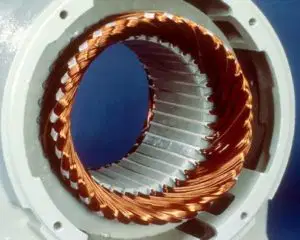
What Part is Shown
Rotor
Coils
Stator
Rectifier
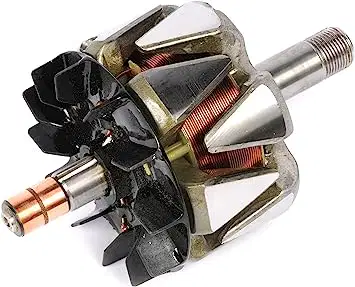
What part is Shown
Stator
Rotor
Rectifier
Armature
A Charging system component that adjust voltage needed by the system
Voltage Regulator
Rectifier
Armature
Biased Sensor
Corrosion on the battery Terminals will create resistance in the charging circuit
true
False
A Fully Charged Battery is
12V
12.2V
12.6V
13-15V
The Alternator Pulley is Driven by the Drive (a)
The Alternator rectifies AC Voltage into Usable (a) Voltage
A Common Alternator Belt Problem is
Glazed
Contaminated
Misadjusted
All The above
What is an Example of a charging system defect
Cracked alternator case
Loose battery Terminals
Worn Belt Tensioner
All the above
V type belts are only used for A/C systems
True
False
What is the function of the alternator in a vehicle's electrical system?
To power the headlights
To charge the battery and power the electrical system when the engine is running
To start the engine
To control the air conditioning system
What could be a possible symptom of a failing alternator?
The vehicle's speed suddenly increases
The engine oil level drops
The battery warning light on the dashboard comes on or the vehicle has difficulty starting
The vehicle's fuel efficiency improves
Technician A says that a loose alternator belt can cause the alternator to fail. Technician B says that a loose alternator belt can cause the battery to overcharge. Who is right?
A
B
Both
Neither


True or False: An alternator produces a Alternating Current (AC).
True
False

What is the name of an electrical device that only allows current flow in one direction. Otherwise known as a electrical check valve?
Fuse
Diode
Photocell
Multi-meter

What is the purpose of the diode in the charging system?
Transform the AC voltage from the alternator into DC voltage
Transform the DC voltage from the alternator into AC voltage

On the common Voltage Rectifier how many diodes are used to convert AC to DC?
2
4
6
8

Why does an alternator use a internal or external fan?
To keep the EPA happy
To help cool the engine
To cool off the diodes preventing damage
To make the alternator cool looking

