
 Worksheets
Outcome 8 Revision
Total questions: 48
Worksheet time: 1hrs 2mins


4- Equilibrium
Is a measurement of the force required to make an object stop moving.
Is a state in which forces acting on an object balance each other by having equally strong yet opposite effects.
Is a continued movement in a substance or field of energy.
Is a natural attractive force that that makes particles come together, and is stronger among larger particles.

What is the resultant force?
40N, Left
40N, Right
0N, Balanced
75N, Right

Which method is used to find the resultant of the two forces?
Parallelogram of forces
Triangle of forces
Resolution
Square of forces

Which method is used to find the resultant of two coplanar forces acting at a point?
Parallelogram of forces
Triangle of forces
Cosine Rule
Resolution of Forces
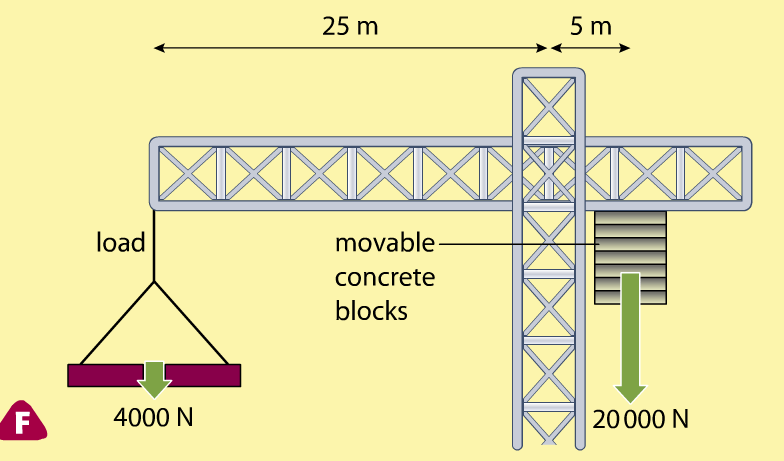
What is the anti-clockwise torque (moment)acting on this crane?
80,000Nm
100,000Nm
120,000Nm
140,000Nm
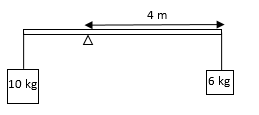
Two masses of mass 10.0 and 6.0 kg are hung from massless strings at the end of a light rod. The rod is virtually weightless. A pivot (fulcrum) is placed off center and the system is free to rotate. If the 6.0 kg mass is 4.0 m away from the pivot, how far away is the 10.0 kg mass if the system is not rotating?
0.42 m
2.4 m
4.8 m
4.2 m
The moment of a force causes an object to
move forward
move backward
stop moving
turn about a fixed point
When an object is in equilibrium, which equation is true?
Clockwise moment = anticlockwise moment
Clockwise moment + anticlockwise moment = 0
Clockwise moment / anticlockwise moment = 0
Clockwise moment + anticlockwise moment = resultant force
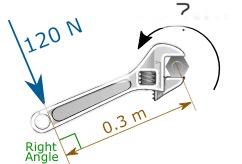
What is the size of the moment shown by the black arrow?
30 Nm
36 Nm
40 Nm
60 Nm
The point through which the whole weight of the body acts is called
Inertial Point
Center of gravity
Centriod
Central point
Where the center of gravity of a circle lies?
At its centre
Anywhere on its radius
Anywhere on its circumference
Anywhere on its diameter
What is one way you might increase the stability of an object?
Lower the center of gravity
Raise the center of gravity
Increase the height of the object
Shorten the base of the object
The centre of gravity for an aircraft is important because it impacts the aircraft's stability.
True
False
What is the unit of pressure?
newton
joules
pascal
_____________ is the amount of force pushing on a certain area.
weight
mass
pressure

Pressure can be exerted by solids, liquids and gases.
TRUE
FALSE
The pressure resulting from a force of 100 N exerted over an area of 25 m2 is
125 N
2500 N
4 N/m2
2500 N/m2
Which of the following is the correct relationship between gauge pressure, atmospheric pressure, and absolute pressure?
Absolute pressure = Atmospheric pressure + Gauge pressure
Absolute pressure = Atmospheric pressure - Gauge pressure
Gauge pressure = Absolute pressure + Atmospheric pressure
Gauge pressure = Atmospheric pressure
The gauge pressure on a small sedan measures 32 psi. What is the absolute pressure assuming the car is at sea level with an atmospheric pressure of 14.7 psi?
46.7 psi
44.7 psi
14.7 psi
can not be determined
What happens to liquid pressure as you go deeper under water?
it increases
it decreases
it stays the some
no soup for you!

Calculate the pressure exerted by the water on the fish.
[Density of water = 1 000 kg m−3 and g = 10N/kg]
5 × 10⁴ Pa
5 × 10⁷ Pa
5 × 10⁶ Pa
5 × 10⁻¹ Pa

The diagram shows a cross-section of a pool. The density of water in the pool is 1000 kg m-3.
What is the pressure exerted by the water at X?
2.5 x 10² Pa
2.5 x 10⁻³ Pa
4.0 x 10³ Pa
4.0 x 10⁴ Pa
What does the unit atmosphere, atm, measure?
Pressure
Temperature
Volume
Moles
Absolute zero is
0 K
where there is no molecular movement
the coldest temperature possible
all of these


(Charles Law) There are 40 liters of helium in a balloon at 100 K. If the temperature of the balloon is increased to 200 K, what will the new volume of the balloon be?
80 L
45 L
54 L
45.33 L
The density of water is
13600 kg/m3
1000 kg/m3
7800 kg/m3
625 kg/m3
To convert the density of kg m-3 into g cm-3, we divide the quantities with
100
10
200
1000
You have a rock with a volume of 15cm3 and a mass of 45 g. What is its density?
3.0 g/cm3
0.3 g/cm3
30 g/cm3
-30 g/cm3
Find the mass of an object with volume 300 cm3 and density 5 g/cm3. Give your answer in grams.
1000 grams
500 grams
1500 grams
750 grams
The density of aluminium is 19300 kg/m3. What is its relative density? Will it float or sink in water?
19.3. Sink.
0.05. Float
19.3. Float.
0.05. Sink

